CBSE Class 12 Chemistry 2022 Term II Solved Paper
CBSEChemistry2022 Previous Year Paper
Paper code: 56/4/1 · 2022Practise the full 2022 CBSE Class 12 Chemistry Term II theory paper, then use the worked explanations to check how you chose a rule, interpreted a graph or justified a chemical trend.
This set is one of the year's papers. See every set from 2022, grouped by series.
What the 2022 Term II paper contains
This year-wise file contains the English version of the 2022 CBSE Class 12 Chemistry main examination paper, Set 1, with question paper code 56/4/1. It is a full theory paper for that session, not a chapter worksheet. The printed format allows two hours of writing time and specifies a separate 15-minute reading period. The paper carries 35 marks and does not permit calculators or log tables.
Section A has three very short-answer questions worth two marks each. Section B has eight short-answer questions worth three marks each. Section C has one five-mark case-based question. All 12 numbered questions are compulsory, but some contain internal choices. In a timed attempt, follow the printed choice within each question. The file gives worked explanations for both branches of the printed OR choices, so you can revisit the branch you skipped afterwards.

Chemistry 2022 | Class 12 | Previous Year Paper | Code 56/4/1
In the StudentCurio app
A complete solved CBSE Class 12 Chemistry theory paper for the 2022 main examination, covering questions across multiple chapters. It helps students practise board-exam questions and review worked solutions.
Organic chemistry: explain the property being tested
The organic questions move between comparisons, reasons, conversions and reaction equations. These tasks call for different kinds of reasoning. In a carbonyl reactivity comparison, consider how accessible the carbonyl carbon is and how readily it accepts attack by a nucleophile. In an acidity comparison, ask what stabilises the conjugate base. For boiling point, look instead at attractions between molecules, including whether they can hydrogen-bond with one another.
The amines questions give you a chance to distinguish the behaviour of a free amine from that of its protonated form. Before using a directing rule in aromatic substitution, ask which form of the group is present under the stated conditions. For conversions, track the carbon skeleton before choosing a reaction: a nitrile reduction retains the nitrile carbon, whereas Hoffmann bromamide degradation gives an amine with one fewer carbon atom than the starting amide.
Coordination compounds: count before predicting
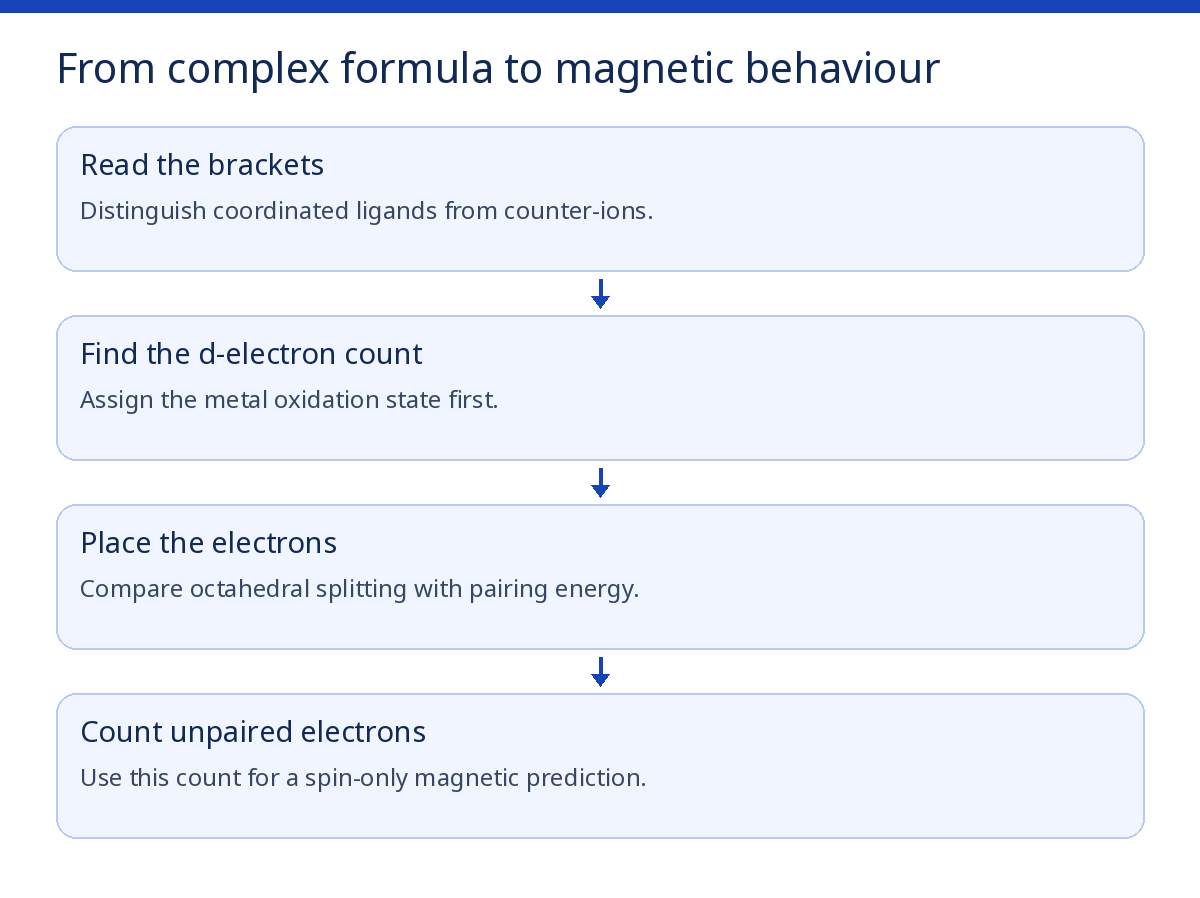
The coordination questions cover crystal field splitting, magnetic behaviour, naming, ions in solution and chelation. Start by separating ligands inside the coordination brackets from counter-ions outside them. That distinction matters both when assigning the charge of the complex and when deciding which species are present after dissociation. Determine the metal oxidation state before assigning its d-electron count.
When the splitting rule applies: In an octahedral field, compare the splitting energy with the pairing energy before placing the electrons. When the splitting is smaller than the pairing energy, electrons can occupy higher-energy orbitals rather than pair prematurely in the lower set. Base a spin-only magnetic prediction on the resulting number of unpaired electrons, not simply on the total d-electron count. The transition-element questions use electronic configurations for a different purpose, asking you to connect them with properties such as colour and resistance to oxidation.
Electrochemistry: separate limiting values from cell conditions
The conductivity question centres on why the graphical extrapolation used for a strong electrolyte is not reliable for a weak one. As a weak electrolyte is diluted, its degree of dissociation changes substantially. Kohlrausch’s law offers a route at infinite dilution, where the limiting molar conductivity is the sum of the ionic contributions, counted in the proportions given by the electrolyte formula. That condition matters: the law is not a shortcut for adding finite-concentration conductivities.
The cell question tests a different idea: how a cell potential depends on composition. Balance the oxidation and reduction half-reactions before setting up the Nernst equation. The balanced reaction fixes both the number of electrons transferred and the powers in the reaction quotient. Pure solids do not appear in that quotient. This guide leaves out the numerical emf example because the potential signs are not reliably rendered in the supplied transcription.
Graph check: read the axes before interpreting the line
In the surface chemistry question, the graph represents the Freundlich adsorption isotherm on logarithmic axes. The empirical relation describes gas adsorption on a solid at a fixed temperature over the pressure range where it applies. Here, the amount adsorbed per unit mass of adsorbent is the quantity being related to gas pressure.
A good way to check your interpretation is to take logarithms of the power-law expression and compare the result with the general equation of a straight line. Identify the term multiplying the horizontal variable and the term that is independent of it. This keeps you from treating a slope or intercept measured on transformed axes as if it were read from a plot of the original quantities.
Kinetics: distinguish order, rate and fraction remaining
The final case asks you to move between the meaning of reaction rate, the exponents in a rate law, the effect of temperature and a first-order time calculation. The overall order comes from the sum of the concentration exponents in the rate law. For an overall reaction, do not assume those exponents can be read from the coefficients of the balanced equation. Also distinguish changing a concentration from changing temperature: at fixed composition, a temperature change can affect the rate through the rate constant.
Quick self-check: If a question gives a percentage completed, can you identify the fraction still present before choosing the logarithmic ratio? The integrated first-order equation uses the initial amount relative to the amount remaining. The time unit must also match the inverse-time unit of the rate constant.
Use the worked pages to diagnose your first wrong step
Attempt the question pages before opening the linked solutions. On review, compare your work with the file’s separate formula, concept and step-by-step explanations. For a conversion, check where you first lost track of the functional group or carbon count. For a numerical question, check whether the error began in the setup or only in the arithmetic. For a written reason, look for the link between the chemical feature you named and the property the question asks you to explain. Then try an unused OR branch to see whether you can apply the same reasoning without following the worked steps.
Spotted an error? Report a correction. Practise this in the app: notes, formula sheets and mind maps.















































































































































Loading comments…