CBSE Class 12 Chemistry 2022 Term II Solved Paper
CBSEChemistry2022 Previous Year Paper
Paper code: 56/1/1 · 2022Practise the full CBSE Class 12 Chemistry 2022 Term II main board paper (56/1/1), then use its worked solutions to check how you chose an equation, explained a trend or interpreted a chemical test.
This set is one of the year's papers. See every set from 2022, grouped by series.
What this year-wise paper contains
This English-language file pairs the original question paper with a worked-solution section. The paper was set for 2 hours and carried 35 marks. It preserves the printed layout, diagrams and alternatives, and the solution section covers each question, its subparts and both sides of the printed OR choices. The explanations distinguish the formula used, the underlying concept and the steps that connect them.
Use this as a record of the 2022 Term II format, not as a statement of the current CBSE syllabus or marking pattern. Its value is that it lets you attempt physical, inorganic and organic chemistry together, in the order in which they appeared on one board paper.

Chemistry 2022 | Class 12 | Previous Year Paper | Code 56/1/1
In the StudentCurio app
Complete solved CBSE Class 12 Chemistry 2022 Term II paper (code 56/1/1), with questions spanning physical, inorganic and organic chemistry. Helps students practise board-style questions and review worked solutions.
When the equations in physical chemistry apply
In chemical kinetics, the rate of a reaction is not simply the concentration change of whichever species is easiest to track. For the simple reaction , the rate from the reactant is , and that from the product is . The minus sign accounts for reactant consumption; division by the stoichiometric coefficient makes the two expressions agree. In a separate kind of kinetics problem, check the reaction order before using a half-life expression. The relation is for a first-order process, and the integrated rate law uses the concentration remaining, not the amount already consumed.
In electrochemistry, write the balanced cell reaction in the direction being considered before forming the reaction quotient or counting electrons. Pure solids do not appear in the quotient because their activities are unity. The familiar decimal-log form of the Nernst equation with a coefficient of approximately before division by applies at . Keep that calculation distinct from , which uses the standard cell potential.
Use electron configuration to explain inorganic properties
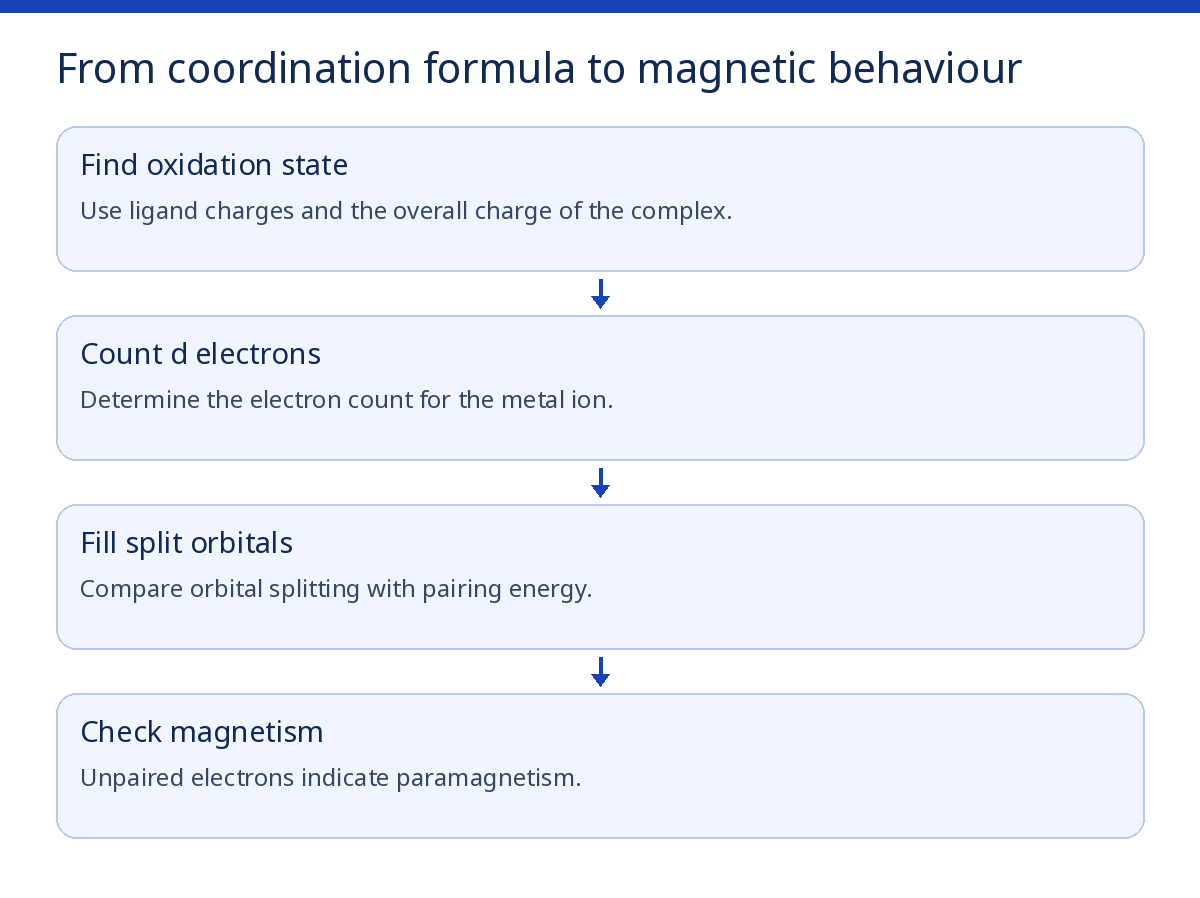
The inorganic questions connect electron configuration to redox behaviour, colour and magnetism. In a coordination problem, establish the metal’s oxidation state and d-electron count before deciding how those electrons occupy the split orbitals. For an octahedral complex, a high-spin arrangement is favoured when the splitting is smaller than the pairing energy. Count the unpaired electrons from the resulting arrangement rather than from the oxidation state alone.
Keep coordination number separate from oxidation state: coordination number counts donor atoms bound to the metal, so a ligand that binds through two donor atoms contributes two. Also distinguish coordinated chloride from chloride outside the coordination sphere when interpreting a silver chloride precipitation result. For colour, an empty or full d subshell rules out ordinary d–d transitions, not every possible source of colour; charge-transfer absorption can still occur.
Common mix-ups in amines and carbonyl chemistry
The amine questions ask you to distinguish aqueous basicity from water solubility. Basicity depends on the tendency to accept a proton in water, so electron donation and hydration both matter; solubility also depends on how much of the molecule is hydrophobic. Check the direction of the comparison before writing an order: because , greater basicity corresponds to lower .
The paper also contrasts amine preparation with identification. The carbylamine reaction tests for primary amines, whereas the Hofmann rearrangement produces a primary amine with one fewer carbon atom than the starting amide. In the carbonyl questions, ask what structural feature each test detects before combining the clues. Formation of a 2,4-DNPH derivative is evidence for an aldehyde or ketone but does not by itself distinguish between them. For a ketone, a positive iodoform test points to a methyl ketone group. Keep the test evidence separate from the products of a subsequent reaction.
Compare adsorption and colloid concepts precisely
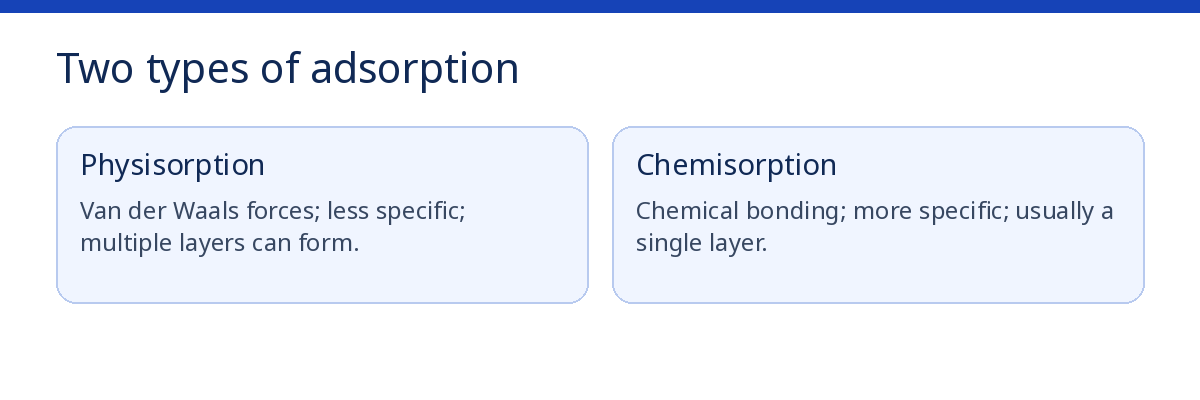
For an adsorption comparison, pair each property with its cause or consequence. Physisorption relies on van der Waals forces and can form multiple layers. Chemisorption involves chemical bonding, tends to be more specific and usually forms a single layer. Preserve qualifiers such as “usually” rather than turning these comparisons into unconditional rules.
The colloid questions use different criteria for different terms. Lyophilic describes an affinity between the dispersed material and its medium; macromolecular describes a dispersion in which individual large molecules are already of colloidal size. These labels answer different questions about a sol. Coagulation, by contrast, is a process: colloidal particles aggregate when the dispersion loses stability.
Review your first decision, not just your final answer
For a timed attempt, work from the question pages and follow the printed choice instructions. Afterward, use the question-number links to compare your reasoning with the worked explanations. Review the OR alternatives separately: a timed attempt tests the choice you made, while the unused branch gives you another way to revisit the material.
When you find a mismatch, identify the first decision that changed the result. In a calculation, was it the reaction direction, the electron count or the amount remaining? In an explanation, did you name the relevant property without showing why it affects the observation? For example, a conductance calculation needs the number of each type of ion contributed per formula unit, not just a list of ions present. Fixing that first decision makes a second attempt more useful than copying a final value.
Spotted an error? Report a correction. Practise this in the app: notes, formula sheets and mind maps.















































































































































Loading comments…