Chemical Kinetics: CBSE Class 12 PYQs and Worked Solutions
CBSEChemistryChemical Kinetics
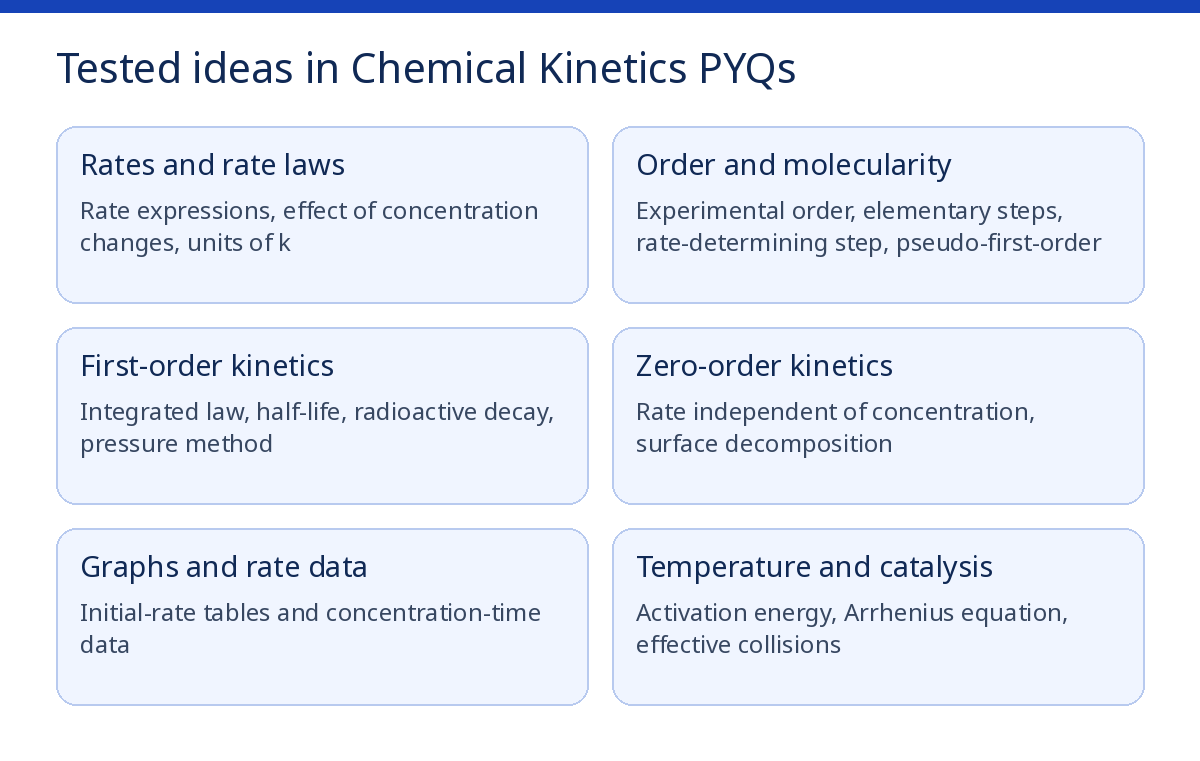
This guide to the Chemical Kinetics CBSE Class 12 previous year question collection explains rate laws, order and molecularity, pseudo-first-order reactions, first- and zero-order integrated equations, half-life, the pressure method and the Arrhenius equation. It also shows how the 180 questions labelled 2022–2026 are organised, so you can practise one tested idea at a time.
How a rate law turns concentration changes into rate changes
Many short questions give a rate law and ask how the rate responds to new concentrations. A rate law has the form . The exponents come from experiment, not from the balanced equation.
To predict a change, raise each concentration factor to its exponent and multiply the results. That product is the factor by which the rate changes. One typical stem describes a reaction that is first order in A and second order in B, then asks what happens when only B is tripled.
Two variations need care:
- Volume changes: reducing the volume of a gas-phase vessel raises every concentration by the same factor. Apply the change to each reactant.
- Rate versus rate constant: in a sealed isothermal container, adding more of a reactant changes its concentration, but the temperature stays fixed. Discuss the rate and separately in your answer.

Chemical Kinetics | Class 12 | Previous Year Paper
In the StudentCurio app
A comprehensive collection of solved previous year questions for Class 12 Chemical Kinetics, covering reaction orders, integrated rate equations, and the Arrhenius equation with detailed step-by-step solutions.
Order, molecularity and pseudo-first-order behaviour
A case-based passage in the collection states the key distinction.
- Order is the sum of the powers of the concentration terms in the experimentally observed rate law.
- Molecularity is the number of reacting species in an elementary reaction that must collide simultaneously.
Some stems give rate laws with fractional exponents and ask whether the reaction could be elementary. Answer by testing the rate law against the definition of molecularity.
For complex reactions, the slowest step is the rate-determining step, and it sets the rate law. The decomposition of catalysed by in alkaline medium appears more than once. It has a slow step and a fast step. Questions ask for the rate law, the individual and overall orders, and the molecularity of one step.
A pseudo-first-order reaction occurs when one reactant is present in large excess. Its concentration stays effectively constant, so a bimolecular reaction can show first-order kinetics. Questions ask for this condition and an example.
Reading order from rate-constant units and initial-rate tables
For a reaction of order , the units of are . Questions work in both directions. Some ask you to write the unit for a given order. Others give a unit such as and ask for the order. Derive the exponent from the formula instead of memorising a list.
Initial-rate tables follow one routine:
- Pick two experiments where one reactant's concentration is unchanged.
- Set the ratio of rates equal to the concentration ratio raised to the unknown order.
- Repeat for the other reactant and add the orders.
- Write the rate law, then calculate from any row if asked.
Some tables include rows where both concentrations change, so choose your pairs deliberately.
First-order integrated law, half-life and the pressure method
First-order kinetics is the largest calculation group in the topic finder. The working equations are:
- , which does not depend on the initial concentration.
Percentage-completion stems need one conversion first. If a reaction is complete, then is of . The papers supply the log values you need. Radioactive decay is treated with the same first-order equations.
Gas-phase decompositions at constant volume give the total pressure, not the reactant's pressure. Use the reaction's stoichiometry to write the reactant's partial pressure in terms of the initial and total pressures. Then substitute that partial pressure for concentration in the integrated law.
The collection includes the decompositions of and . Their stoichiometries differ, so build the pressure expression for each reaction.
Zero-order reactions and stoichiometric rates
In a zero-order reaction, the rate does not depend on reactant concentration. The equations are:
- , with in
- , which does depend on the initial concentration.
One stem describes the decomposition of on a platinum surface as zero order and asks for the rates of production of and . Solving it requires the stoichiometric rule: the rate of reaction equals each species' rate of change divided by its coefficient.
Temperature, activation energy and catalysts
Short definition items cover effective collision, collision frequency and activation energy. Calculations use the two-temperature form of the Arrhenius equation:
When a stem says the rate "doubles" or "quadruples", that factor is , because the concentrations are unchanged. These stems state the assumption that does not change with temperature.
One item gives half-life data for a first-order reaction at two temperatures. Since , the half-lives must be inverted to obtain the ratio of rate constants.
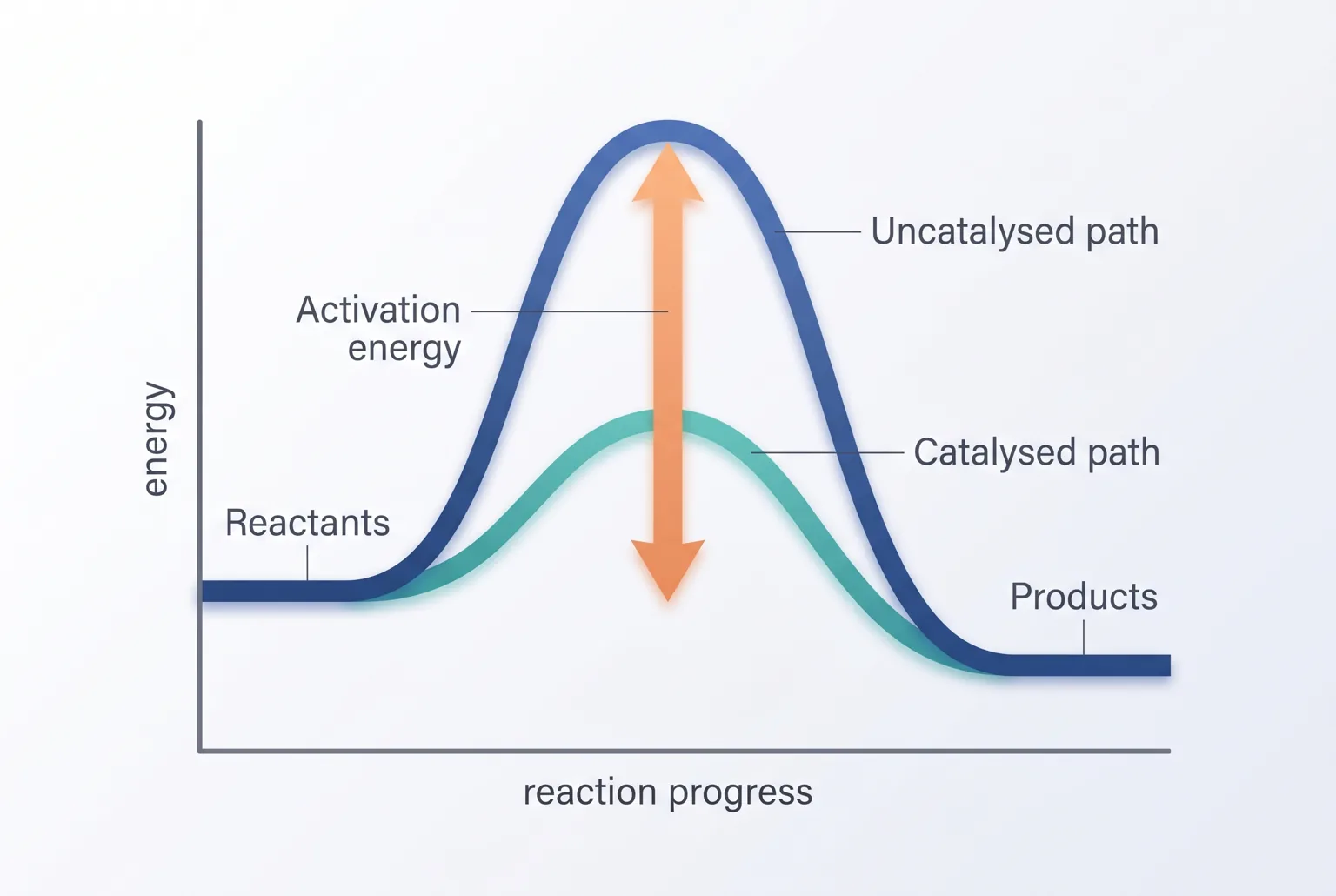
Reasoning questions ask how a temperature change or an added catalyst affects the rate. Answer in terms of activation energy and the fraction of collisions that are effective.
Common mistakes in kinetics calculations
- Energy units: is given as , so first comes out in . Convert to kJ only deliberately.
- Log base: pair the factor with base-10 logs. One paper gives directly.
- Temperature: use kelvin values in the Arrhenius equation.
- Order from equations: one item asks you to explain why order cannot be read from the balanced chemical equation.
- Pressure data: do not substitute total pressure for the reactant's pressure.
Practising with the 180-question collection
The paper prints 89 subjective questions (Q1–Q89) and 91 single-answer MCQs (Q90–Q180), with exam-year labels from 2022 to 2026. It also keeps set, region and compartment labels, and gives marks only where they were printed.
There are two ways to find questions:
- A topic finder groups them under seven headings.
- A question-type finder separates subjective, case-based (Q22, Q69, Q86, Q87), MCQ and assertion-reason items.
The original material contained only answer keys, so the full solutions are added and labelled "Added solution". Apparent source errors are kept in the questions and explained in the solutions.
A sensible practice order:
- Rate laws and units.
- Order and molecularity.
- First- and zero-order calculations.
- Arrhenius problems.
- Mixed MCQs and assertion-reason items.
Attempt each question before opening View Solution.
Quick self-check: can you explain why responds to temperature but not to concentration? Can you explain why only first-order half-life is independent of ?
Frequently asked questions
Why is Chemical Kinetics labelled Chapter 3 here?
The collection follows the current CBSE Class 12 Chemistry sequence. It notes that older NCERT editions may number Chemical Kinetics as Chapter 4.
Are the worked solutions from the original papers?
No. The supplied material had answer keys and online links but no complete written solutions. The full solutions were added for this edition and are labelled "Added solution".
Spotted an error? Report a correction. Practise this in the app: notes, formula sheets and mind maps.















































































































































Loading comments…