Biomolecules: CBSE Class 12 PYQs and Key Ideas Explained
CBSEChemistryBiomolecules
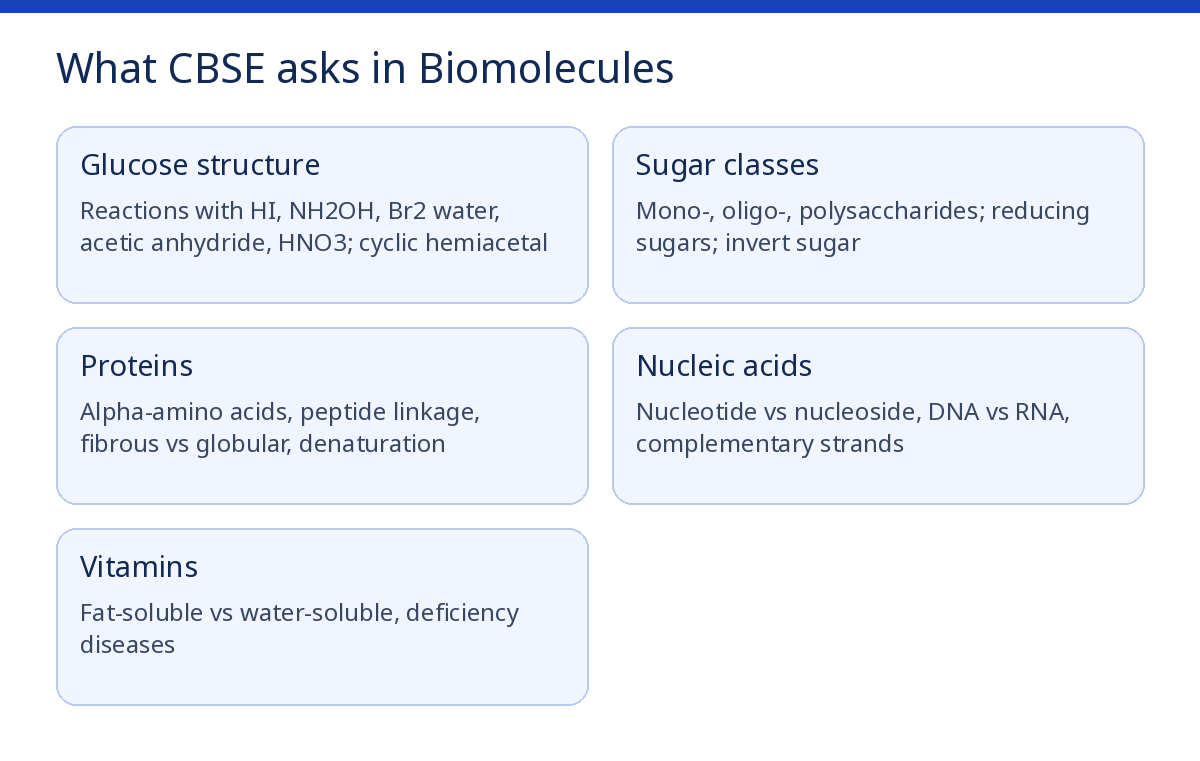
Biomolecules (Chapter 10, CBSE Class 12 Chemistry) is tested through glucose reactions and ring structure, sugar classification, amino acids and proteins, nucleic acids and vitamins. This guide explains these ideas as the board questions frame them and shows how to practise with a solved 187-question collection.
Where the Biomolecules board questions concentrate
This collection gathers 187 questions with exam-year labels 2021 (Term 1), 2023, 2024, 2025 and 2026. They come from main, compartment, Delhi and Outside Delhi sets. Its topic finder sorts them into eight NCERT sub-topics:
- amino acids and peptide bonds
- carbohydrate classes
- disaccharides and polysaccharides
- glucose and fructose
- nucleic acids
- nucleosides and linkages
- protein structure
- vitamins
The glucose list is the longest, followed by proteins, disaccharides and vitamins. The chapter is numbered 10 in the current CBSE sequence. Older NCERT editions may call it Chapter 14.

Biomolecules | Class 12 | Previous Year Paper
In the StudentCurio app
A comprehensive 157-page collection of solved previous year questions (PYQs) for CBSE Class 12 Chemistry, covering carbohydrates, proteins, nucleic acids, and vitamins with detailed step-by-step solutions.
Reading glucose's open structure from its reactions
A case passage summarises the core idea. Glucose is an aldohexose, correctly named D(+)-glucose. Its open structure was assigned from its reactions with HI, , water, and nitric acid.
Board questions ask you to link each reagent to the structural feature it reveals:
- Acetic anhydride gives a pentaacetate. This confirms five groups on different carbon atoms.
- Hydroxylamine gives an oxime and HCN gives a cyanohydrin. Both point to a carbonyl group.
- Bromine water, a mild oxidant, is tied to showing that the carbonyl is aldehydic.
- Concentrated nitric acid appears as an oxidation reaction of glucose.
Some stems simply say "write the reactions of D-glucose with...". Others ask how you explain the straight chain, the five groups or the aldehyde group. For those, give the reaction and state the conclusion it supports.
Why cyclic glucose does not behave like a simple aldehyde
The same passage notes an anomaly. Despite having a group, glucose does not give Schiff's test. It also does not form the hydrogen sulphite addition product with .
The reason is ring formation. One group adds to the group, giving a six-membered cyclic hemiacetal.
Questions on this idea ask you to:
- prove that cyclic glucose has no free group
- define anomers
- draw the α-D(+)-glucose or β-D-glucopyranose ring
These often appear as internal-choice alternatives. One case passage adds stereochemistry. The number of stereoisomers is estimated as , where is the number of chiral carbons, and mirror-image stereoisomers are enantiomers.
Common mistake: treating the failed Schiff's test as proof that glucose has no aldehyde group. The aldehyde is tied up in the hemiacetal ring, not absent.
Classifying sugars: reducing behaviour and storage polysaccharides
The source defines carbohydrates as optically active polyhydroxy aldehydes or ketones, or compounds that give such units on hydrolysis. They are grouped as monosaccharides, oligosaccharides and polysaccharides. Separately, they are classed as reducing or non-reducing sugars.
Recurring stems ask for the hydrolysis products of sucrose (the sugar in sugarcane) and lactose. Others ask whether a sugar is reducing, or why sucrose is called invert sugar.
Polysaccharide questions are framed as structural comparisons:
- Amylose is the unbranched chain polymer of α-D-(+)-glucose.
- Amylopectin is the branched chain polymer of α-D-(+)-glucose.
- Glycogen, called animal starch, is compared with starch.
- Starch is compared with cellulose.
When a stem says "on the basis of structure", base the difference on chain structure, not on where the sugar comes from.
Amino acids, peptide linkage and levels of protein structure
Proteins are polymers of α-amino acids joined by the peptide linkage. Amino-acid stems test three ideas:
- why amino acids are amphoteric
- why their melting points exceed those of the corresponding carboxylic acids (the finder groups this under zwitterions)
- how essential amino acids differ from non-essential ones, and acidic from basic ones
By molecular shape, proteins are classed as fibrous or globular. One stem asks which bonds hold the polypeptide chains together in fibrous proteins.
Structure questions set up three contrasts:
- the α-helix versus the β-pleated sheet
- primary versus secondary structure
- native versus denatured protein
They often ask what denaturation does to protein structure, with an example. A clear two-column contrast usually suits these "differentiate between" questions.
Nucleotides, nucleosides and the DNA–RNA comparison
A case passage defines nucleic acids as polymers of nucleotides. Each nucleotide is made of a base, a pentose sugar and a phosphate moiety. Another passage notes that purine and pyrimidine derivatives coupled to a ribose sugar are nucleosides. The nucleotide–nucleoside distinction therefore turns on the phosphate.
DNA and RNA transfer characters from parents to offspring. Recurring stems ask:
- what structural differences separate DNA from RNA
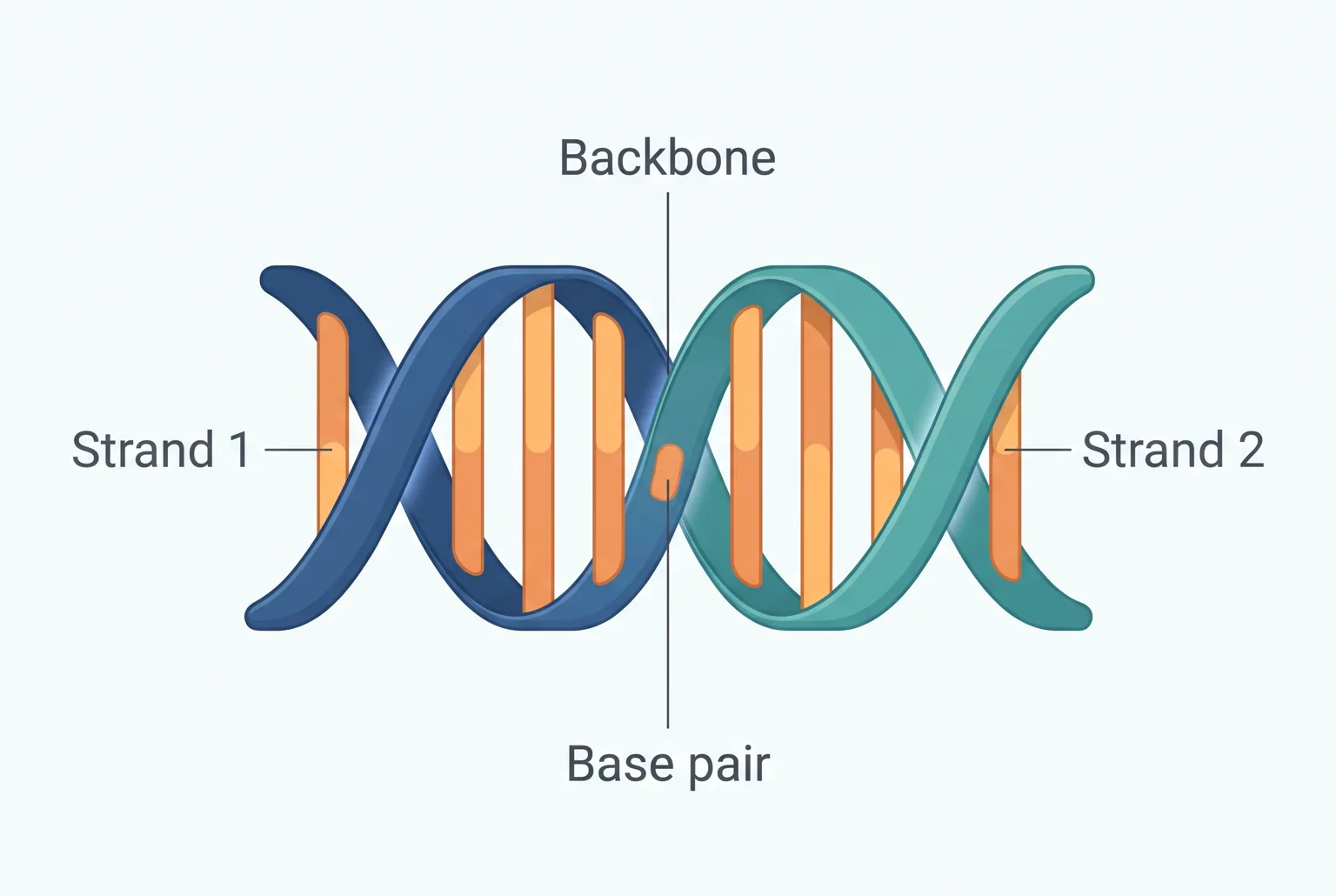
- why DNA's two strands are complementary rather than identical
- what a thymine-containing DNA nucleotide gives on hydrolysis
Good to remember: linkage questions cross topics. Expect to contrast the peptide linkage with the glycosidic linkage or the phosphodiester linkage.
Vitamin questions: solubility class and deficiency diseases
Vitamins appear as accessory food factors, classified as fat-soluble or water-soluble. Their deficiency causes disease.
Most stems are short recall items:
- the disease caused by a deficiency of vitamin A, B₁, B₁₂ or C
- the vitamin linked to blood coagulation
- examples of each solubility class
Explaining why vitamin C cannot be stored in the body is a reasoning item. Answer it from the vitamin's solubility class.
Working through subjective, case-based, MCQ and assertion-reason items
The collection keeps the original serial order. Q1–Q96 are 82 subjective and 14 case-based questions. Q97–Q187 are 69 single-answer MCQs and 22 assertion-reason items.
Many subjective questions offer internal choice marked OR. Case passages supply facts you are expected to use in your answers.
The supplied paper had answer keys but no written solutions. Every worked solution is therefore labelled an added solution and covers every subpart and alternative. Apparent source errors are kept in the questions and explained in the solutions.
A practical order:
- Clear the glucose questions first, using the topic finder.
- Move on to proteins and nucleic acids.
- Attempt the case-based items.
- Finish with mixed MCQs and assertion-reason items.
Attempt each question before opening its solution.
Quick self-check: can you explain, without notes, why glucose has an aldehyde group yet fails Schiff's test?
Frequently asked questions
Is this Biomolecules collection meant for JEE preparation?
No. It contains CBSE Class 12 Chemistry board questions labelled with CBSE sets, including main, compartment and Term 1 papers.
Why is Biomolecules called Chapter 10 here?
The collection follows the current CBSE Class 12 Chemistry sequence. It notes that older NCERT editions may number this chapter as Chapter 14.
Are the worked solutions official CBSE answers?
No. The supplied material had answer-key entries and online links but no written worked solutions. The full solutions were added for this edition and are labelled as added solutions.
Spotted an error? Report a correction. Practise this in the app: notes, formula sheets and mind maps.















































































































































Loading comments…