CBSE Class 12 Amines: Guide to the Case-Based Assessment
CBSEChemistryAmines
This CBSE Class 12 Chemistry assessment uses short passages, reaction schemes and structures to test how you apply ideas from Amines. Use the questions-first layout to practise identifying the decisive clue before checking the linked worked solutions.
What the assessment asks you to do
The file contains 11 case studies, 42 numbered questions and 10 OR alternatives. It combines multiple-choice, short-answer, and assertion-and-reason questions, with no separate chapter-practice section. The first cases bring together classification, preparation, solubility and basicity. Later cases focus on topics such as identification tests, aromatic substitution, basicity constants and the mechanism of Hofmann bromamide degradation.
The case passage supplies context, but the wording of each question determines which part of that context matters. A question about a basicity constant calls for a different argument from one about an observation in a separation scheme. Use the clickable index either to follow the original case order or to revisit a topic where you can recognise the reaction but cannot yet explain why it applies.

Amines | Class 12 | CBSE Case-based Assessment
In the StudentCurio app
Case-based questions and worked solutions cover amine basicity, preparation methods, identification tests, Hofmann bromamide degradation, aniline reactions and diazonium chemistry. Helps Class 12 CBSE students practise applying amine concepts to case studies and assessment questions.
Read the structure before naming the reaction
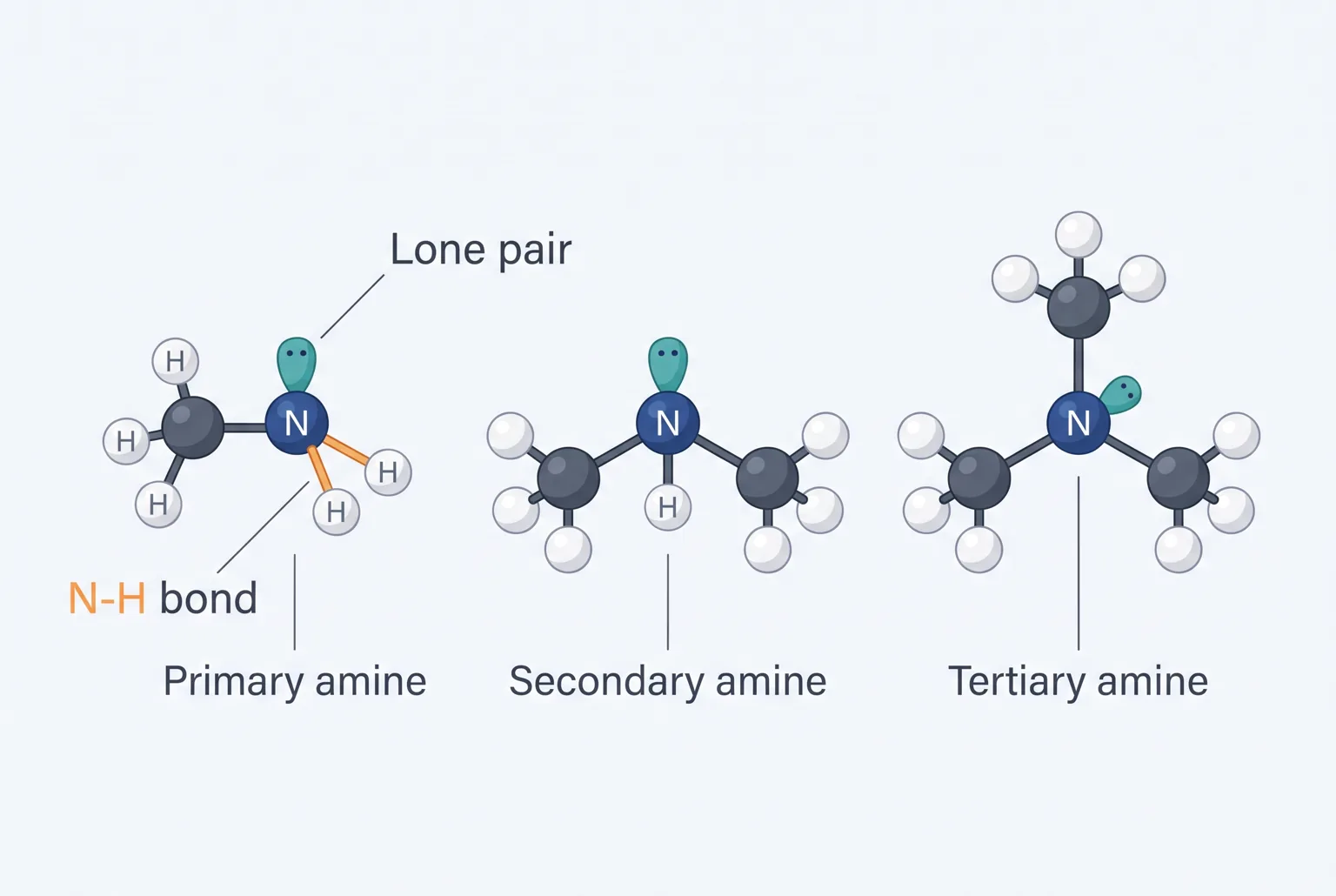
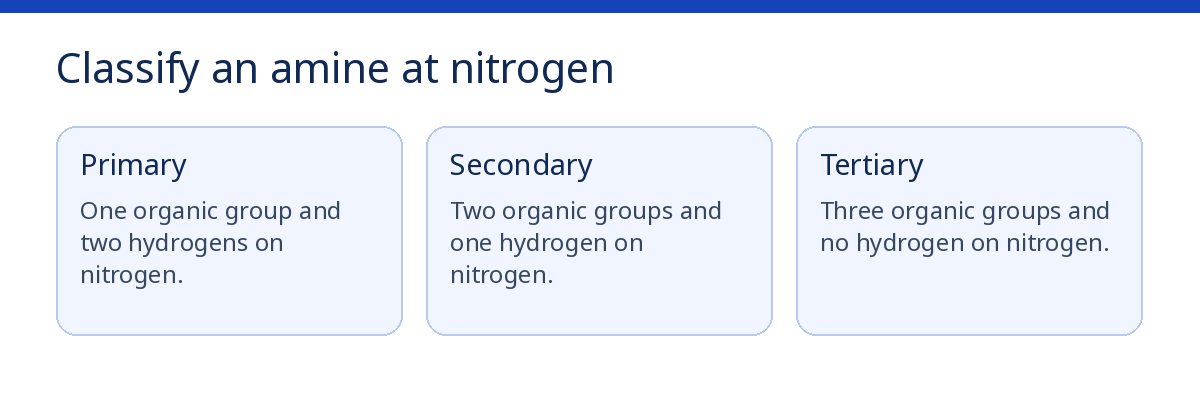
Classify an amine by counting the carbon-containing groups bonded directly to nitrogen. Primary, secondary and tertiary amines have one, two and three such groups, respectively. This classification is separate from the aliphatic–aromatic distinction. For that distinction, check whether nitrogen is bonded directly to an aromatic ring rather than merely looking for a ring somewhere in the structure.
The structure also helps you reason about hydrogen bonding. Primary and secondary amines have nitrogen–hydrogen bonds and can donate hydrogen bonds. A tertiary amine has no nitrogen–hydrogen bond, but its lone pair can accept a hydrogen bond from water. Not donating a hydrogen bond is therefore not the same as being unable to interact with water. Use that distinction in the solubility case, where hydrogen bonding is one factor alongside the size and nature of the organic groups.
Basicity: check the solvent before ranking
An amine acts as a base when the nitrogen lone pair accepts a proton. In water, the equilibrium produces the corresponding ammonium ion and hydroxide. The assessment expresses base strength through and , related by . Under the same conditions, a larger means a stronger base and a smaller . A ranking written in increasing therefore runs in the opposite direction to one written in increasing basic strength.
Common mistake: Treating the number of alkyl groups as a universal ranking rule. Alkyl groups donate electron density, but in water, solvation of the protonated amine and steric crowding also affect the comparison. The file includes questions set in water and in benzene, so note the stated medium before comparing structures. For aniline, consider resonance as well: delocalisation into the ring makes its nitrogen lone pair less available for protonation.
Compare preparation routes by tracking the carbon skeleton
The preparation cases distinguish routes by what each can make. In ammonolysis, ammonia acts as a nucleophile towards an alkyl halide. The amines formed can undergo further alkylation, so the reaction can give a mixture of amines and quaternary ammonium salts. Conventional Gabriel phthalimide synthesis instead uses suitable alkyl halides to prepare primary alkyl amines. Ordinary aryl halides do not undergo the required substitution under those conditions; reduction of nitroarenes is a route to aryl amines.
Before you compare products: Mark the carbonyl carbon in an amide. In Hofmann bromamide degradation, bromine and alkali convert a primary amide to a primary amine with one fewer carbon atom. The redrawn mechanism lets you follow that carbon through the intermediates rather than assuming it remains attached to nitrogen in the final amine.
Separate the test observation from the inference
In the Hinsberg case, distinguish the initial reaction with benzenesulfonyl chloride from the behaviour of the resulting material in aqueous alkali. Whether a sulfonamide forms and whether it dissolves in the alkaline medium are different pieces of evidence. Follow each branch of the separation scheme in order, noting when the medium changes, rather than assigning an amine class from the final appearance alone.
The carbylamine case uses a different kind of clue: formation of an isocyanide associated with an unpleasant odour under the stated reaction conditions. When the passage also describes an extraction, keep the two observations separate. The layer tells you where the compound is after extraction; the subsequent reaction provides evidence about its functional group.
Aniline: connect ring reactivity to reaction conditions
The same lone pair that affects aniline’s basicity helps explain its ring reactivity. In neutral aniline, donation into the ring activates it towards electrophilic substitution and favours attack at the ortho and para positions. Under strongly acidic nitration conditions, protonation changes the group on the ring, so the directing effect of neutral aniline is not sufficient to predict the outcome of direct nitration.
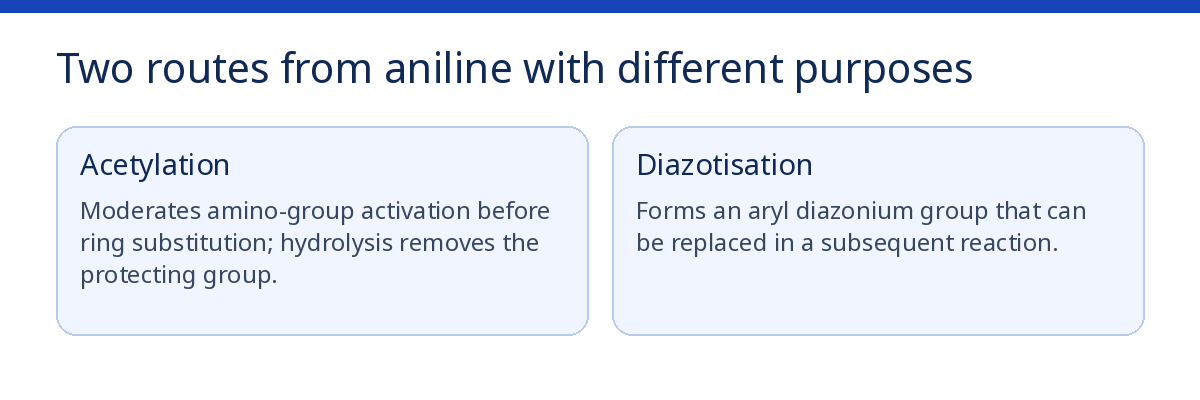
A useful connection: Acetylation and diazotisation serve different purposes. Acetylation moderates the activating effect of the amino group before ring substitution, and hydrolysis can subsequently remove the protecting group. Diazotisation instead creates an aryl diazonium group that can be replaced. The assessment uses diazonium chemistry to connect aromatic amines with routes to aryl halides, nitriles, phenols and arenes.
Use the solution links to check your reasoning
Attempt a case before opening its solutions. For multiple-choice items, write down the clue that rules out an alternative. For short answers, show the structural feature or reaction condition on which your explanation depends. In assertion-and-reason items, judge each statement independently before deciding whether the reason explains the assertion. Then use the solution and return links to compare your reasoning with the explanation and revisit the original prompt.
The linked clarification identifies the final preparation claim in the Case Study 10 passage as a source error, so that claim is omitted here. Unclear printed options, subscripts and isotope labels are also left uninterpreted; they are not needed to study the underlying concepts.
Spotted an error? Report a correction. Practise this in the app: notes, formula sheets and mind maps.















































































































































Loading comments…