Aldehydes, Ketones and Carboxylic Acids: Class 12 Guide
CBSEChemistryAldehydes, Ketones and Carboxylic Acids
This CBSE Class 12 NCERT Chemistry chapter connects the structure of aldehydes, ketones and carboxylic acids with their properties and reactions. Use the textbook file to practise naming compounds, planning conversions and interpreting chemical tests.
Start with structure, then name the compound
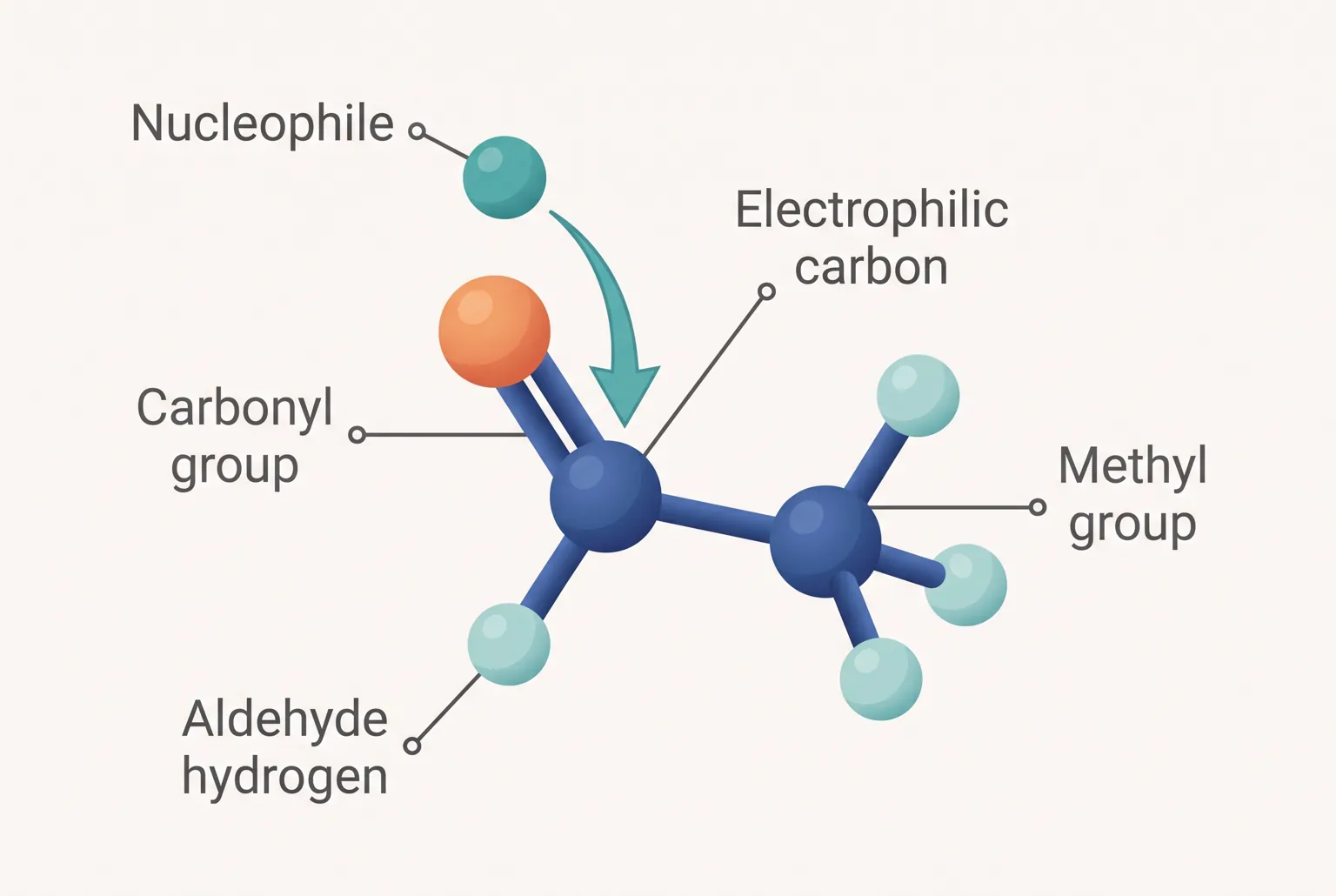
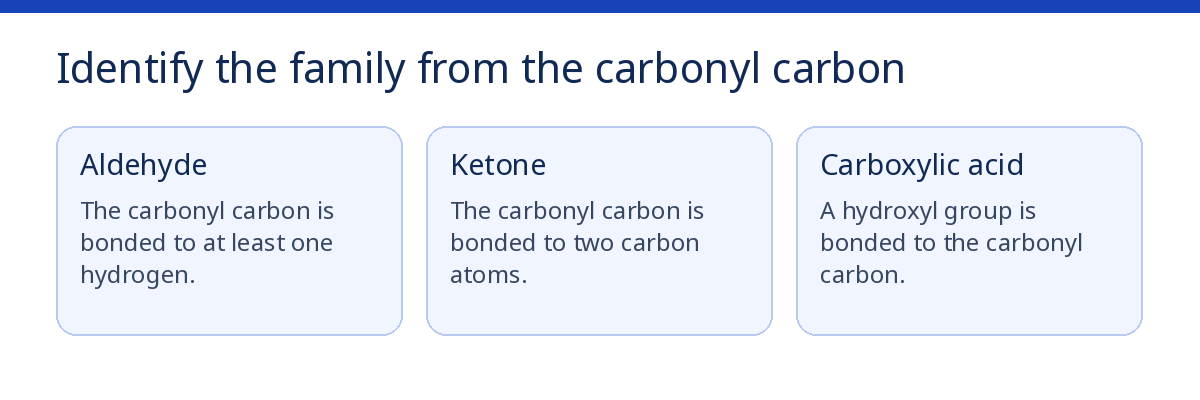
All three families contain a carbonyl group, a carbon–oxygen double bond. In an aldehyde, the carbonyl carbon is bonded to at least one hydrogen; in a ketone, it is bonded to two carbon atoms. In a carboxylic acid, the same carbon bears a hydroxyl group, forming the carboxyl group. Finding these attachments first helps you classify a structure before choosing its name or predicting its reactions.
Use Table 8.1 to practise translating between structures, common names and IUPAC names. Open-chain aldehydes use –al, with numbering starting at the aldehyde carbon. Open-chain ketones use –one, with numbering starting at the end nearer the carbonyl group. A cyclic ketone assigns its carbonyl carbon position one; an aldehyde group attached to a cycloalkane instead takes the suffix carbaldehyde.

Aldehydes, Ketones and Carboxylic Acids | Class 12 | NCERT Textbook
In the StudentCurio app
This textbook chapter covers the preparation, properties and reactions of aldehydes, ketones and carboxylic acids, including carbonyl reactions, acidity, conversions and chemical tests. It also includes end-of-chapter exercises for Class 12 students studying organic chemistry.
Read preparation methods as a map of conversions
The preparation section groups reactions by the compound they produce. Read it in both directions: starting with a substrate helps you predict a product, while starting with the required product helps you choose a route. Controlled oxidation of a primary alcohol can give an aldehyde; oxidation of a secondary alcohol gives a ketone. The chapter also revisits alkene ozonolysis with a zinc-and-water work-up, where the alkene’s substitution pattern determines whether aldehydes, ketones or both are formed.
A nitrile shows why the starting group alone does not determine the product. The Stephen reaction uses reduction followed by hydrolysis to obtain an aldehyde, whereas treatment with a Grignard reagent followed by hydrolysis yields a ketone. In your notes, keep the work-up with the reagent rather than recording just the first step.
Good to remember: hydrogen bonding depends on the partner
The carbonyl bond is polar because oxygen is more electronegative than carbon. This gives aldehydes and ketones dipole–dipole attractions. The chapter uses those attractions to explain why their boiling points are generally higher than those of hydrocarbons and ethers of comparable molecular mass. Alcohols of similar mass generally boil at higher temperatures because alcohol molecules can hydrogen-bond to one another.
Do not carry that last comparison over to water solubility. Aldehydes and ketones lack an oxygen–hydrogen bond, but their carbonyl oxygen can accept a hydrogen bond from water. Methanal, ethanal and propanone are miscible with water; water solubility decreases as the alkyl chain lengthens. The separate boiling-point table supports the intermolecular-force comparison. The disputed worked example on that page is omitted from this guide.
Follow the electron shift in nucleophilic addition
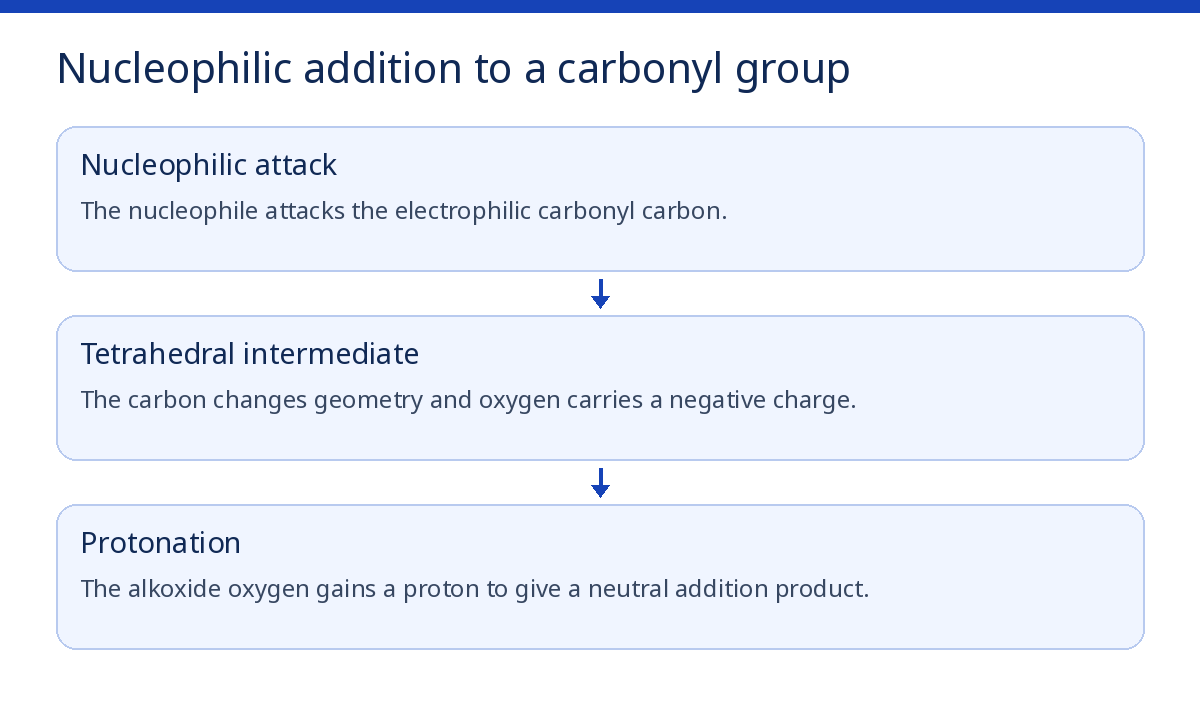
The chapter’s carbonyl diagrams show a planar arrangement around the carbonyl carbon, which is -hybridised. Bond polarity makes that carbon electrophilic, so it is the site of nucleophilic attack. In the mechanism drawn for an anionic nucleophile, attack produces a tetrahedral alkoxide intermediate: the carbon becomes -hybridised, and the oxygen is then protonated to give a neutral addition product.
For nucleophilic addition, aldehydes are generally more reactive than ketones. Two carbon substituents in a ketone can hinder the nucleophile’s approach, and two alkyl groups can reduce the electrophilicity of the carbonyl carbon. Keep this comparison tied to nucleophilic addition. Also distinguish simple addition from the reactions with ammonia derivatives, in which addition is followed by loss of water and formation of a carbon–nitrogen double bond.
Distinguish oxidation, reduction and chemical tests
Reduction can take aldehydes and ketones to primary and secondary alcohols, respectively. The chapter contrasts this with Clemmensen and Wolff–Kishner reductions, which convert the carbonyl group to a methylene group. Oxidation shows a different contrast: aldehydes readily oxidise to carboxylic acids, whereas ketones generally need vigorous conditions and undergo carbon–carbon bond cleavage.
When reviewing tests, separate the observation from what it establishes. Tollens’ reagent gives a silver mirror with an aldehyde and produces a carboxylate in the alkaline medium. Fehling’s test can give a reddish-brown precipitate, but aromatic aldehydes do not respond, so a negative result alone does not establish that a compound is a ketone. The iodoform test is not a general ketone test either: it detects a methyl carbonyl group or an alcohol group that can be oxidised to it.
Compare acids by looking at their conjugate bases
The chapter summary compares carboxylic acids with alcohols and most simple phenols. Carboxylic acids are stronger acids in that comparison. To explain why, draw the carboxylate ion left after the acid loses a proton: its negative charge is delocalised over two oxygen atoms. This stabilisation makes proton loss more favourable and gives you a structural reason for the acidity trend.
This is a different use of structure from locating the electrophilic carbon in an aldehyde or ketone. For an acidity comparison, ask what happens to the electron distribution after proton loss. For nucleophilic addition, ask where the nucleophile attacks in the starting molecule. Keeping the two questions separate helps you choose an explanation that fits the reaction.
Quick self-check before the chapter exercises
Use the in-text questions after the relevant reading, then move to the end-of-chapter exercises, which cover names, structures, reaction products, conversions, acidity and tests. For a conversion, mark the functional group at each end before choosing a reagent. For a test question, note both the observation you would expect and any limitation on what it proves.
Before moving on, try explaining two distinctions without the textbook: Why does numbering start differently for an open-chain aldehyde and a ketone? Why can a small ketone hydrogen-bond with water even though ketone molecules do not hydrogen-bond to one another? If either explanation is incomplete, return to the naming table or the physical-properties discussion before attempting a mixed set of exercises.
Spotted an error? Report a correction. Practise this in the app: notes, formula sheets and mind maps.















































































































































Loading comments…