CBSE Class 12: Aldehydes and Ketones Case-Based Assessment
CBSEChemistryAldehydes and Ketones
This CBSE Class 12 Chemistry assessment uses case passages to connect carbonyl structure with reaction mechanisms, identification tests and organic conversions. It also covers linked carboxylic acid concepts from the NCERT chapter and places worked solutions after the questions.
What the assessment covers and how it is organised
The file is a case-based assessment for Chapter 8, Aldehydes, Ketones and Carboxylic Acids, rather than a set of chapter notes or a separate chapter-practice bank. It contains 12 case studies, 47 numbered questions and 11 OR alternatives. The index identifies cases by topic and links to both the questions and the complete solutions. The assessment includes multiple-choice, short-answer and assertion–reason items.
The cases ask you to reason in different directions. A mechanism case starts with a functional group and asks what a reagent can do to it. An identification case starts with observations or products and asks what they imply about the starting structure. The linked-conversion cases combine these approaches: a structure inferred at one stage must also make sense in the next reaction.

Aldehydes and Ketones | Class 12 | CBSE Case-based Assessment
In the StudentCurio app
Case-based questions and worked solutions cover carbonyl reactivity, nucleophilic addition, aldehyde and ketone tests, and related reactions including aldol, Cannizzaro and haloform reactions. The material also includes linked carboxylic-acid concepts and helps Class 12 students practise applying reaction reasoning to case studies.
Nucleophilic addition: follow the electrons
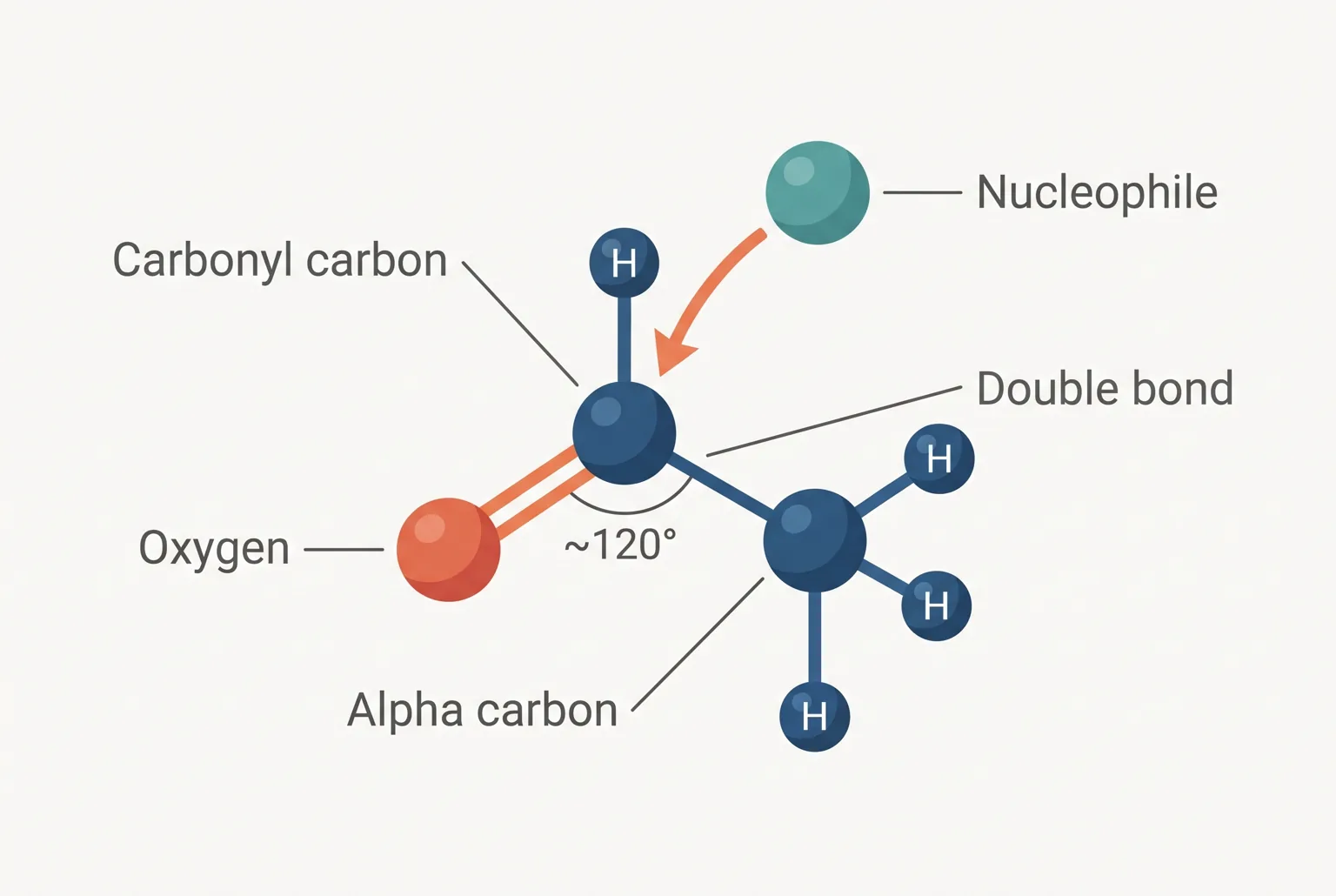
Oxygen is more electronegative than carbon, so the carbonyl bond is polar and its carbon is electrophilic. When an anionic nucleophile attacks an aldehyde or ketone, the carbonyl π electron pair moves onto oxygen. The immediate intermediate is an alkoxide, with the negative charge on oxygen, not on carbon. Protonation gives an alcohol group at the original carbonyl carbon. The cyanohydrin scheme illustrates this sequence, while the alcohol-addition scheme distinguishes the first addition product from subsequent acetal or ketal formation, which eliminates water.
When comparing similar aldehydes and ketones, consider both electronics and crowding. A ketone generally has two alkyl groups around the carbonyl carbon where a comparable aldehyde has one. Those groups can reduce its electrophilicity and make it harder for a nucleophile to approach. Use this as a trend, not as a ranking independent of structure.
Before choosing aldol or Cannizzaro, check the α-carbon
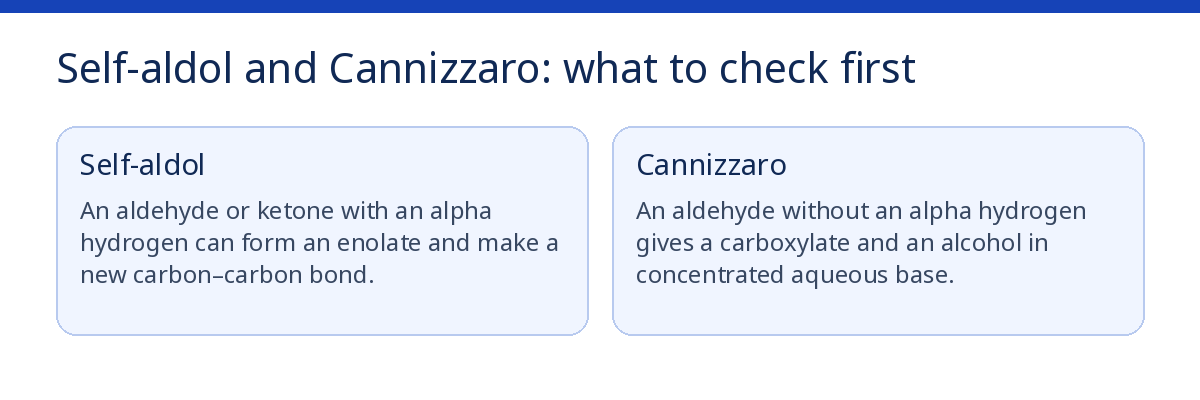
An α-hydrogen is attached to a carbon next to the carbonyl carbon. In ordinary base-promoted self-aldol reactions, removing an α-hydrogen allows an enolate to form. The enolate attacks a second carbonyl molecule, making a carbon–carbon bond. The initial aldol product is a β-hydroxy aldehyde or ketone. If it dehydrates, as in the heated scheme in the assessment, the result is an α,β-unsaturated carbonyl compound. Distinguish the addition step from the overall condensation rather than treating them as names for the same product.
The Cannizzaro case instead concerns an aldehyde without α-hydrogen in concentrated aqueous base. Hydride transfer between two aldehyde-derived species leads to oxidation of one molecule to a carboxylate and reduction of the other to an alcohol. The absence of α-hydrogen alone is not enough to apply this rule: the starting functional group must also be an aldehyde.
Common mistakes with reduction and identification tests
Do not assume that every reduction removes the carbonyl oxygen. With or , aldehydes give primary alcohols and ketones give secondary alcohols. Clemmensen and Wolff–Kishner reductions instead replace the carbonyl oxygen with hydrogen at the original carbonyl carbon. The assessment contrasts the acidic conditions of Clemmensen reduction with the strongly basic conditions used for Wolff–Kishner reduction.
Likewise, do not treat a test result as a complete structural identification. Tollens’ and Fehling’s tests draw on the greater ease of oxidation of aldehydes compared with ordinary ketones. Fehling’s reagent is useful for many aliphatic aldehydes but is not a universal test for all aldehydes. In the isomer cases, read a test result alongside the molecular formula and any other reaction evidence.
Haloform: account for carbon on both sides
The haloform passage shifts attention from the mere presence of a carbonyl to the methyl group directly attached to the carbonyl carbon. For a methyl ketone under the stated haloform conditions, that methyl carbon ends up in the haloform, while the original carbonyl carbon remains in the carboxylate. The carboxylate therefore contains one fewer carbon atom than the starting ketone. In the iodine version, iodoform is the yellow precipitate.
This carbon accounting gives you a way to check a proposed conversion without relying on recognition alone. Identify which bond is broken and check that both fragments together account for the starting carbon skeleton.
A useful connection: acidity and conjugate-base stability
Although carboxylic acids contain a carbonyl group, their group does not behave like the carbonyl group of an aldehyde or ketone in the addition reactions discussed here. In the acidity case, the relevant change is loss of a proton. In the resulting carboxylate ion, the negative charge is delocalised across two equivalent oxygen atoms. That stabilisation helps explain why carboxylic acids are stronger acids than simple phenols.
For comparisons within a related set of carboxylic acids, ask what the substituent does to the conjugate base. Electron withdrawal generally stabilises the carboxylate and increases acidity; electron donation generally has the opposite effect. The index also points to a separate case on α-halogenation and decarboxylation.
Use the solutions to check your reasoning
Read the passage and attempt its questions before opening the linked solutions. For a mechanism item, mark the reacting atom and note whether the step is addition, proton transfer or elimination. For a conversion or identification item, write what each observation establishes before deciding whether the clues together support a structure. Then use the solution and return links to compare the reasoning step by step, not just the final choice.
This guide leaves out three flagged items: Case Study 3 (ii), Case Study 7 (iii) OR and Case Study 9 (ii).
Spotted an error? Report a correction. Practise this in the app: notes, formula sheets and mind maps.















































































































































Loading comments…