Alcohols, Phenols and Ethers: Class 12 NCERT Guide
CBSEChemistryAlcohols, Phenols and Ethers
This CBSE Class 12 Chemistry chapter uses the position and bonding of oxygen to explain how alcohols, phenols and ethers are named, prepared and distinguished. Use the guide alongside the NCERT structures, reaction schemes and exercises to see why similar-looking compounds behave differently.
Classify by looking at what oxygen is attached to
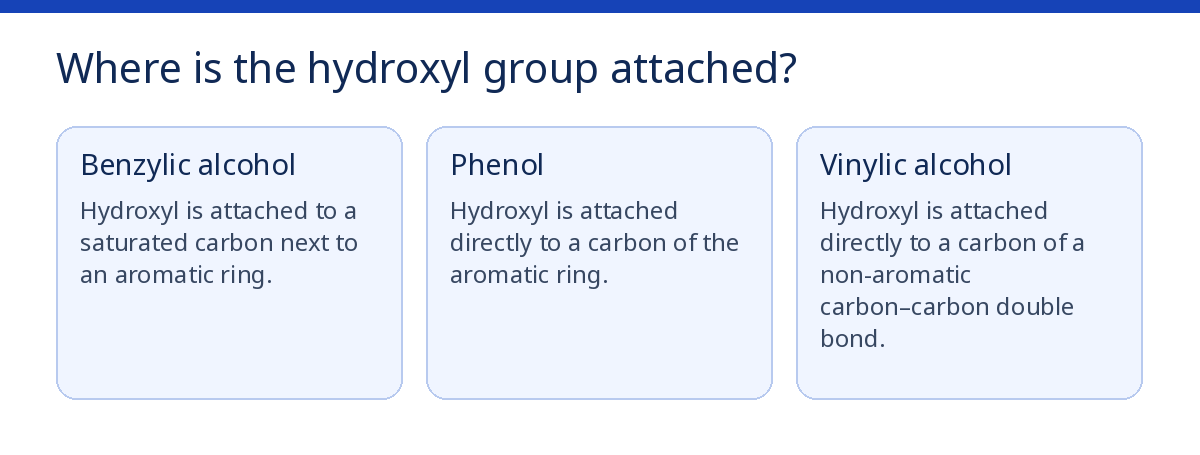
Start with the carbon bonded to the hydroxyl group. In a phenol, that carbon is part of the aromatic ring itself. In a benzylic alcohol, the hydroxyl group is attached to a saturated carbon next to the ring. Likewise, an allylic alcohol has its hydroxyl group on a saturated carbon next to a double bond, whereas in the vinylic example it is attached directly to a double-bond carbon.
Monohydric, dihydric and trihydric describe how many hydroxyl groups are present. Primary, secondary and tertiary describe how many carbon neighbours the saturated carbon bearing the hydroxyl group has. These labels answer different questions. For an ether, compare the two groups bonded to oxygen: identical groups make it symmetrical; different groups make it unsymmetrical.
Editorial note: One disputed classification statement in NCERT §7.1.1(ii) is omitted from this guide.

Alcohols, Phenols and Ethers | Class 12 | NCERT Textbook
In the StudentCurio app
Covers the classification, preparation, properties and reactions of alcohols, phenols and ethers, including phenol substitution, ether synthesis and cleavage, and anisole reactions. Includes chapter exercises to support Class 12 CBSE Chemistry study.
Read and write names from the structure
For the chain alcohols illustrated in the chapter, number the parent chain from the end nearer the hydroxyl group. In propan-2-ol, the locant tells you where that group sits, not where a carbon branch begins. For multiple hydroxyl groups, specify each position: ethane-1,2-diol has one on each carbon. In the cyclic alcohol examples, the carbon carrying the hydroxyl group is carbon 1.
For substituted phenols, the ring positions are measured relative to the hydroxyl group: ortho, meta and para correspond to the 1,2-, 1,3- and 1,4-arrangements. In the ether naming table, an oxygen-linked group can be named as a substituent on the parent. Thus methoxybenzene, also called anisole, identifies benzene as the parent and methoxy as the attached group. Use the tables in both directions: name a structure, then check whether the name lets you redraw it.
When the preparation route changes the product
For an unsymmetrical alkene, acid-catalysed hydration follows Markovnikov’s rule, whereas hydroboration–oxidation places the hydroxyl group on the double-bond carbon that originally carried more hydrogen atoms when the two carbons differ in that respect. The acid-catalysed mechanism proceeds through protonation of the alkene, attack by water on the carbocation, and deprotonation. Compare where the hydroxyl group ends up rather than remembering both methods simply as additions of water.
With carbonyl compounds, distinguish reduction from Grignard addition. Reduction of an aldehyde gives a primary alcohol; reduction of a ketone gives a secondary alcohol. Grignard addition forms a new carbon–carbon bond, and subsequent hydrolysis gives a primary alcohol from methanal, a secondary alcohol from other aldehydes, and a tertiary alcohol from ketones. The chapter also describes reduction of carboxylic acids to primary alcohols using lithium aluminium hydride followed by work-up.
Follow the starting material in phenol preparation
The phenol section compares routes from haloarenes, benzenesulphonic acid, diazonium salts and cumene. In the chlorobenzene and benzenesulphonic acid routes, sodium phenoxide is formed before acidification gives phenol. That last step matters: the salt and the neutral compound are not interchangeable when identifying the product at a particular stage.
The diazonium route instead uses hydrolysis on warming with water or treatment with dilute acid. In the cumene route, oxidation gives cumene hydroperoxide, which on treatment with dilute acid yields phenol and acetone. When comparing the schemes, identify the intermediate or stage that distinguishes each route. This is more useful than memorising four lists of reagents without seeing what they do.
Common mix-up: hydrogen bonding with water versus itself
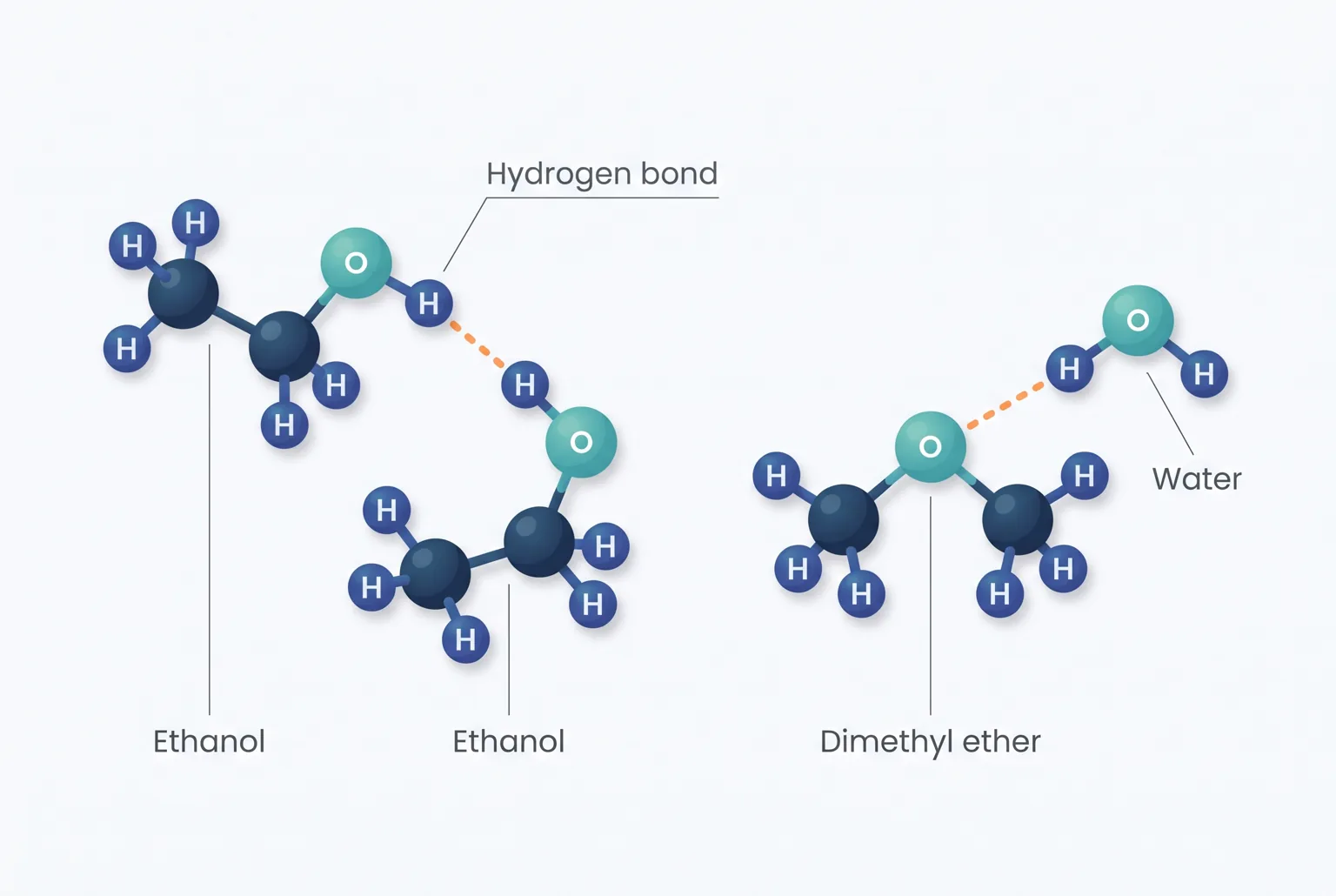
Alcohol and phenol molecules can hydrogen-bond to one another through their hydroxyl groups. This helps explain their higher boiling points compared with ethers of comparable molecular mass. Ethers lack an oxygen–hydrogen bond, so they cannot donate hydrogen bonds to one another, but their oxygen can accept hydrogen bonds from water. The absence of self-association by hydrogen bonding does not mean the absence of hydrogen bonding with water.
Keep molecular shape and size in view as well. Among comparable isomeric alcohols, increased branching generally lowers the boiling point because it reduces surface contact and weakens intermolecular attractions. For alcohols and phenols, a larger hydrophobic alkyl or aryl group generally reduces water solubility. Boiling point and water solubility therefore require different comparisons, even though both involve intermolecular attractions.
Explain phenol acidity through the conjugate base
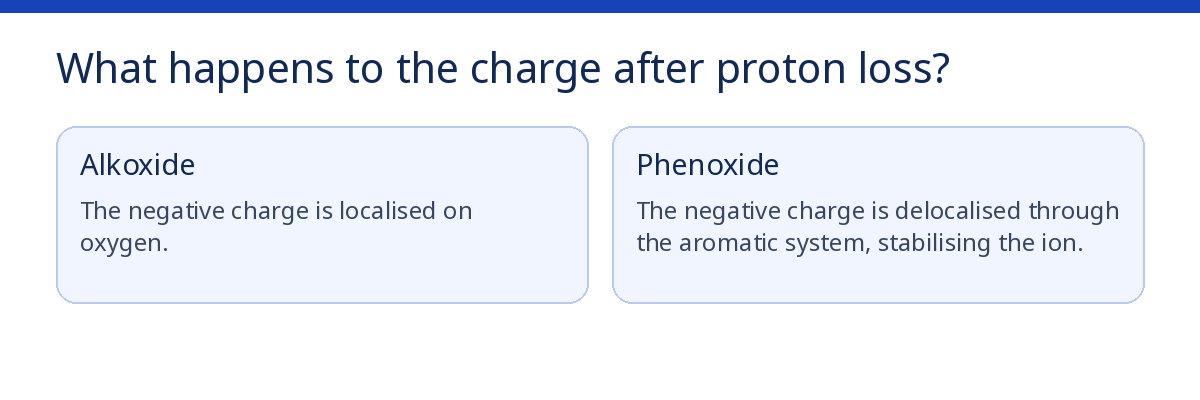
Alcohols and phenols can lose the proton of the hydroxyl group, but the resulting ions differ. In an alkoxide, the negative charge is localised on oxygen. In phenoxide, it is delocalised through the aromatic system. The greater stabilisation of phenoxide helps explain why phenol is more acidic than ethanol and reacts with aqueous sodium hydroxide to form sodium phenoxide.
Read the chapter’s acidity table in the correct direction: a lower means a stronger acid. A nitro group increases phenol’s acidity, with a more pronounced effect at ortho and para positions than at meta. Alkyl groups generally have the opposite effect; the cresols in the table are less acidic than phenol. Keep this conjugate-base comparison separate from electrophilic substitution, which changes the aromatic ring itself.
Track the bond that changes in reactions and exercises
In Williamson ether synthesis, an alkoxide or aryloxide attacks an alkyl halide. A primary alkyl halide favours substitution; with a tertiary alkyl halide, elimination is favoured instead. In ether cleavage by a hydrogen halide such as hydrogen iodide, oxygen is protonated before a carbon–oxygen bond breaks. Distinguish both processes from electrophilic substitution in phenol or anisole, where a substituent enters the aromatic ring.
Use the in-text questions to check classification and naming before moving to the chapter exercises. For a reaction prompt, first mark whether the change involves the oxygen–hydrogen bond, a carbon–oxygen bond or the ring. Then check which condition or structural feature justifies that choice.
Spotted an error? Report a correction. Practise this in the app: notes, formula sheets and mind maps.















































































































































Loading comments…