Alcohols, Phenols and Ethers: Class 12 NCERT Solutions
CBSEChemistryAlcohols, Phenols and Ethers
This CBSE Class 12 Chemistry solutions file works through the NCERT intext and exercise questions on Alcohols, Phenols and Ethers. Use it to connect molecular structure with naming, physical properties, acidity and reaction pathways.
Find the right question before you compare solutions
The file indexes 12 intext questions on pages 3–8 and 33 exercise questions on pages 9–25. The two sections have their own numbering, so check the section as well as the question number. The edition note also explains that a question numbered 11.1 in the older chapter numbering corresponds to 7.1 within the same section. Match the prompt as well as the number if you are switching between the file and your textbook.
Use the intext solutions to review a concept before moving to a related exercise. The nomenclature questions are a useful example: one task asks you to name a structure, while another asks you to turn a name back into a structure. Doing both helps you check whether you understand what each part of the name specifies.

Alcohols, Phenols and Ethers | Class 12 | NCERT Solutions
In the StudentCurio app
Step-by-step NCERT solutions cover alcohol classification, nomenclature, preparation and reactions, along with phenol acidity and reactions, ether synthesis and cleavage, and anisole reactions. Useful for Class 12 students practising and reviewing this chapter’s questions.
Common mistake: counting carbons in the wrong place
Start by identifying what the oxygen is bonded to. A phenol has its hydroxyl group attached directly to an aromatic ring carbon. An alcohol can contain a benzene ring without being a phenol: if the hydroxyl group is on a saturated side-chain carbon directly next to the ring, the alcohol is benzylic. An allylic alcohol has its hydroxyl group on a saturated carbon directly next to a carbon–carbon double bond. In an ether, oxygen links two carbon-containing groups instead of carrying a hydroxyl hydrogen.
To classify a primary, secondary or tertiary alcohol, count the carbon atoms bonded directly to the carbon carrying the hydroxyl group. Do not count branches on a neighbouring carbon. This classification and the allylic or benzylic label answer different questions: one describes the hydroxyl-bearing carbon’s immediate carbon neighbours, while the other locates that carbon relative to a double bond or ring.
Hydrogen bonding: identify who bonds with whom
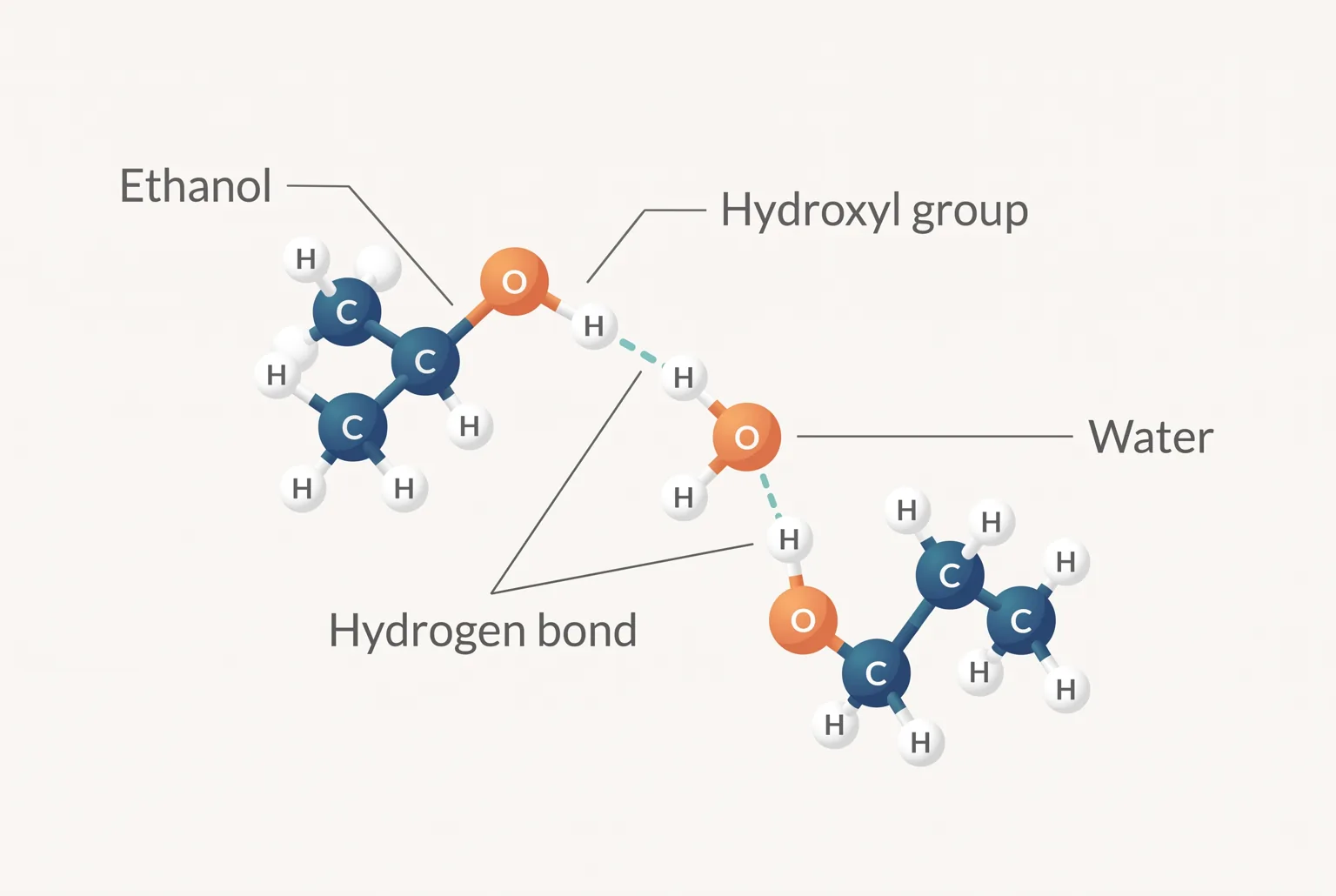
The exercises use hydrogen bonding to explain three different observations: boiling point, water solubility and separation by steam distillation. In a boiling-point comparison with a hydrocarbon, look for attractions between alcohol molecules. Separating molecules into the vapour phase requires overcoming those attractions. For water solubility, look instead at attractions between the alcohol and water: the hydroxyl group can donate a hydrogen bond, and its oxygen can accept one.
The nitrophenol comparison adds a third possibility: hydrogen bonding within a molecule. Whether this can occur depends on the positions of the hydroxyl and nitro groups on the ring. When an internal bond reduces association between molecules, it can favour entry into the vapour. The key is not just whether hydrogen bonding is possible, but whether it links separate molecules or occurs within one.
When the reagent changes the alcohol
The file compares two ways to add the elements of water across a double bond. In its acid-catalysed hydration example with an unsymmetrical alkene, hydroxyl placement follows Markovnikov orientation. In hydroboration–oxidation, boron adds to the less substituted carbon in the example, and oxidation replaces the carbon–boron bond with a carbon–oxygen bond there. The overall hydroxyl placement is anti-Markovnikov. Identify the route before deciding where to place the hydroxyl group.
For carbonyl compounds, the solutions distinguish reduction from carbon–carbon bond formation. Under the usual conditions shown, sodium borohydride reduces an aldehyde or ketone while leaving the ester group in the illustrated substrate intact. Grignard addition instead forms a carbon–carbon bond. The reagent adds to the carbonyl compound in dry ether, and the resulting alkoxide is protonated in a separate acidic work-up. Keeping those stages separate explains why the alcohol appears only after work-up.
Phenol: separate acidity from ring reactivity
To explain phenol acidity, compare the species formed after proton loss. Phenoxide can delocalise negative charge into the aromatic ring, whereas the charge in ethoxide remains localised on oxygen. The solutions then use substituted phenols to show why position matters: an ortho or para nitro group can provide additional resonance stabilisation to the conjugate base. In a resonance drawing, moving the formal charges does not change the ion’s net charge.
Ring substitution asks a different question. Here the hydroxyl oxygen donates electron density into the aromatic system and helps stabilise the intermediate formed during ortho or para electrophilic attack. The file also covers phenol preparation and distinguishes the Kolbe–Schmitt and Reimer–Tiemann reactions. Compare the reagents and the functional group each reaction introduces, rather than treating the two as interchangeable simply because both are taught with phenol.
Ether synthesis and cleavage: locate the reacting carbon
In Williamson ether synthesis, identify the carbon bearing the leaving group before choosing which fragment should supply the alkoxide or phenoxide. The usual displacement favours an unhindered methyl or primary alkyl carbon. A halogen bonded directly to an aromatic carbon does not undergo that same displacement, even though an aromatic fragment can be introduced through a phenoxide nucleophile.
For cleavage with HBr or HI, first picture the protonated ether, then inspect the groups on either side of oxygen. The file contrasts attack at an accessible alkyl carbon with a case in which cleavage at a tertiary carbon can proceed through a carbocation. Aryl–alkyl ethers also illustrate why the aromatic and alkyl carbons cannot be treated as equivalent. Before checking a product, ask: Which bond can break by the mechanism available to this substrate?
Spotted an error? Report a correction. Practise this in the app: notes, formula sheets and mind maps.















































































































































Loading comments…