Alcohols, Phenols and Ethers: Class 12 NCERT Notes
CBSEChemistryAlcohols, Phenols and Ethers
These NCERT notes for CBSE Class 12 Chemistry connect the structures of alcohols, phenols and ethers to their physical properties, preparation and reactions. Use the chapter index to revisit a specific concept, then use the conversion sequences to see how reactions fit together.
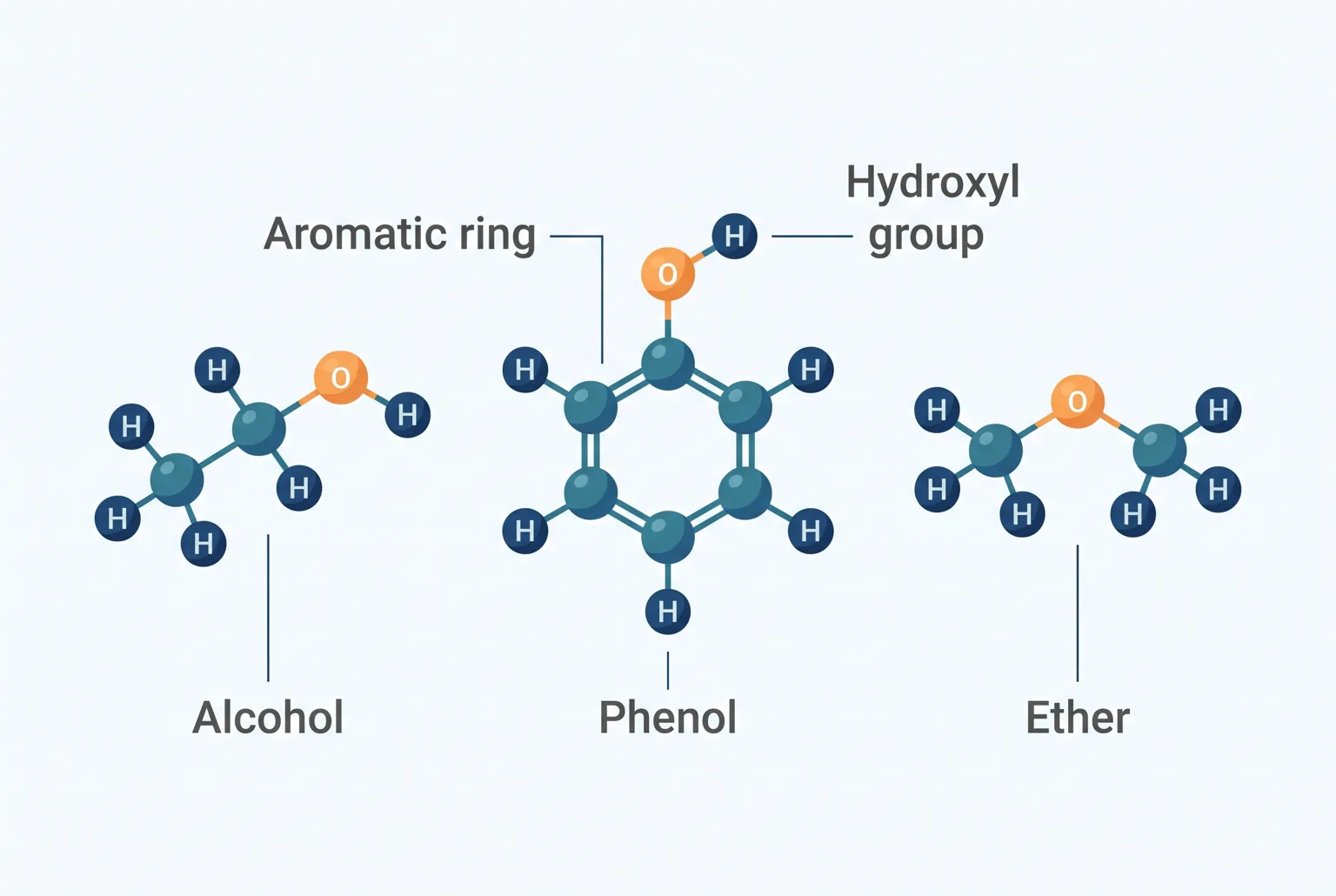
Start with what the oxygen is bonded to
An alcohol has an group bonded to a saturated carbon, while a phenol has it directly attached to an aromatic ring carbon. To classify an alcohol as primary, secondary or tertiary, count the carbon groups attached to the carbon bearing the hydroxyl group. An ether has oxygen bonded to two carbon groups and is symmetrical if those groups are identical.
Alcohols and phenols can donate and accept hydrogen bonds. Ethers have no oxygen–hydrogen bond, so they cannot donate hydrogen bonds to one another, but they can accept them from water. This distinction explains why alcohols generally boil at higher temperatures than ethers of comparable molar mass, even though small ethers can have water solubilities comparable to those of similar alcohols. A larger hydrophobic group generally reduces water solubility.

Alcohols, Phenols and Ethers | Class 12 | NCERT Notes
In the StudentCurio app
Class 12 revision notes cover alcohol preparation, properties and reactions; phenol preparation, acidity and reactions; and ether synthesis, cleavage and anisole reactions. They help students review key concepts, conversions and reactions from the NCERT chapter.
Alcohol preparation: track where OH and carbon go
The notes contrast two ways to turn an alkene into an alcohol. Acid-catalysed hydration usually follows Markovnikov orientation: protonation gives the more stable carbocation, which water attacks. In hydroboration–oxidation, boron adds preferentially to the less substituted carbon. Oxidation replaces the carbon–boron bond with a carbon–oxygen bond, so the overall hydration has anti-Markovnikov orientation.
The carbonyl routes answer a different question: does the reaction add a carbon group? Reduction converts an aldehyde into a primary alcohol or a ketone into a secondary alcohol without adding one. A Grignard reagent, by contrast, adds its carbon group to the carbonyl carbon, and acidic work-up protonates the resulting alkoxide. Methanal gives a primary alcohol, other aldehydes give secondary alcohols, and ketones give tertiary alcohols. The notes also show lithium aluminium hydride reductions of carboxylic acids and esters.
Common mistake: treating every heated alcohol as an oxidation
For a primary alcohol, controlled oxidation with PCC can stop at an aldehyde, whereas a strong oxidant such as acidified permanganate gives a carboxylic acid. Secondary alcohols give ketones. Tertiary alcohols resist mild oxidation, although forcing conditions can break carbon–carbon bonds.
Over copper at , primary and secondary alcohols form aldehydes and ketones, respectively, by dehydrogenation. A tertiary alcohol can instead dehydrate to an alkene if a beta hydrogen is available. Dehydrogenation releases hydrogen; dehydration removes water. That difference helps distinguish the reaction types even when both involve heating.
In the Lucas test, turbidity comes from an insoluble alkyl chloride. For typical simple alcohols at room temperature, tertiary alcohols turn cloudy immediately, secondary alcohols take several minutes, and primary alcohols usually require heating. Read those timings with the test conditions in mind.
Phenol acidity: compare the conjugate bases
The phenol preparation page groups routes from chlorobenzene, a benzenesulfonate, cumene and a diazonium salt. In the cumene route, acetone is formed alongside phenol. In routes that first produce sodium phenoxide, acidification is the step that gives phenol itself.
To understand why phenol is more acidic than ordinary aliphatic alcohols, compare what remains after each loses a proton. In an alkoxide, the negative charge is localised on oxygen. In phenoxide, resonance distributes charge over oxygen and the ortho and para ring carbons. Neutral phenol also has resonance contributors, so the explanation is not simply that phenol has resonance: deprotonation gives a conjugate base that gains more stabilisation. For substituted phenols, the notes distinguish electron-withdrawing nitro groups, which increase acidity, from alkyl groups, which generally decrease it.
Phenol and anisole: separate ring direction from product choice
Phenol’s hydroxyl group and anisole’s methoxy group both donate a lone pair into the aromatic ring. This activates the ring towards electrophilic substitution and favours attack at the ortho and para positions. That shared directing effect does not mean that every reaction stops after one substitution or gives the same product ratio.
The phenol bromination table makes the role of conditions clear. Bromine in carbon disulfide at low temperature gives ortho- and para-bromophenol, with para usually the major product. Bromine water gives a white precipitate of 2,4,6-tribromophenol. The anisole table likewise treats para preference as a trend rather than a fixed ratio. For phenol’s named reactions, distinguish the groups introduced: the Kolbe reaction gives a carboxyl group after acidification, whereas Reimer–Tiemann introduces a formyl group.
When ether formation and cleavage favour substitution
With ethanol and concentrated sulfuric acid, about favours intermolecular dehydration to diethyl ether. At about , ethene is favoured instead. These are conditions for the ethanol example, not a universal temperature rule for all alcohols.
In Williamson synthesis, the alkoxide attacks the carbon bearing the halide by a backside displacement. Methyl and primary alkyl halides are generally better choices because secondary and tertiary halides are more prone to elimination. The important distinction is which group carries the halide, not whether the alkoxide is tertiary.
For ether cleavage with a hydrogen halide, protonation comes first. In a simple unsymmetrical ether reacting by , halide usually attacks the less hindered carbon. A tertiary group can instead cleave through a carbocation pathway. In an aryl alkyl ether, cleavage occurs on the alkyl side, leaving phenol.
Before you move on: track the group that must survive
Use the final conversion page to practise reading a reaction sequence one intermediate at a time. The routes from phenol to salicylaldehyde and benzaldehyde show why the presence of an aldehyde group is not enough to identify the target. Salicylaldehyde retains a hydroxyl group on the ring; in the benzaldehyde route, the phenolic hydroxyl group is removed in the first step. The page also traces a route from phenol to benzenediazonium chloride through aniline.
When reviewing a sequence, mark the functional group that changes at each arrow and the one that must remain in the final product. If a step is unclear, use the index to return to the relevant reaction page. That lets you check why a reagent or work-up is used instead of memorising the whole sequence as a single line.
Spotted an error? Report a correction. Practise this in the app: notes, formula sheets and mind maps.















































































































































Loading comments…