Work, Energy and Power: CBSE Class 11 NCERT Notes Guide
CBSEPhysicsWork, Energy and Power
These CBSE Class 11 Physics notes connect the work done by forces to changes in motion and energy. Use this guide to read force–displacement graphs, choose the right conservation rule and distinguish elastic from inelastic collisions.
How the notes are organised
The Chapter 6 NCERT Notes file opens with a checklist and a clickable index. Its first topic moves from constant and variable forces to conservative forces and friction. The second connects kinetic energy, the work–energy theorem and potential energy. The third brings together power and collisions, and the index points to a chapter summary for a final review.
If you are revising a particular formula, use the index to open the subsection that explains its conditions. For example, if you remember that area gives work but are unsure which area to count, revisit the variable-force graphs rather than the units table. This guide leaves out worked answers and the isolated formula display and claims flagged in the PDF review.

Work, Energy and Power Class 11 Physics | NCERT Theory | Revision Notes
In the StudentCurio app
Comprehensive revision notes covering work-energy theorem, conservative forces, potential energy, and collisions for Class 11 students and JEE aspirants.
Read the sign of work from force and displacement
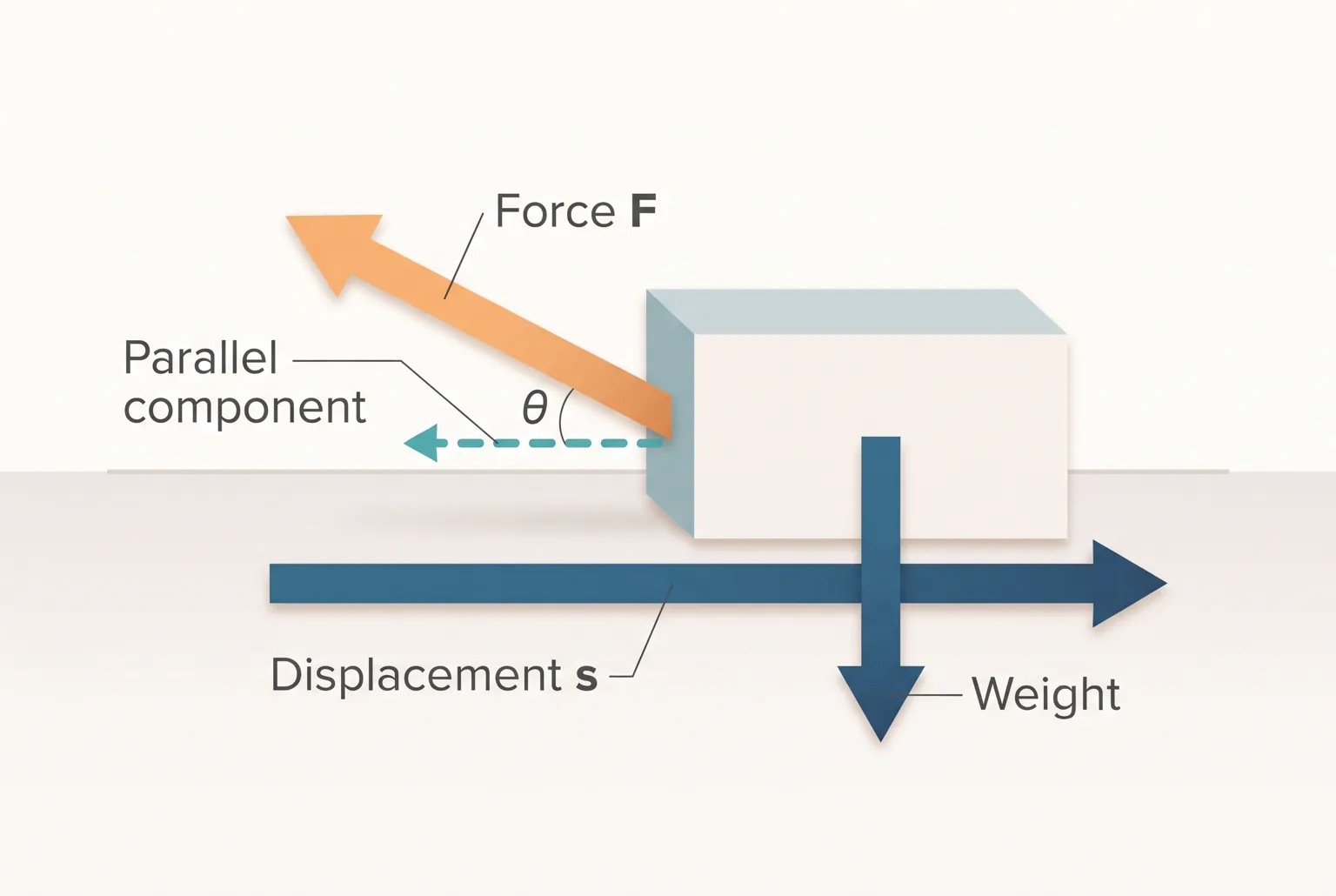
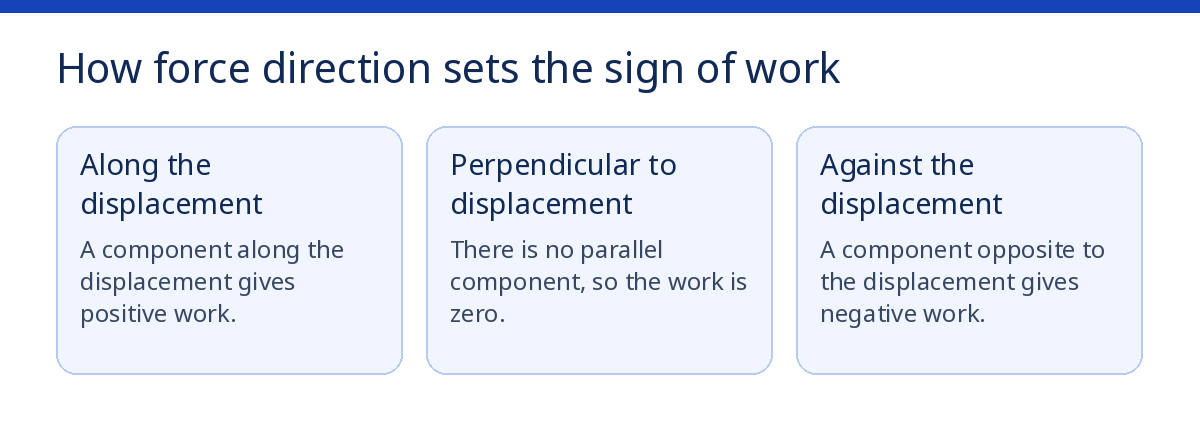
For a constant force, the work done over a displacement is , where is the angle between the force and the displacement. Only the force component parallel to the displacement contributes. A component pointing along the displacement does positive work; one pointing against it does negative work. A perpendicular force does zero work, and so does a force whose point of application does not move.
When you read the notes’ sketches, name the force before assigning the sign. During an upward lift, the lifting force does positive work while gravity does negative work on the same object. Work is a scalar, so these contributions are added with their signs, not as vectors. The SI unit is the joule: .
Common mistake: counting all graph areas as positive
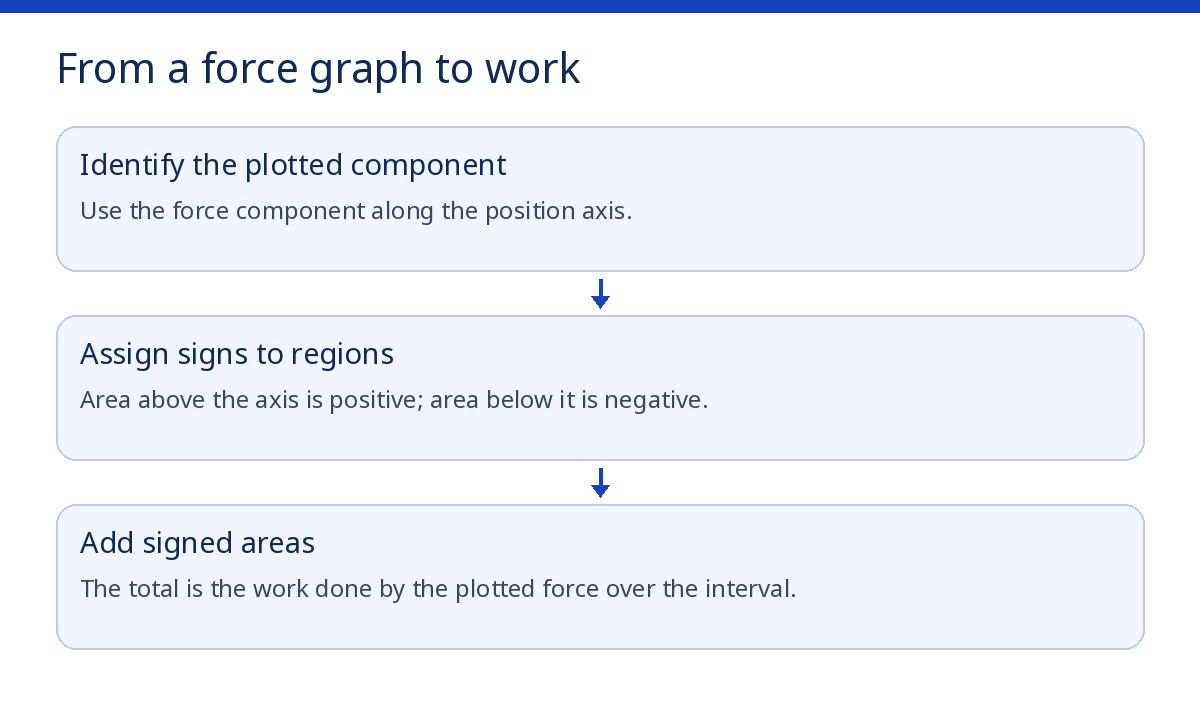
For motion along the x-axis, the notes build up work by dividing the displacement into short intervals. Over each sufficiently small interval, the force component is treated as nearly constant. Adding the contributions and taking the limit gives . This explains why the graph method works even when there is no single force value to multiply by the whole displacement.
When reading the graph from smaller to larger x, count regions above the axis as positive and regions below it as negative. Check which force the curve represents: the area for an applied force gives the work of that force alone. To find net work, include the contributions of the other forces as well.
Use net work to find a change in kinetic energy
For a body treated as a particle, the work–energy theorem states that the net work done on it equals its change in kinetic energy: . The notes cover the theorem for both constant and variable forces. Kinetic energy is , so it is zero at rest and depends on the reference frame in which speed is measured. Use the same frame for the initial and final speeds.
A useful check is to ask whether you know the work of one force or the sum for all forces. Zero net work means the initial and final kinetic energies are equal. It does not mean that every force did zero work, or that the body's direction of motion stayed fixed.
When mechanical energy stays constant
A conservative force does work that depends only on the initial and final positions. Its work around a closed path is therefore zero. The work done by such a force is the negative of the change in its associated potential energy, . The notes develop this link through gravitational and spring potential energy.
Mechanical energy is the sum of kinetic and potential energy. It stays constant when the forces doing work are conservative and their associated potential energies are included. If a block slides on a fixed rough surface, friction can reduce its mechanical energy. That is not a failure of energy conservation: the total energy of an isolated system remains constant, but energy need not remain in mechanical form.
Keep power separate from work and energy
Power tells you how quickly work is done. Average power is the work done divided by the elapsed time, . The same positive amount of work done in less time corresponds to greater average power. The SI unit is the watt, with one watt equal to one joule per second.
The notes also give the conversion . A kilowatt-hour is a unit of energy, not power: multiplying power by time gives an amount of energy. When revising the units, check whether the quantity describes how much energy was transferred or how fast it was transferred.
Quick self-check: what is conserved in a collision?
Begin by identifying the colliding bodies as a system. Their total linear momentum is conserved during the collision if the net external impulse is zero, or can be treated as conserved if that impulse is negligible. In two dimensions, apply this condition to both momentum components. In one dimension, choose a positive direction and keep the signs of the velocities.
Next ask what happens to the system’s total kinetic energy. An elastic collision conserves it; an inelastic collision does not. In a perfectly inelastic collision, the bodies stick together and share a final velocity. Before turning to the indexed sections on restitution and rebounding, check that you can explain why conserving momentum does not, by itself, establish that a collision is elastic.
Spotted an error? Report a correction. Practise this in the app: notes, formula sheets and mind maps.








































Loading comments…