System of Particles and Rotational Motion: Class 11 Assessment
CBSEPhysicsSystem of Particles and Rotational Motion
This CBSE Class 11 Physics assessment pairs topic-wise questions with worked solutions, then brings the chapter together in a mixed practice set. Use it to practise choosing the right principle for problems on centre of mass, torque, equilibrium, moment of inertia and rolling.
How the assessment is organised
The PDF divides the chapter into two topics: Centre of Mass and Rotational Motion and Moment of Inertia and Rolling Motion. Each has a Practice Questions block and a Topical Understanding block, with objective, very short, short and long-answer questions. Chapter Practice adds assertion-and-reason and case-based questions, so you can move from working within a named topic to deciding which concept a question calls for.
The clickable index has separate Questions and Solutions views. Use the topic heading, block name and question number together when switching between them: numbering restarts in different blocks. That matters if you are returning to a question after working through another part of the chapter.

System of Particles and Rotational Motion | Class 11 | CBSE Assessment
In the StudentCurio app
Chapter-wise assessment questions and worked solutions cover centre of mass, torque, angular momentum, moment of inertia, rotational equilibrium and rolling motion. Helps Class 11 students practise conceptual and numerical Physics questions.
Centre of mass: Separate location from motion
The first topic develops two uses of the centre of mass. One is to locate it from the mass distribution. For discrete particles, its position is the mass-weighted average , with every position measured from the same origin. Symmetry can constrain the location when the mass distribution shares that symmetry. The assessment moves between discrete masses, uniform shapes and discs with material removed, so the geometric outline alone is not always enough.
The other use is to describe the translation of the system as a whole. The net external force determines the acceleration of the centre of mass. Internal forces can change how parts move relative to one another, as in a breakup, without changing the total momentum if the net external impulse is zero over the interval. When reading a question, distinguish a request to locate the centre of mass from a request to track its velocity.
Torque and equilibrium: Choose a reference point
The door, balance and supported-beam contexts connect torque with the line of action of a force. The magnitude of torque about a point is the force magnitude times the perpendicular distance from that point to the line of action. The distance to the point of application is not automatically the lever arm. In a planar problem, choose a positive sense for rotation before assigning signs to the moments.
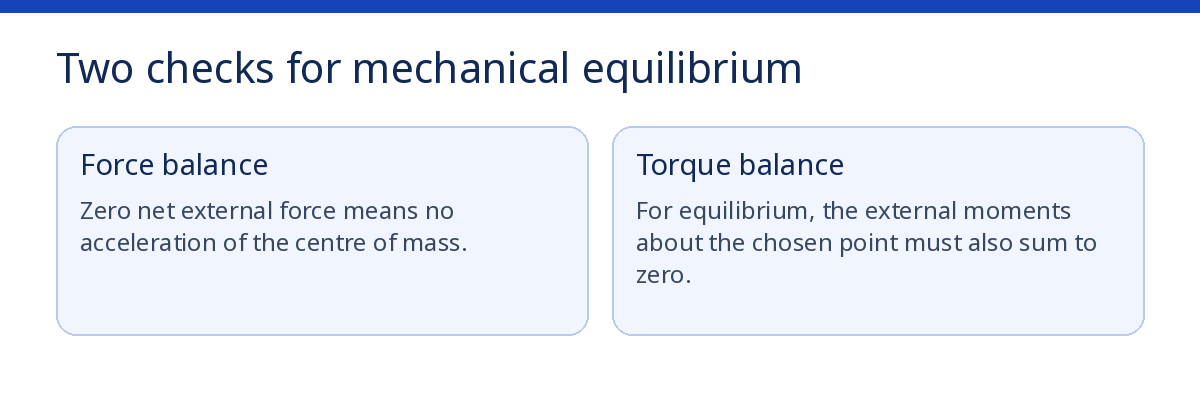
For a rigid body in mechanical equilibrium, both the net external force and the net external torque must vanish. These are separate checks: the force equation governs translation, while the torque equation checks rotational balance. In a support-reaction problem, taking moments about one support can remove its unknown reaction from the torque equation if that reaction’s line of action passes through the chosen point. The reaction still belongs in the force balance.
Common mistake: Conserving angular speed instead of momentum
Angular momentum must be specified about a reference point or axis. For a particle about a point, . A particle does not have to follow a circular path to have angular momentum; what matters is how its momentum is directed relative to its position vector. That distinction helps connect the first topic’s vector questions with its questions about translational motion.
For a chosen fixed axis in an inertial frame, a zero net external torque component along that axis conserves the angular momentum component along it. In fixed-axis rotation, that component is , taking with its sign for the chosen sense of rotation. If the mass distribution changes, angular speed need not stay constant. In the rotating-chair and rotating-table contexts, identify the system and axis before deciding whether to use conservation.
Moment of inertia: Name the axis before using a formula
The second topic compares bodies such as spheres and cylinders and uses moment of inertia in rotational energy and angular momentum questions. For discrete masses, , where each is a perpendicular distance to the chosen axis. This explains why total mass alone does not determine rotational inertia. For a rigid body about a specified axis, changing the rotation speed does not change its moment of inertia.
The cover also lists axis theorems. When using the parallel-axis theorem, check that the reference axis passes through the centre of mass and is parallel to the target axis. The added term is , where is the perpendicular separation between those axes. The theorem does not transfer a value directly between axes that meet at an angle.
When the rolling relation applies
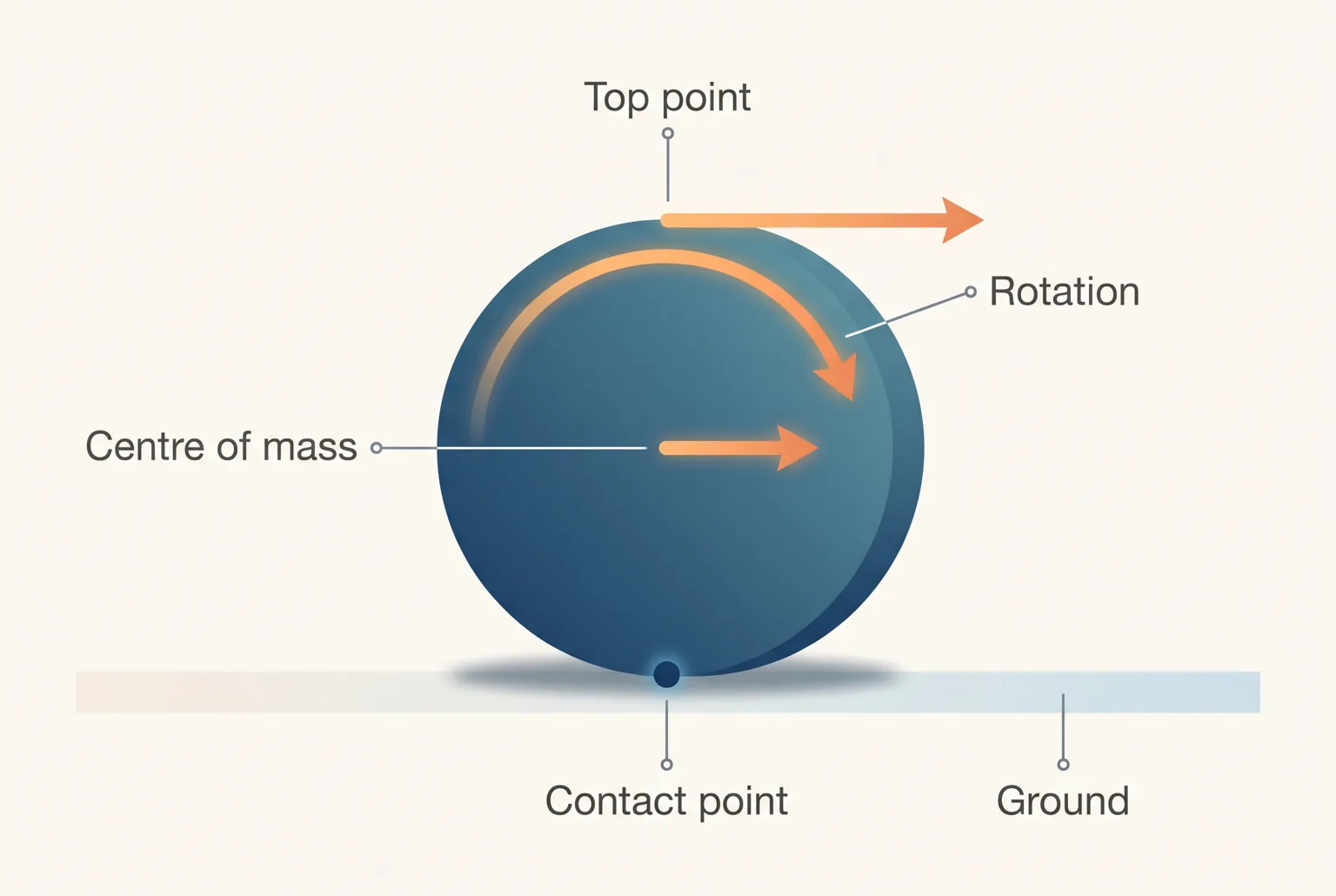
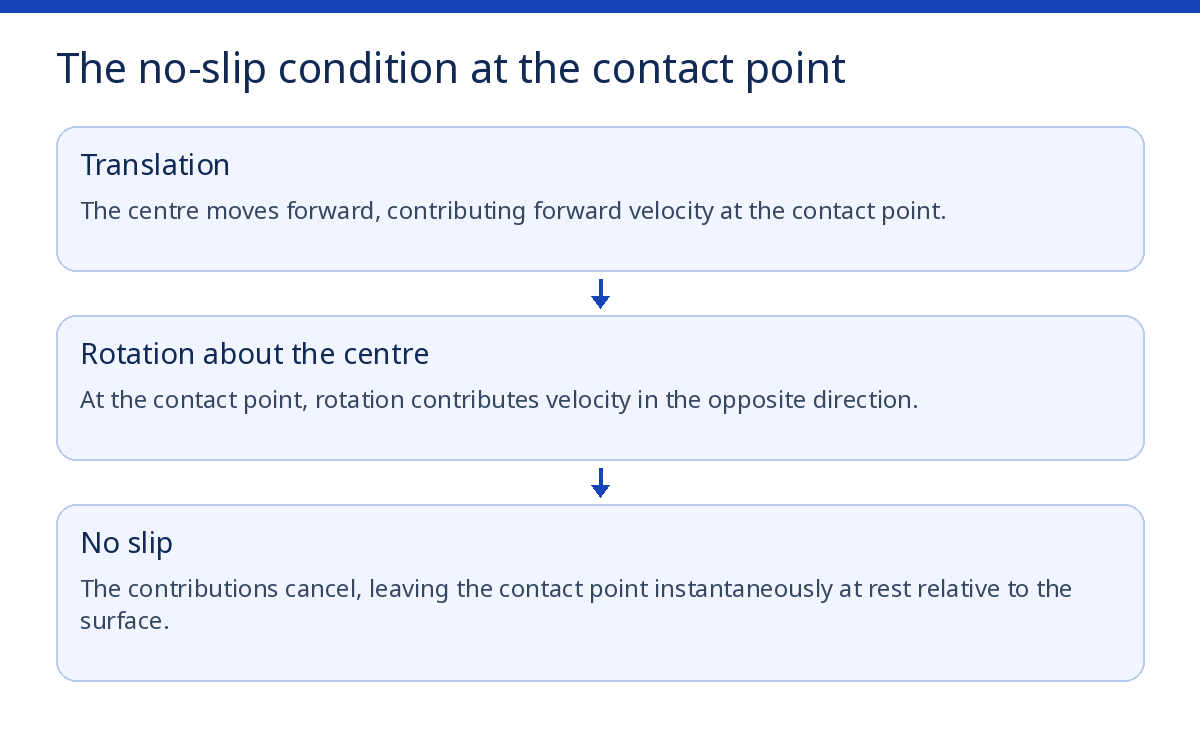
The cover illustrates rolling without slipping on a stationary surface. The contact point is instantaneously at rest relative to that surface, and the centre-of-mass speed satisfies , with the angular speed. To reason about the velocity of a point on the rim, combine the translation of the centre with the point’s rotational velocity relative to the centre.
Do not impose the no-slip relation during a stage when a body is skidding. The practice questions distinguish rolling on an incline from situations in which a disc has yet to reach pure rolling. If static friction is needed to maintain no slip, its required magnitude cannot exceed , where is the normal force. It need not equal that limit unless slipping is impending.
Before opening the worked solution
Write down the decision the question depends on: your system boundary, your moment axis or whether the contact is slipping. Then compare your setup with the corresponding worked solution before checking the arithmetic. For an assertion-and-reason item, judge each statement separately and then ask whether the reason actually explains the assertion. The guide leaves out the unclear rotational-law options on page 5 and the axle-load item on page 8.
Spotted an error? Report a correction. Practise this in the app: notes, formula sheets and mind maps.








































Loading comments…