Class 11 CBSE Physics: Thermodynamics Assessment Guide
CBSEPhysicsThermodynamics
This Class 11 CBSE Physics assessment pairs topic-wise questions with mixed chapter practice and worked solutions. Use it to connect the first law to pressure–volume diagrams, then distinguish energy conservation from the limits the second law places on heat engines.
How the assessment is organised
The file divides the chapter into Heat and First Law of Thermodynamics and Second Law of Thermodynamics. Each topic has separate practice and assessment sets, with objective questions and written responses of different lengths. The chapter practice brings the topics together and adds assertion–reason and case-based questions. That makes it useful for checking whether you can identify the relevant principle without a topic heading to guide you.
The clickable index has separate routes to questions and solutions. Start with the practice set for a topic, then try its assessment set without opening the worked answers. When reviewing, use the Solution link to inspect the reasoning and Back to question to revisit the wording or diagram that determined the method.

Thermodynamics | Class 11 | CBSE Assessment
In the StudentCurio app
This assessment resource provides conceptual, numerical, objective, case-based and written-response questions with worked solutions on heat, work, internal energy, the first law and thermodynamic processes. It also covers the second law, heat engines, refrigerators, Carnot efficiency, and reversible and irreversible processes for Class 11 CBSE students.
From thermal equilibrium to energy accounting
The first topic starts with thermal equilibrium and the zeroth law, which makes temperature a consistent basis for comparing systems. If two systems are each in thermal equilibrium with a third, they are in thermal equilibrium with each other. Thermal equilibrium concerns temperature; it does not by itself establish mechanical equilibrium. The distinction matters when a question switches from thermal equilibrium to the broader idea of thermodynamic equilibrium.
The first law then tracks energy transferred as heat or work. With positive for heat entering the system and positive for work done by the system, write . Fix the system boundary before assigning either sign. In a numerical question, also check that heat and work are in the same energy unit before subtracting. If the quantities are given per second, the balance gives a rate of change of internal energy, not a total energy change.
Read the path before calculating work
Several questions use pressure–volume diagrams to compare routes between equilibrium states or trace a complete cycle. Internal energy is a state function, so its change between the same two states is fixed. Heat and work describe transfers during a process and can differ between routes. This is why knowing the endpoints is enough to compare internal-energy changes, but not enough to calculate work.
For a quasistatic gas process, the work done by the gas is . Follow the arrows before interpreting the area: expansion and compression contribute with opposite signs. For a closed path the enclosed area gives the magnitude of the net work, while the direction gives its sign. The gas returns to its original internal energy after a full cycle, but the heat and work transfers need not vanish.
Common mistake: treating every constraint as zero heat
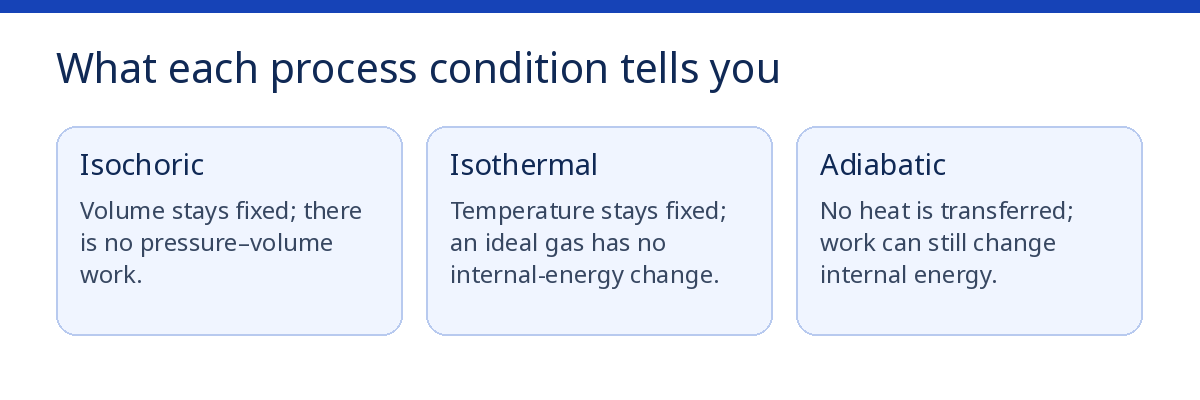
A process label tells you what is held fixed or what transfer is absent. Isochoric means constant volume, so pressure–volume work is zero. Isobaric means constant pressure, which simplifies the work calculation but does not fix the temperature. This also explains why the assessment distinguishes molar heat capacities at constant pressure and constant volume: at constant pressure a gas can expand and do work as it is heated.
Isothermal means constant temperature, not thermal insulation. For an ideal gas, internal energy depends only on temperature, so it does not change in an isothermal process. Adiabatic means no heat transfer, but work can still change the internal energy and temperature. In the assessment's expansion and compression comparisons, identify the process constraint before deciding which term of the first-law balance is known. Do not infer that a process is reversible merely because it is adiabatic.
What the second law adds
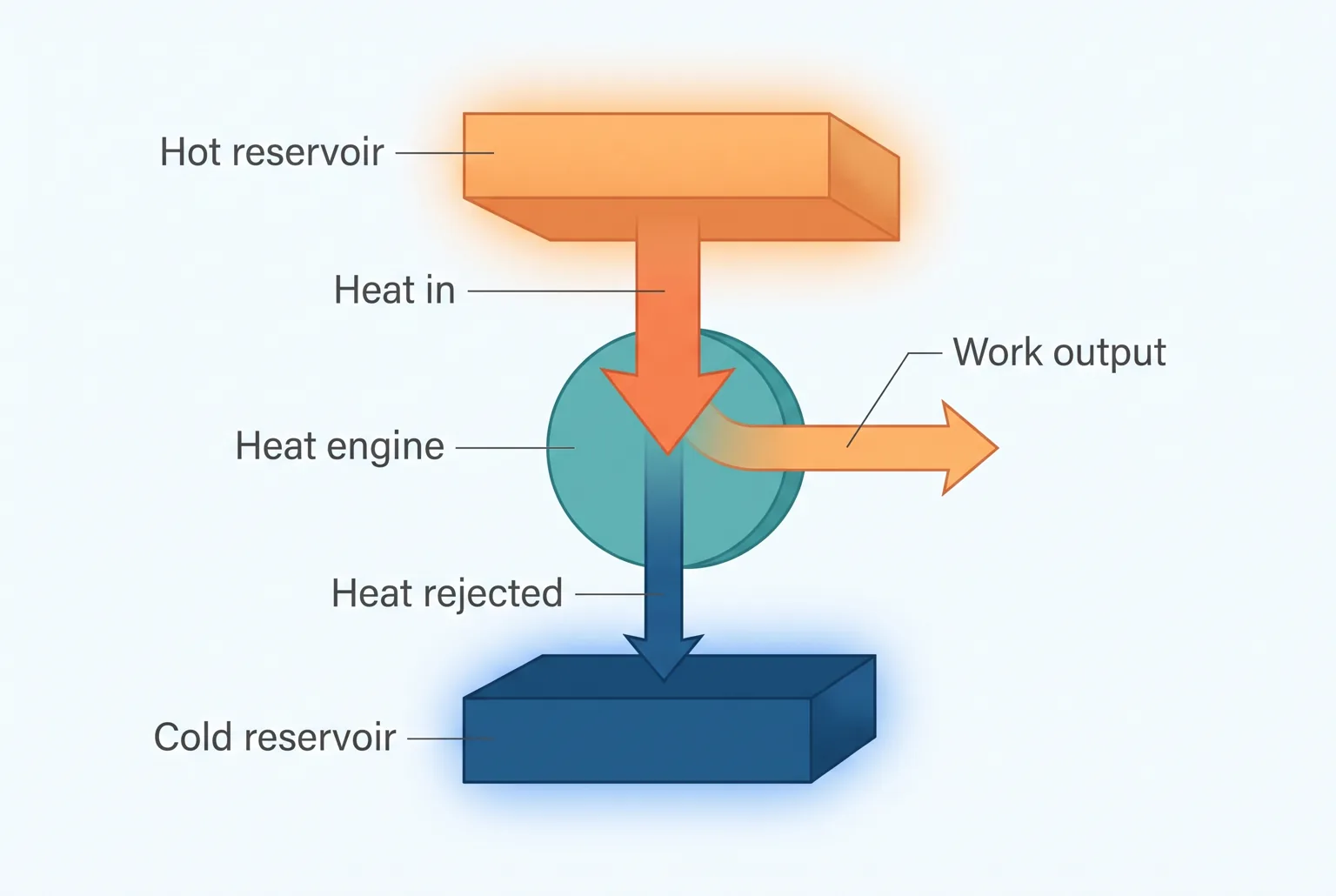
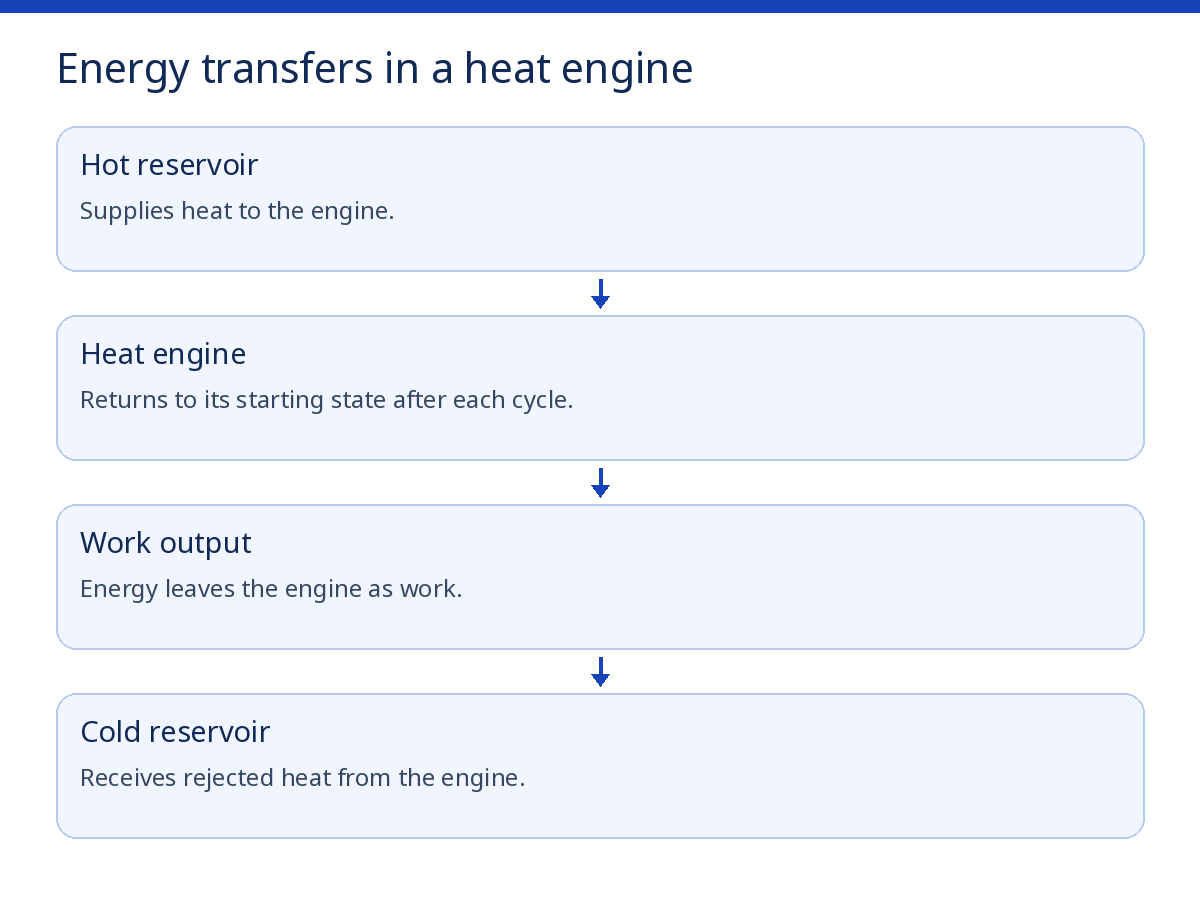
The first law checks whether energy balances; the second law limits what a process can accomplish. Heat does not flow by itself from a colder body to a hotter one. That qualification distinguishes spontaneous heat transfer from refrigeration: a refrigerator uses work input to move heat from a colder region to a warmer one. The heat-engine diagram on the cover shows the other energy-flow pattern: heat enters from a hot reservoir, some energy leaves as work, and the engine rejects heat to a cold reservoir.
Reversibility is central to the second topic. A reversible process is an ideal limit in which both the system and surroundings can be restored without a net change. Being slow is not sufficient: dissipative effects such as friction can make even a slow process irreversible. In written responses, explain what prevents reversal rather than relying only on how fast the process occurs.
When the Carnot formula applies
For a reversible engine operating between a hot reservoir at and a cold reservoir at , with , the Carnot efficiency is . Use kelvin for both temperatures: a ratio of Celsius readings is not a ratio of absolute temperatures. The result depends on the reservoir temperatures, not on the choice of working substance, and sets an upper bound for an engine operating between those reservoirs.
The assessment asks learners to distinguish that bound from actual efficiency. When heat transfers are given, compare work output with heat absorbed from the hot reservoir, not with the heat rejected. Use a consistent energy unit for the two quantities in that ratio.
Before you check the worked solution
In chapter practice, write down why a rule applies before substituting values. For a graph question, label the axes and direction; for an assertion–reason item, judge each statement separately before deciding whether the reason explains the assertion. For a case-based or longer response, separate facts given in the prompt from assumptions needed for the model. When you open the solution, look for the first point where its reasoning differs from yours. A mismatch in the process constraint or sign convention is more useful to identify than a mismatch in the final number alone.
Spotted an error? Report a correction. Practise this in the app: notes, formula sheets and mind maps.








































Loading comments…