Understanding Wave Mechanics in Class 11 CBSE Case-Based Problems
CBSEPhysicsWaves and Sounds
Explore complex wave behavior, resonance in strings and pipes, and mathematical propagation models through this StudentCurio assessment for Class 11 Physics.
Overview of the Case-Based Assessment Structure
This StudentCurio resource for CBSE Class 11 Physics focuses on Chapter 14: Waves. It is designed as a case-based assessment, a format that requires learners to apply theoretical principles to specific physical scenarios. The material is organized into four distinct case studies, encompassing a total of 16 subquestions. These include multiple-choice questions (MCQs), assertion-reasoning tasks, and short-answer qualitative explanations.
The resource provides a integrated learning experience where questions are presented first, followed by comprehensive, step-by-step solutions. A notable feature of this file is the clickable index and cross-linking between questions and answers, allowing students to verify their logic immediately after attempting a problem. By addressing water waves, pulses on cords, sonometer resonance, and organ pipe harmonics, the material ensures coverage of both transverse and longitudinal wave phenomena as outlined in the NCERT curriculum.

Waves Class 11 |Physics | CBSE Case Based Assessment
In the StudentCurio app
Comprehensive case-study questions and step-by-step solutions for Class 11 Physics, covering sonometer resonance, organ pipes, and standing wave harmonics.
Wave Speed and Medium Elasticity in Water Waves
The first case study challenges the common simplification that water waves are purely transverse. The material explains that surface water waves are more accurately described as a combination of transverse and longitudinal motions. When an object floats on water, it bobs vertically and moves to-and-fro horizontally, indicating that particles follow a circular or elliptical path. For these waves, frequency and wavelength remain consistent across both components, while amplitudes may differ.
Learners are introduced to the fundamental wave relation . For instance, if the distance between crests (wavelength) is and the wave speed is , the frequency is determined to be approximately . Furthermore, the material explores the speed of longitudinal waves in bulk water, defined by the relation , where is the Bulk modulus and is the density. This section serves to bridge the gap between observed wave speed and the intrinsic elastic properties of the medium, such as water's density of and its resulting Bulk modulus of .
Propagation and Energy Dynamics of Pulses on a Cord
Case Study 2 focuses on the mechanical propagation of a pulse along a cord under tension. A critical distinction is made between the motion of the wave and the motion of the medium's particles. In a transverse pulse, cord molecules move up and down, perpendicular to the direction of propagation. The molecules themselves do not travel down the cord; rather, the pulse shape travels as successive groups of molecules respond to the tension and inertia of their neighbors.
The resource explains that this phenomenon is a transfer of energy. The moving molecules possess transverse kinetic energy, and the momentary stretching or bending of the cord stores elastic potential energy. As long as the tension is constant and the amplitudes are relatively small, all pulse shapes travel at the same constant speed , where is the mass per unit length. This speed remains independent of the pulse's specific geometry, though thermal losses may cause a slight decrease in size over long distances.
Resonance and Sound Applications in Strings and Ultrasound
The sonometer and ultrasound scanner provide practical applications of wave theory in Case Study 3. A sonometer demonstrates the relationship between the frequency of a vibrating string and its length, tension, and linear mass density. The resource provides a mathematical framework for resonance in the -th mode, denoted by . It highlights how changing one variable, such as doubling the vibrating length , directly alters the harmonic number required to maintain resonance with a fixed frequency source like a tuning fork.
Additionally, the design of tuning forks is examined. The two-prong structure is not arbitrary; the prongs are mechanically coupled and vibrate in opposite directions. This motion reduces the energy lost through the stem to the support, allowing the fork to sustain its vibration. In the context of medical technology, the resource applies the wave speed equation to ultrasonic scanners. By knowing the speed of sound in human tissue (e.g., ) and the operating frequency of the scanner (e.g., ), students can calculate the wavelength of the ultrasound waves used to locate tumors.
Stationary Waves and Harmonics in Organ Pipes
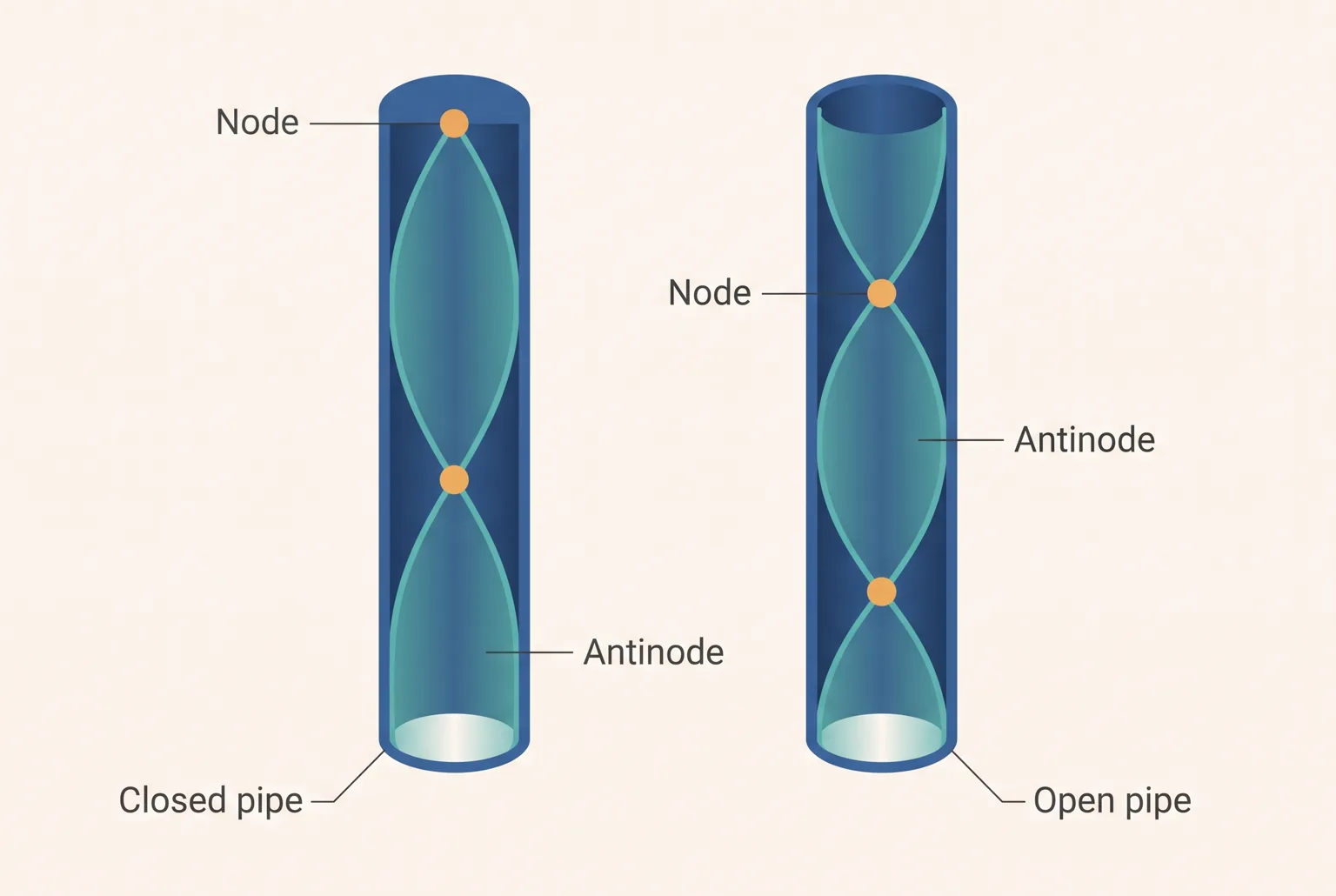
The final case study explores longitudinal stationary waves formed by the superposition of incident and reflected waves in organ pipes. The resource distinguishes between open pipes (open at both ends) and closed pipes (closed at one end). A closed pipe of length supports only odd harmonics, with a fundamental frequency of . Its first overtone is the third harmonic (). Conversely, an open pipe supports all integer harmonics, with its first overtone being the second harmonic ().
A central exercise in this section requires comparing the lengths of open and closed pipes when their first overtones are identical. By setting the frequency equations equal, students can derive that the ratio of the closed-pipe length to the open-pipe length must be . The material also clarifies the nature of standing wave equations, emphasizing that displacement nodes (N) and antinodes (A) are determined by the boundary conditions of the pipe.
Environmental Factors and Pitch Variation
The assessment concludes by analyzing how physical changes to a resonant cavity affect pitch. A common real-world example is filling a bucket with water. As the water level rises, the length of the air column above it decreases. Since frequency is inversely proportional to length (), the resonance frequency—and thus the pitch of the sound—increases. This corrects the common misconception that filling a container lowers the pitch.
The resource also examines the role of the medium's molar mass. The speed of sound in a gas is related to its molar mass by . Because hydrogen has a much lower molar mass than air, the speed of sound in hydrogen is significantly higher. Consequently, replacing the air in a resonance tube with hydrogen will increase its fundamental frequency. This section reinforces the idea that resonance is a dynamic property determined by both the geometry of the container and the specific physical properties of the gas or liquid within it.
Frequently asked questions
How does the amplitude of a spherical progressive wave change with distance?
For a source radiating power uniformly in a lossless medium, the intensity is inversely proportional to the square of the distance (). Since amplitude is proportional to the square root of intensity, the displacement amplitude decreases inversely with distance ().
What is the difference between a pulse's travel and particle motion on a cord?
The pulse travels horizontally along the cord at a constant speed determined by tension and mass density. However, the actual molecules of the cord only move vertically (transversely). The pulse represents the transport of energy, while the matter stays in its local equilibrium area.
Why does a closed pipe have different overtones than an open pipe?
Boundary conditions dictate the possible wavelengths. A closed pipe has a node at the closed end and an antinode at the open end, which limits it to odd harmonics (). An open pipe has antinodes at both ends, allowing for all integer harmonics ().
Spotted an error? Report a correction. Practise this in the app: notes, formula sheets and mind maps.








































Loading comments…