Class 11 Physics Guide to Thermodynamics and Case-Based Analysis
CBSEPhysicsThermodynamics
A comprehensive analysis of thermodynamic laws, heat transfer mechanisms, and Carnot engine efficiency based on CBSE case-study assessments.
The Framework of Thermodynamic Case Studies
Thermodynamics in the Class 11 CBSE curriculum shifts the focus from purely theoretical formulas to the application of energy principles in physical systems. This resource utilizes four distinct case studies to explore how internal energy, heat, and work interact. By isolating a specific portion of the universe—defined as the system—from its surroundings, learners can apply the laws of conservation to solve complex problems. The material covers essential topics including the First Law of Thermodynamics, specific heat capacities, the mechanics of heat transfer, and the theoretical limits of heat engines through the Carnot cycle. Understanding these concepts is vital for mastering how energy transitions between different forms, such as thermal energy converting into mechanical work.

Thermodynamics Class 11 Physics | CBSE Case Based Assessment
In the StudentCurio app
This resource provides case-based assessment questions and detailed solutions for Class 11 Physics, covering the first and second laws of thermodynamics, Carnot engine efficiency, and thermodynamic processes.
Energy Conservation and the First Law
The First Law of Thermodynamics is a fundamental statement of the conservation of energy. It posits that energy in the universe remains constant and can only be transferred or converted, never created or destroyed. In practical terms, when heat is supplied to a system, it is partitioned into two effects: an increase in the system's internal energy and the performance of external work by the system. This relationship is expressed as . The internal energy represents the stored energy within the system, often influenced by the vibrational or translational movement of molecules. This resource emphasizes the importance of sign conventions, where heat absorbed by the system and work done by the system are typically treated as positive values in standard energy balance equations.
Practical Cooling and Refrigeration Logic
A common misconception addressed in this material is the effect of leaving a refrigerator door open to cool a room. Thermodynamically, a refrigerator acts as a heat pump that rejects heat into the kitchen air. When the door is left open, the machine draws energy from the room air, processes it through the refrigeration cycle, and releases it back into the same room. Crucially, the electrical work required to run the compressor also converts into heat. Therefore, the net effect of an open refrigerator is actually to warm the room rather than cool it. In contrast, an ice chest effectively cools a room because the ice absorbs latent heat from the air as it melts, removing energy from the surroundings without the addition of external electrical work that would otherwise dissipate as heat.
Phase Transitions and Critical Temperature
The liquefaction of gases is not solely dependent on the application of high pressure. This resource clarifies that every gas possesses a specific 'critical temperature' denoted as . Above this temperature, the vibrational energy of the molecules is so high that no amount of pressure can force the substance into a liquid phase. A gas can only be liquefied through pressure alone if its current temperature is already below its critical threshold. This distinction is vital for understanding the limits of phase transitions and the behavior of real gases under varying thermal conditions. It challenges the simplistic view that increasing pressure always leads to a denser state of matter, highlighting the dominant role of thermal energy at the molecular level.
Mechanisms of Heat Transfer
Heat transfer occurs through three primary methods: conduction, convection, and radiation. Conduction is the dominant process in solids, where energy is passed through molecular contact. This explains why metals, which have high thermal conductivity, feel colder to the touch than wood on a frosty morning; they conduct heat away from the skin much faster, even if both materials are at the same ambient temperature. Convection, meanwhile, occurs in fluids (liquids and gases) and is often driven by gravity. In natural convection, heated fluid becomes less dense and rises, while cooler, denser fluid sinks, creating a circulation pattern. Radiation is unique because it requires no material medium, allowing solar energy to travel through the vacuum of space at the speed of light to reach Earth.
Thermal Conductivity in Composite Slabs
Analyzing heat flow through composite materials requires an understanding of equivalent thermal conductivity. This resource provides a derivation for slabs arranged in series. When two materials of the same thickness but different conductivities and are placed back-to-back, the heat transfer rate through each layer must be equal at a steady state. By calculating the temperature drop across each section and relating it to the total temperature difference, learners can find the equivalent conductivity . For two layers of equal thickness in series, the formula is . This calculation assumes negligible contact resistance at the interface and consistent cross-sectional area, illustrating how material properties combine to resist or facilitate heat flow.
The Carnot Engine and Absolute Efficiency
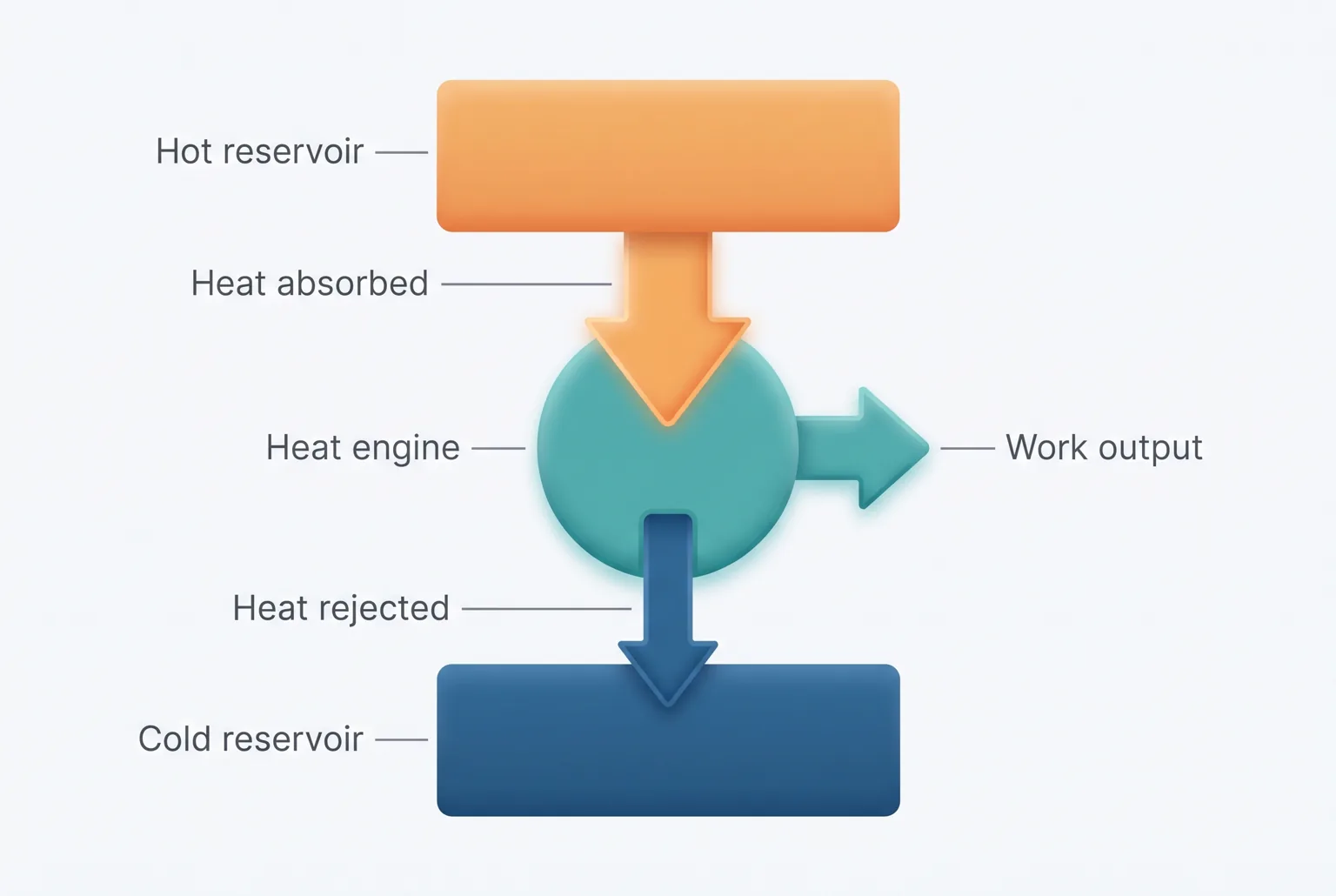
The Carnot cycle is a theoretical model that defines the maximum possible efficiency for any heat engine operating between two temperatures. It consists of four reversible processes: two isothermal and two adiabatic. A significant result of Carnot's work is that the efficiency of such an engine depends solely on the absolute temperatures of the hot reservoir and the cold reservoir . The efficiency is calculated as . This highlights that efficiency is independent of the working substance used in the engine. Furthermore, the area enclosed by the Carnot cycle on a pressure-volume () diagram represents the net work done by the system. This resource underscores that efficiency is physically unattainable because it would require a cold reservoir at absolute zero (), which is impossible to reach.
Comparing Thermodynamic Processes
A critical skill in thermodynamics is distinguishing between isothermal and adiabatic processes. In an isothermal process, the temperature remains constant, and the relationship between pressure and volume follows . In a reversible adiabatic process, no heat is exchanged with the surroundings, leading to the relationship , where is the ratio of specific heats (). Because is always greater than one, the slope of an adiabatic curve on a diagram is steeper than that of an isothermal curve at any given point. This difference is essential for visualizing cycles and calculating the work performed during expansions or compressions. The resource provides the mathematical basis for these slopes, helping learners identify process types by their graphical representations.
Frequently asked questions
Can a gas be liquefied at any temperature by increasing pressure?
No. A gas can only be liquefied by pressure if its temperature is below its specific critical temperature (). Above this point, pressure alone cannot induce a phase transition to a liquid.
Why does natural convection depend on gravity?
Natural convection relies on buoyancy. When a fluid is heated, it expands and becomes less dense. Gravity causes the heavier, cooler fluid to sink and the lighter, warmer fluid to rise, creating the circulation necessary for convection.
What determines the efficiency of a Carnot engine?
The efficiency depends only on the absolute temperatures of the source (hot reservoir) and the sink (cold reservoir). It does not depend on the nature of the working substance used in the engine.
What does the area enclosed by a Carnot cycle represent on a P-V diagram?
The area enclosed by the cycle represents the net amount of external work done by the system during one complete cycle.
Spotted an error? Report a correction. Practise this in the app: notes, formula sheets and mind maps.








































Loading comments…