Mechanical Properties of Solids: Class 11 Case Assessment
CBSEPhysicsMechanical Properties of Solids
This CBSE Class 11 Physics assessment uses two case studies to test how you distinguish material stiffness, wire extension, elastic work and load capacity. The PDF contains eight subquestions, followed by worked solutions linked from the questions and the index.
What the two case studies cover
The first case study, Young’s modulus and stiffness, compares wires under tension and asks you to distinguish a property of the material from the behaviour of a particular wire. It moves from a comparison of wire dimensions to a discussion of the properties that matter in a spring. These short-answer prompts call for an explanation, not just a statement that one specimen is harder to stretch.
The second case study, Elastic behaviour of wires, starts with the example of a crane lifting a load using a thick metal rope. Its multiple-choice and assertion–reason prompts cover work done in stretching, a change in interatomic spacing, ideal rigidity, load capacity and extension. Although most examples involve wires, the questions ask about different physical quantities. A calculation about how far a wire stretches is not necessarily a calculation about how much load it can support.

Mechanical Properties of Solids Class 11 |Physics | CBSE Case Based Assessment
In the StudentCurio app
Case-based assessment covering Young's modulus, elastic behavior, and work done in stretching wires for Class 11 Physics, including MCQs and assertion-reason questions with solutions.
When the Young’s modulus relation applies
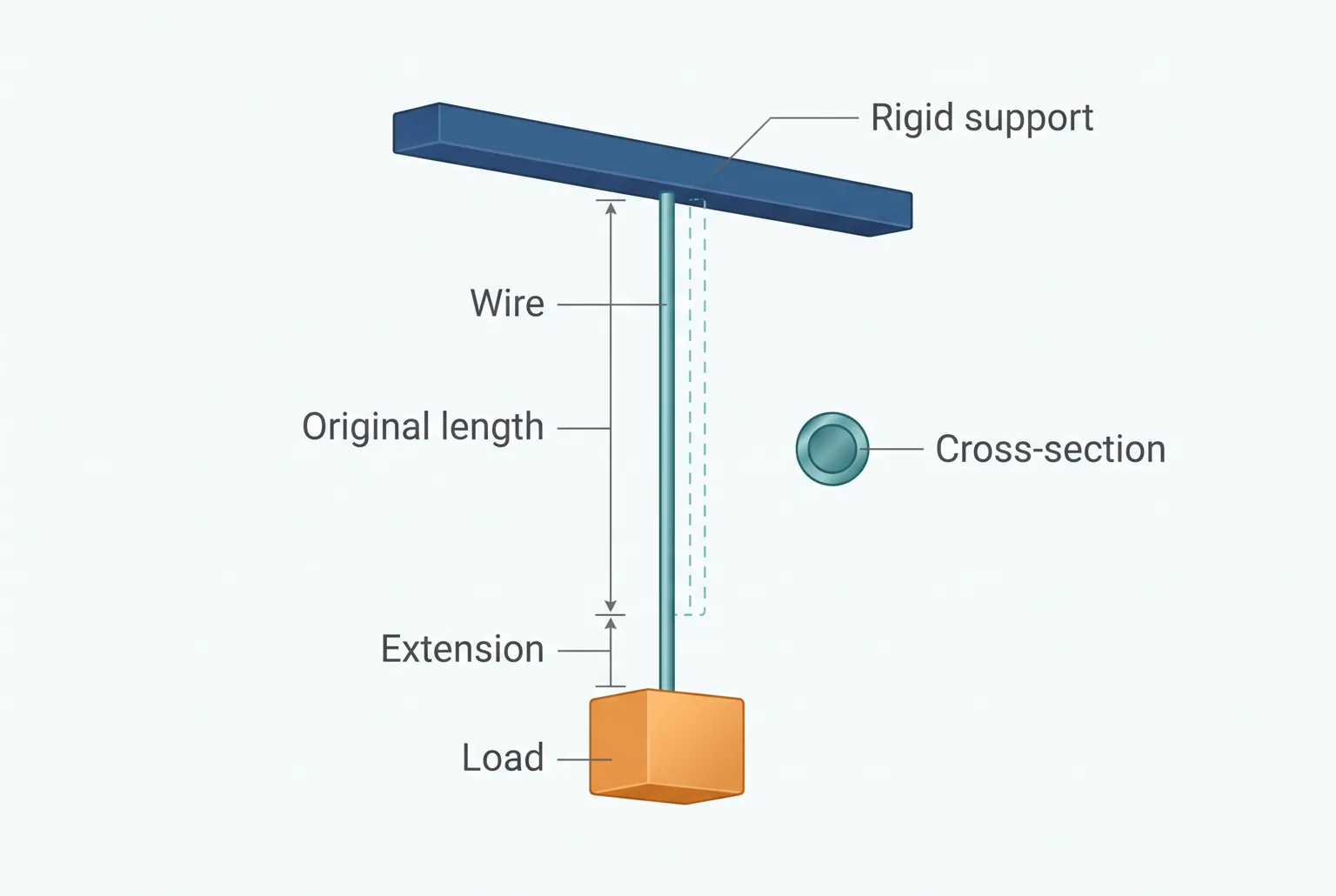
For a wire under an axial tensile force , longitudinal stress is , where is the cross-sectional area. Longitudinal strain is , where is the extension and is the original length. Stress is measured in pascals, equivalent to newtons per square metre. Strain is dimensionless because it compares two lengths expressed in the same unit.
Young’s modulus is the ratio of longitudinal stress to longitudinal strain in the linear elastic region. The word elastic describes recovery after unloading, while linear describes proportionality between stress and strain. The distinction matters because recovery alone does not justify treating stress and strain as proportional throughout a deformation. Check that the linear model applies before using one constant value of to relate the two.
Common mistake: confusing material and specimen
Young’s modulus describes a material under specified physical conditions. The stiffness of a wire as a whole describes its resistance to extension and also depends on its dimensions. When comparing two wires, separate what is given about the material from what is given about the specimen. The assessment includes one comparison in which original lengths are equal and another in which they are not, so the same cancellation cannot be assumed in both.
Another point to check is whether the question gives an area or a diameter. In a circular wire, diameter is a length, while cross-sectional area scales with the square of that length. This distinction also helps when reading the spring prompt: how easily an object stretches is not a complete description of how it would perform as a spring. The solution note qualifies the prompt’s absolute wording about rubber and brings geometry as well as material properties into the comparison.
Read elastic work from the force–extension graph
The work question concerns a wire stretched gradually from its unstretched state within the linear elastic region. During that process, the applied force changes as the extension increases. The force at the final extension is therefore not the force applied throughout the stretch. Treating it as constant would give the wrong area on the graph.
Place extension on the horizontal axis and applied force on the vertical axis. The work done during stretching is the area under this curve over the extension interval. The linear model fixes the shape of the curve for this question. The graph interpretation is more general: if the force does not vary linearly, work is still the area under the actual curve, but a straight-line approximation is not automatically valid.
Distinguish a load from a stress limit
The crane example gives a practical reason to distinguish load from stress. A tensile load is a force; the stress it produces depends on the cross-sectional area carrying that force. A material limit stated as a stress cannot be compared directly with a load in newtons. Relating the two requires the area, or, when selecting an area, both the intended load and the allowable stress.
Read the elastic limit and the breaking condition as separate ideas. The elastic limit concerns whether the material recovers on unloading; the breaking condition concerns failure. The worked notes also distinguish a load that a wire can support from a load identified as its capacity. A statement about one supported load does not, by itself, specify the force at which the wire would break.
Quick self-check before opening the solutions
Use the clickable index to open a question and attempt it before following its solution link. For a wire comparison, can you list which quantities are held fixed before you write a ratio? For the assertion–reason item, decide whether each statement holds in the ideal rigid-body model. Then check the explanatory link separately: judging two statements to be true is not the same as judging one to explain the other.
For the interatomic-spacing item, check the units before substituting. The PDF flags a malformed modulus unit and an unclear stress exponent in the stem, and the worked solution states the values it assumes. Read that explanation as conditional on those values, rather than treating the printed data as unambiguous. After comparing your reasoning with the worked notes, use the back links to return to the original prompts.
Spotted an error? Report a correction. Practise this in the app: notes, formula sheets and mind maps.








































Loading comments…