Mechanical Properties of Solids: Class 11 NCERT Notes
CBSEPhysicsMechanical Properties of Solids
These CBSE Class 11 Physics notes explain how solids deform under a load and what happens when that load is removed. Use the diagrams and stress–strain curve to connect each type of loading with the right strain and elastic modulus.
Elasticity starts with what happens after unloading
A solid can have a definite shape and volume and still deform when stretched, compressed, bent or twisted. The notes begin by distinguishing elastic deformation, which is reversed when the load is removed, from plastic deformation, which leaves a permanent change. A stretched spring illustrates elastic recovery if it has been kept within its elastic limit. The test is not how far the spring stretches while loaded, but whether it returns to its original dimensions after unloading.
The spring–ball model gives a microscopic explanation. The balls represent atoms, and the springs represent interactions between them. Deformation shifts atoms away from their equilibrium positions. The resulting restoring forces tend to bring them back. Read this as a model of why a solid resists deformation, not as a literal picture of springs inside it.

Mechanical Properties of Solids Class 11 |Physics | NCERT Theory | Revision Notes
In the StudentCurio app
Comprehensive revision notes covering stress, strain, Hooke's law, and elastic moduli. Designed for Class 11 CBSE students and JEE/NEET aspirants.
Match each load to the change it produces
Stress measures internal restoring force per unit area. In the notes’ rod diagrams, the magnitude of the longitudinal stress is , where is the magnitude of the force at one end and is the cross-sectional area. Its SI unit is the pascal, or newton per square metre. Strain instead measures relative deformation and has no unit. The same loading diagram can therefore give you two different pieces of information: how the force is distributed and how much the body deforms relative to its original dimensions.
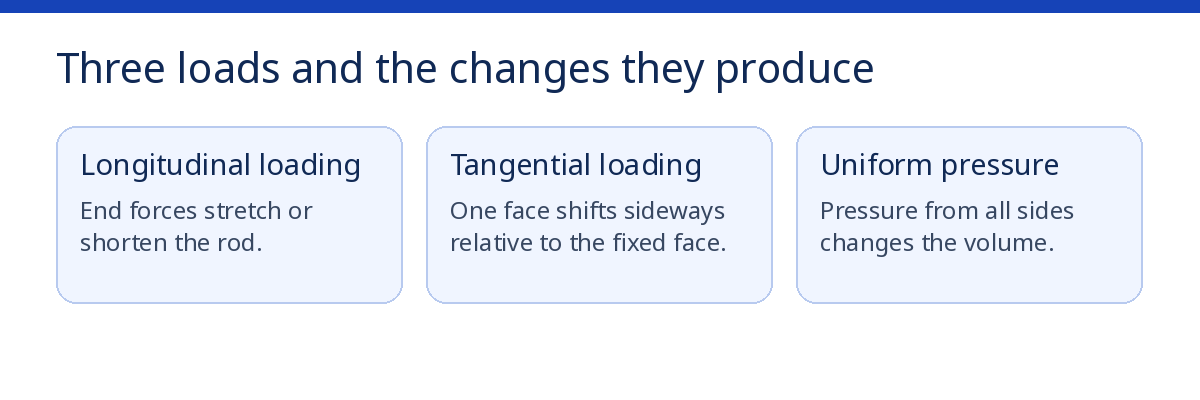
- Longitudinal loading: Pulling along a rod produces tensile stress; pushing along it produces compressive stress. The corresponding strain is the change in length divided by the original length, .
- Shear loading: In the notes’ block model, a tangential force shifts one face sideways relative to the fixed face. The shear strain is the sideways displacement divided by the separation of the faces, equal to in the geometry shown. For a small angle, this is approximately in radians.
- Bulk loading: Uniform pressure acts normally over the surface. The notes illustrate a change in volume rather than shape, measured by the volumetric strain .
Common mix-ups: net force, area and signs
A rod can be in equilibrium and still change length. The forces at its ends are equal and opposite, so the net force is zero, but the stress is not. When reading the wire examples, check that the area in the stress calculation is the cross section, not the curved surface of the wire. For a circular wire, the cross-sectional area is ; if the given measurement is a diameter, halve it before squaring.
Also check whether a solution uses a signed change or its magnitude. With volume change defined as final minus initial volume, compression gives a negative volumetric strain. A positive number can describe the magnitude of that decrease, but it is not the signed strain. In the notes’ cube example, the reported magnitude also uses a small-strain approximation; the accompanying clarification distinguishes it from the exact fractional change.
Where Hooke’s law applies on the curve
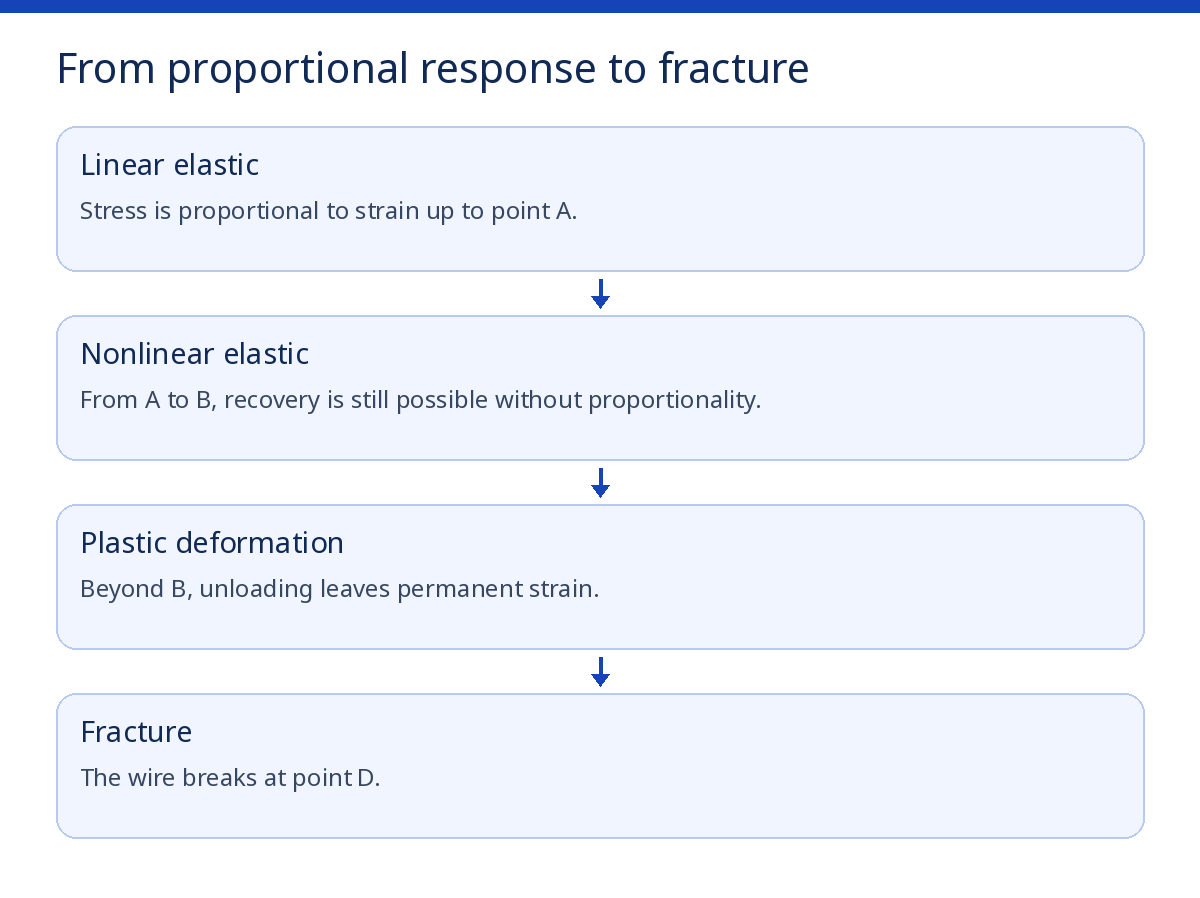
On the wire’s stress–strain curve, stress is on the vertical axis and strain is on the horizontal axis. From the origin to point A, the graph is straight and the two quantities are proportional. This is the region where Hooke’s law applies, and its slope gives Young’s modulus for the longitudinal loading shown.
The diagram separates the proportional limit at A from the elastic limit at B. Between them, the wire can still recover its original length on unloading even though stress and strain are no longer directly proportional. Beyond B, unloading leaves a residual strain at zero stress, called a permanent set. The curve eventually reaches fracture. The notes use a ductile material to show why yielding and breaking are not the same event: appreciable plastic extension can occur before the material snaps.
Choose the modulus from the deformation
The index groups the elastic moduli by the response they describe. Young’s modulus relates longitudinal stress to longitudinal strain. Shear modulus, also called the modulus of rigidity, relates tangential stress to shear strain. Bulk modulus relates a pressure increase to the resulting fractional decrease in volume. In each case, the modulus describes resistance to the corresponding deformation in the linear elastic range. Since strain is dimensionless, all three moduli have the same SI unit as stress.
The later entries also point to the determination of Young’s modulus for a wire, Poisson’s ratio, energy stored in a deformed body and applications of elastic behaviour. Use those entries to locate follow-up reading after you can identify the loading and deformation in the earlier diagrams.
Quick self-check with the notes
Use the chapter checklist to pick a topic, then use the clickable index to find its diagram or worked example. Before reading the calculation, identify the loaded surface, name the stress, and decide which original dimension belongs in the strain denominator. On the wire graph, ask yourself what the shape of the curve tells you about proportionality and what unloading tells you about recovery. Those are separate tests.
This guide leaves out the collision calculation, the conflicting quartz classifications and the page 13 equivalence between fracture stress and ultimate tensile strength. For revision, rely on the loading diagrams and the clearly distinguished stages of the wire curve rather than those isolated passages.
Spotted an error? Report a correction. Practise this in the app: notes, formula sheets and mind maps.








































Loading comments…