Waves and Sound: Class 11 Physics NCERT Notes Guide
CBSEPhysicsWaves and Sounds
These CBSE Class 11 Physics notes explain how disturbances travel, how to read a wave equation, and how overlapping waves produce standing patterns and beats. Use this guide to connect the diagrams, formulas and worked examples in the NCERT notes.
What travels when a wave moves?
Start with the notes’ connected-spring model. When the first spring is disturbed, its restoring force brings it back toward equilibrium and disturbs the next spring. The disturbance moves along the chain, but each spring oscillates about its own equilibrium position. This is the key distinction in mechanical wave motion: energy travels through the medium without the medium moving along with the disturbance as a whole.
The notes distinguish mechanical waves, which need a material medium, from electromagnetic waves, which can travel through a vacuum. They also introduce matter waves as waves associated with moving particles. For the sound and string sections, the mechanical-wave model is the one to carry forward: the medium’s inertia and elasticity help determine how a disturbance propagates.

Waves Class 11 Physics | NCERT Theory | Revision Notes
In the StudentCurio app
Comprehensive revision notes for Class 11 Physics covering wave motion, speed of sound, superposition principle, standing waves, and beats.
Compare sound in air with a wave on a string
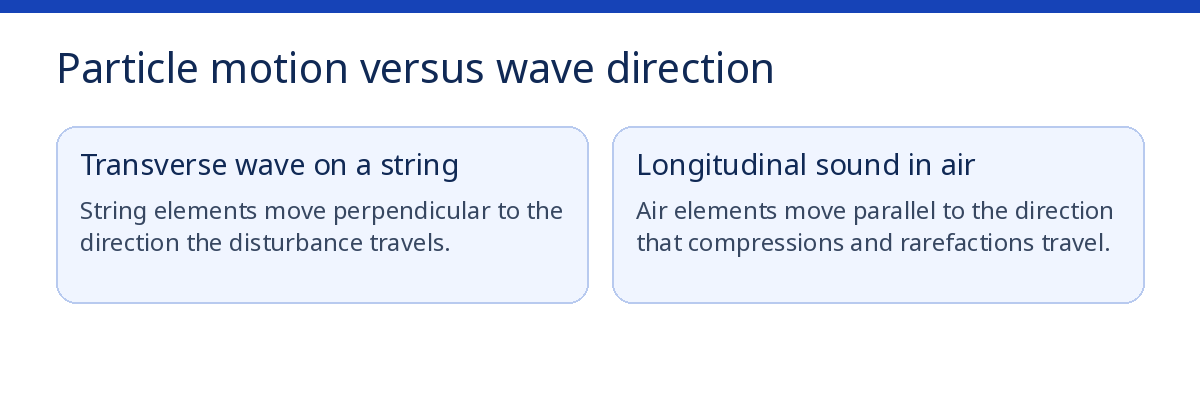
Classify a mechanical wave by comparing two directions: the direction in which an element of the medium moves and the direction in which the disturbance travels. In a transverse wave on a stretched string, a string element moves perpendicular to the direction of propagation. A crest or trough marks an extreme displacement in a snapshot of the string, not a piece of string travelling along it.
In a longitudinal wave, the two directions are parallel. Follow the notes’ piston illustration to see what this means for sound in air. Pushing the piston compresses the adjacent air; pulling it back produces a rarefaction. A compression is a region of temporarily higher density and pressure, while a rarefaction has temporarily lower density and pressure. These regions travel along the pipe even though the air elements oscillate locally.
Read a progressive wave in space and time
The notes represent a sinusoidal wave travelling in the positive direction as , with and positive. Here is the amplitude, is the angular wave number, is the angular frequency, and sets the initial phase at the origin. In the same convention, replacing with gives travel in the negative direction. To see why, follow a crest: its phase stays fixed as its position changes.
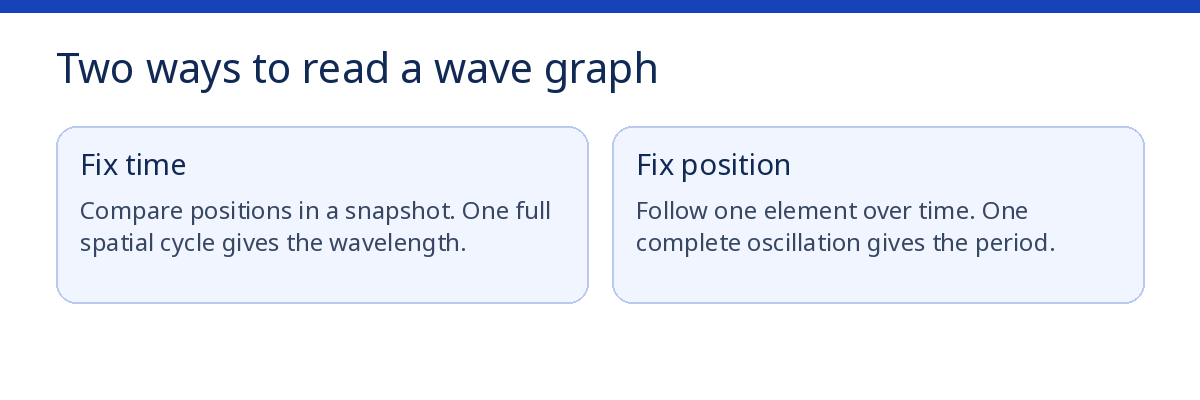
Common mistake: treating every graph as a snapshot. Fix time to read the shape across different positions. Fix position to follow one element’s motion over time. On a position graph, the shortest nonzero spacing between points in the same phase is the wavelength , with . On a time graph, the interval for one full oscillation is the period , with and . Equal displacement alone does not establish equal phase.
When the two wave-speed formulas apply
The relation describes the speed of the travelling pattern: it advances one wavelength in one period. This is not the velocity of a particle in the medium. For example, a string element can be momentarily at rest at its maximum displacement while the wave pattern continues to travel.
For a transverse wave on an ideal stretched string, the notes give , where denotes tension and is mass per unit length. This guide uses to avoid confusing tension with the period . At fixed linear mass density, higher tension means greater wave speed. At unchanged tension and linear mass density, driving the string at a higher frequency changes the wavelength rather than the speed. The string formula is not a formula for the speed of sound in air.
Connect reflection, superposition and normal modes
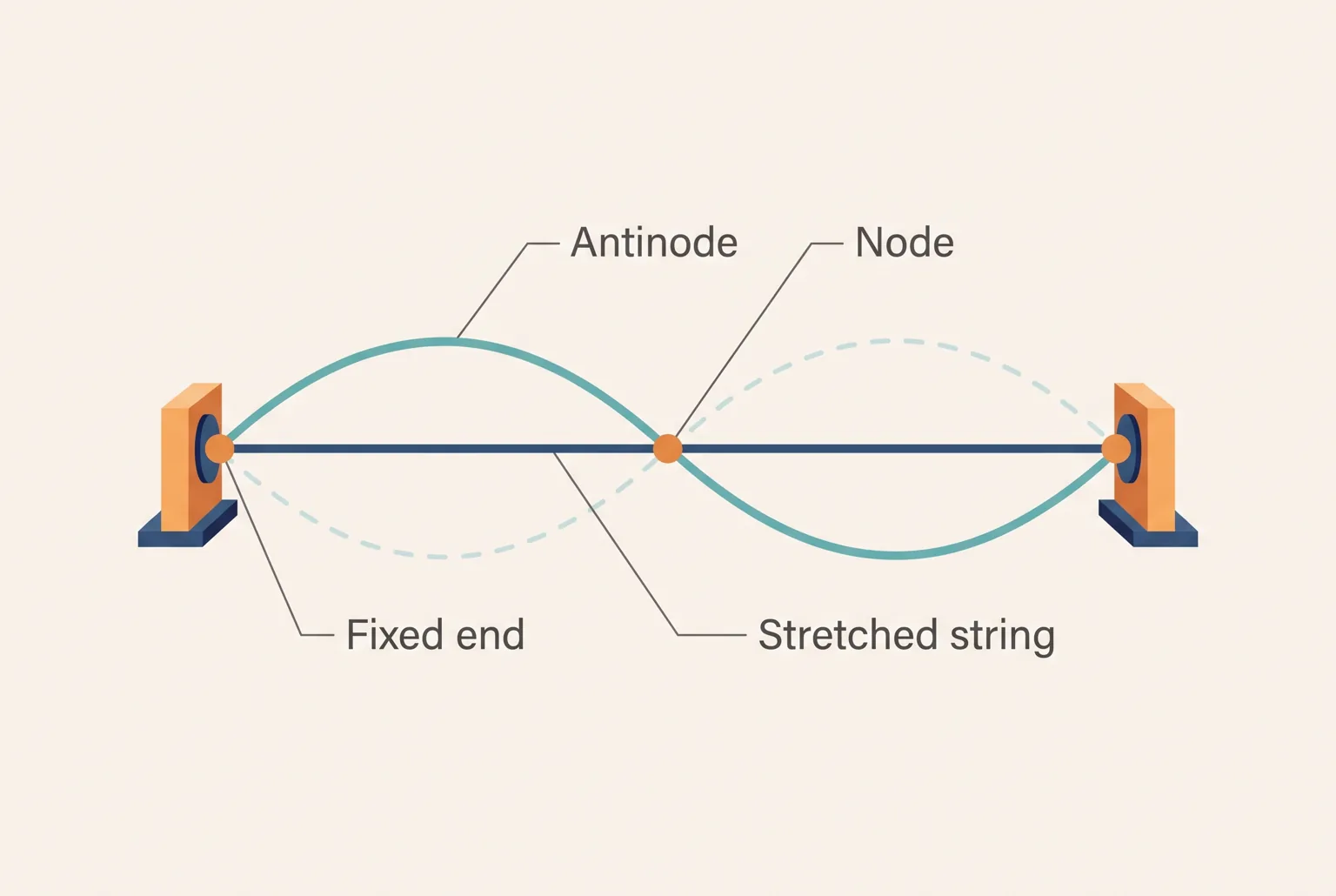
The chapter turns from individual travelling waves to superposition: where waves overlap in a linear medium, their displacements add algebraically at each position and time. Reflection gives a way for waves to travel in opposite directions through the same region. Two sinusoidal waves of equal amplitude and frequency travelling in opposite directions along the same line can form a standing wave, with fixed nodes of zero displacement and antinodes of maximum oscillation amplitude.
Use the sections on strings and air columns to connect these patterns to boundary conditions. A string fixed at both ends must have a displacement node at each end, so only patterns that satisfy both constraints are normal modes. In the ideal air-column model, a closed end is a displacement node and an open end is a displacement antinode. Identify which quantity a diagram represents before labelling its nodes.
Use beats and the chapter summary to check your understanding
Quick self-check: The beats topic gives you a second way to think about superposition. When two sounds of nearby frequencies overlap, their combined amplitude rises and falls; if the variation is slow enough to hear, the sound alternates between louder and softer. How would you distinguish that change over time at one listening point from the fixed locations of nodes and antinodes in a standing wave?
For a revision pass, use the progressive-wave examples to practise identifying amplitude, angular wave number and angular frequency before choosing a formula. Then use the chapter summary to check whether you can explain what each formula describes and when it applies. This guide leaves out the wave-identification example’s disputed classification, the stretched-wire example’s approximate numerical result, and the air-pressure passage’s ambiguous proportionality. The contents heading mentions Doppler’s effect, but the supplied pages do not establish substantive coverage of it.
Spotted an error? Report a correction. Practise this in the app: notes, formula sheets and mind maps.








































Loading comments…