Oscillations: CBSE Class 11 Physics NCERT Notes Guide
CBSEPhysicsOscillations
Use these NCERT revision notes to distinguish periodic motion from simple harmonic motion, connect displacement graphs to force and acceleration, and understand what changes as an oscillator moves through equilibrium.
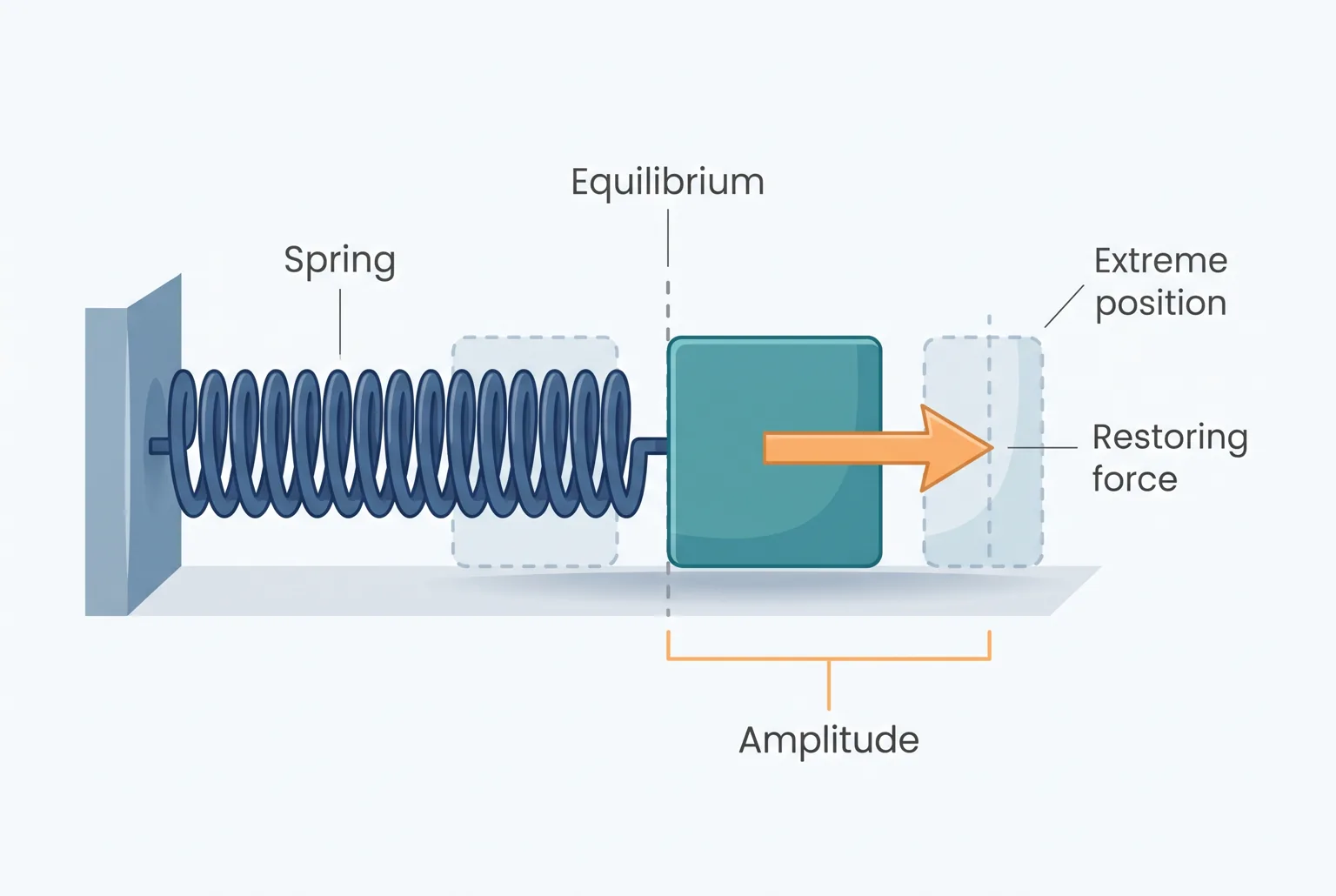
What repeats, and what moves back and forth?
The CBSE Class 11 notes begin with a distinction that matters throughout the chapter. Periodic motion repeats after regular intervals. Oscillatory motion, as introduced here, is repeated back-and-forth motion about an equilibrium position. A planet’s orbit illustrates why repetition alone is not enough: the planet returns to its starting point, but it does not move back and forth about a point on its path as a pendulum does.
The period is the shortest time for a complete repeat, measured in seconds in SI. The frequency counts cycles per unit time: , with one hertz equal to one cycle per second. When reading a displacement graph, don’t count two successive crossings of equilibrium as one cycle. The particle crosses in opposite directions; the motion has not yet returned to the same state.

Oscillations Class 11 Physics | NCERT Theory | Revision Notes
In the StudentCurio app
Comprehensive revision notes covering periodic and oscillatory motion, SHM equations, energy in oscillations, and simple pendulums for Class 11 Physics.
Read the motion from its displacement equation
The notes measure displacement relative to equilibrium: a spring-mounted block has a signed position along its line of motion, while a pendulum can be described by its signed angular deviation from the vertical. A periodic displacement must satisfy for all times in the motion, not merely take the same value at two particular instants.
For the sinusoidal form , amplitude is the maximum magnitude of displacement, not the distance between the two extremes. For a nonzero oscillation with , the period is . Angular frequency is measured in radians per second, whereas ordinary frequency is measured in hertz. The phase constant specifies where in the cycle the motion begins for the chosen time origin and sine or cosine convention; changing it does not change the period.
The notes also show how a sum of sine and cosine terms with the same angular frequency can be rewritten as a single sinusoid. That condition matters: a repeating waveform need not be a single sinusoid.
The restoring-force test for SHM
A restoring force points toward equilibrium, but that alone does not make a motion simple harmonic. For one-dimensional simple harmonic motion (SHM), the net force has the form , with measured from equilibrium and a positive constant in newtons per metre. The minus sign makes the force oppose the signed displacement on either side. The proportionality means doubling the displacement magnitude doubles the force magnitude.
For a particle of constant mass, the same test can be written as . This is the link between the force law and the sinusoidal displacement: differentiating the displacement twice gives an acceleration proportional to the displacement and opposite in sign. At equilibrium the acceleration is zero, but the particle can still be moving. Zero net force at an instant is not the same as being at rest.
A useful connection: follow the circular projection
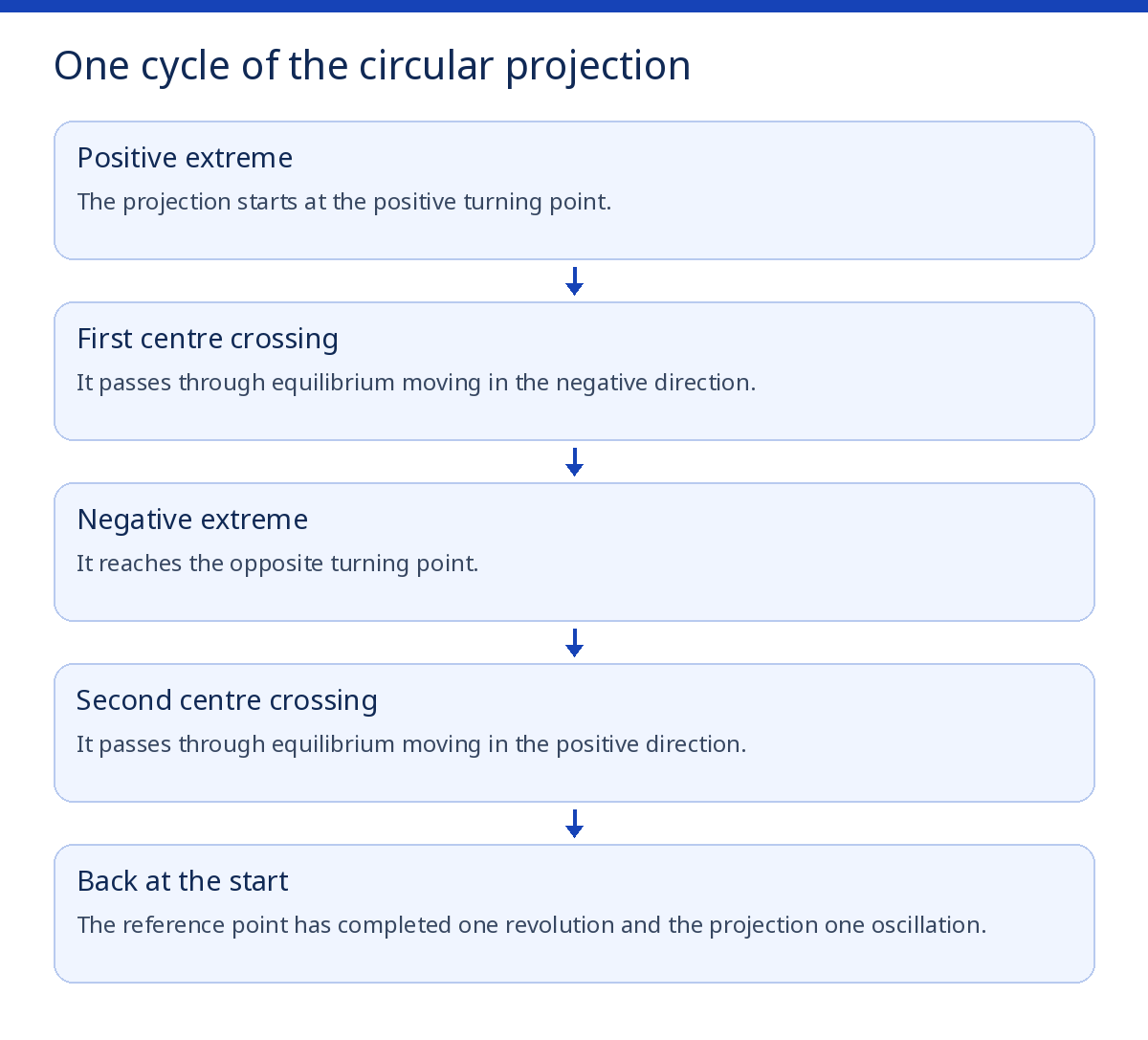
The reference-circle diagram gives a geometric way to read the sinusoid. A reference point travels at uniform speed around a circle of radius . Its projection onto a fixed diameter moves between the two extremes, crossing the centre on the way. One complete revolution produces one complete oscillation of the projection. The point on the circle and its projection are not executing the same kind of motion: it is the projection that performs SHM.
Pair this diagram with the notes’ quarter-period sketches. When the projection starts at the positive extreme, successive quarter turns take it through equilibrium, to the negative extreme, through equilibrium in the opposite direction, and back to the start. Use the sequence to relate phase to both position and direction, rather than treating phase as just a number in an equation.
Common mistakes: confusing speed with signed velocity
Read velocity from the slope of the displacement–time graph. A positive slope means motion in the positive direction; a negative slope means motion in the negative direction. The expression gives speed for . It cannot tell you the sign of velocity, because an oscillator generally passes through the same interior position once in each direction per cycle.
At equilibrium, speed is greatest and acceleration is zero. At either extreme, speed is zero and the magnitude of acceleration is greatest, directed inward. This contrast also helps you approach the listed energy topic: for an ideal oscillator without energy loss, kinetic energy is greatest at equilibrium, while the oscillation’s potential energy is greatest at the turning points.
How to use the notes for revision
Start with the definitions, then use the displacement graphs to identify amplitude, period and starting phase separately. When reading a worked example on motion, pause after the displacement equation and identify whether the requested quantity is a signed component or a magnitude. The contents also list an energy section, systems executing SHM and a chapter summary; the supplied excerpt ends before those later sections. For the simple pendulum introduced here, keep the distinction between angular deviation and the block’s linear displacement in view. The pendulum’s SHM approximation requires small angular displacements.
For a final self-check, pick an interior point on a displacement graph and ask what the position tells you about the direction of acceleration, and what extra information you need to determine the direction of motion.
The circular-motion worked example with inconsistent signs, the phase graph with conflicting labels, and the worked example that does not specify the initial direction from equilibrium are not used here.
Spotted an error? Report a correction. Practise this in the app: notes, formula sheets and mind maps.








































Loading comments…