Thermodynamics: CBSE Class 11 Physics NCERT Notes
CBSEPhysicsThermodynamics
These NCERT notes for CBSE Class 11 Physics connect thermal equilibrium, the first law and heat capacity with pressure–volume diagrams. Use the chapter checklist to map your revision and the clickable index to return to a definition, a process or the Carnot cycle.
Start by drawing the system boundary
Thermodynamics describes matter on a macroscopic scale. Instead of tracking individual molecules, the notes describe the state of a gas through quantities such as pressure, volume, temperature, mass and composition. Before using any of these variables, identify the system you are studying and the boundary that separates it from its surroundings. The boundary can be real or imaginary; what matters is what can cross it.
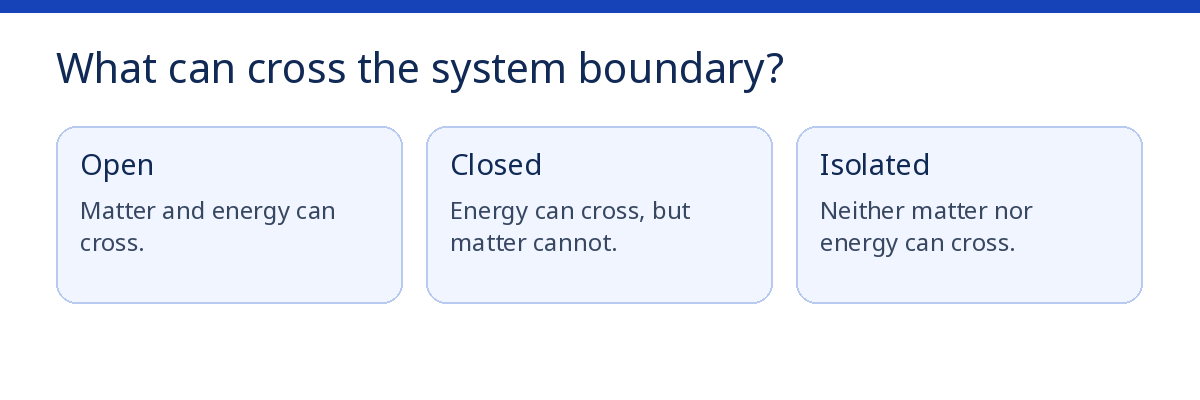
An open system can exchange matter and energy with its surroundings. A closed system can exchange energy but not matter. An isolated system exchanges neither. In the notes’ gas-and-piston diagram, take the gas as the system. The piston can move and the gas can do work without any gas leaving the cylinder. That is why a closed system is not necessarily an isolated one.

Thermodynamics Class 11 Physics | NCERT Theory | Revision Notes
In the StudentCurio app
Comprehensive revision notes for Class 11 Physics covering the laws of thermodynamics, isothermal and adiabatic processes, and the Carnot cycle.
Thermal equilibrium and the zeroth law
The notes distinguish thermal equilibrium from thermodynamic equilibrium more broadly. Two systems in thermal equilibrium have the same temperature, so there is no net heat flow when they are brought into thermal contact. Mechanical and chemical equilibrium concern different kinds of change, so matching temperatures alone does not establish full thermodynamic equilibrium.
Compare the notes’ two wall diagrams. An adiabatic wall prevents heat transfer, so observing no heat flow through it does not establish that the gases have equal temperatures. A diathermic wall permits heat transfer. The zeroth law then gives a way to compare systems without putting them directly in contact: if two systems are each in thermal equilibrium with a third, they are in thermal equilibrium with each other. The third system gives them a common temperature reference.
First-law signs: track what enters and leaves
Internal energy is a property of the system’s state. It includes energy associated with molecular motion and configuration, but not the kinetic energy of the container moving as a whole. For a fixed amount and composition of an ideal gas, internal energy depends only on temperature. The notes contrast this with a real gas, for which intermolecular interactions can make internal energy depend on volume as well.
Heat and work are modes of energy transfer, not properties stored in the system. Using the notes’ convention, the first law is : is positive for heat supplied to the system, and is positive for work done by the system. Work done on the system is therefore negative in this convention. Write these meanings beside the equation before substituting values, especially when a process involves compression or heat leaving the system.
When the area on a pressure–volume graph gives work
The piston derivation connects a small displacement to a small volume change. For a process with a well-defined gas pressure along the path, the work done by the gas is . The graph gives signed work: expansion gives positive work, and compression gives negative work. If pressure varies, use the area along the actual path rather than multiplying the final pressure by the volume change.
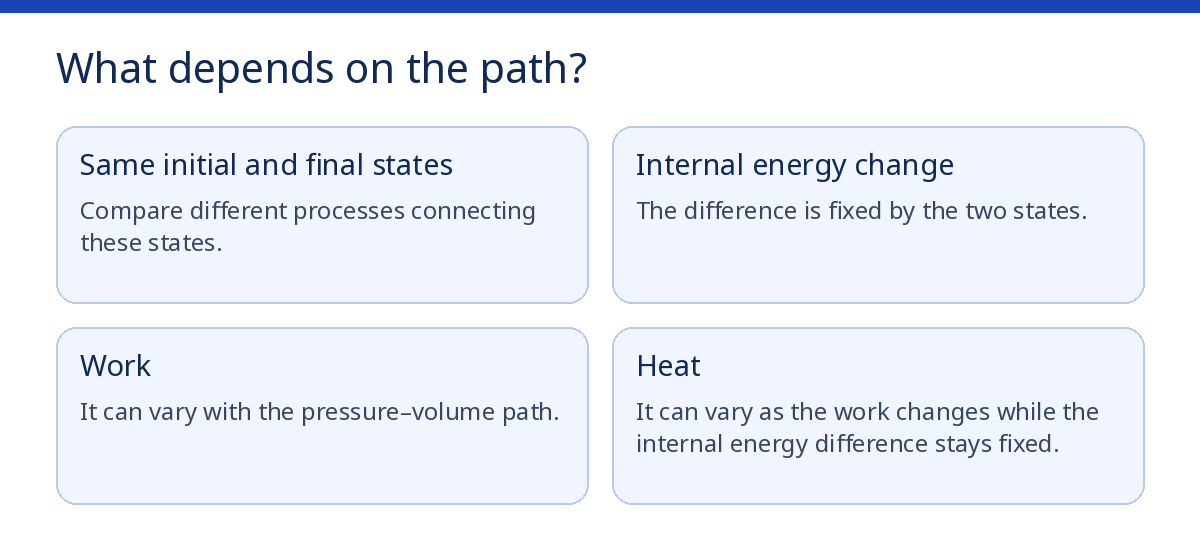
Different paths between the same initial and final states can give different work and heat transfers, but they give the same change in internal energy. In a complete cycle, the system returns to its starting state, so its internal energy has no net change. The enclosed area gives the magnitude of net work; a clockwise loop gives positive work under the notes’ convention.
Two worked details are left out here: the steam example has a flagged water-volume misprint, and the path example’s ordering of signed heat transfers does not by itself establish an ordering of their magnitudes.
Heat capacity: check what the value is measured per
Heat capacity refers to the whole sample and is measured in joules per kelvin. Specific heat capacity is measured per kilogram, while molar heat capacity is measured per mole. The units tell you whether to use the heat capacity directly, multiply a specific value by mass, or multiply a molar value by the amount in moles.
For a temperature change over which the specific heat capacity can be treated as constant, use with the value appropriate to the conditions. The notes’ water graph illustrates why the constant-value assumption is an approximation: specific heat capacity varies slightly with temperature. For gases, also check how the heat is supplied. Holding volume fixed prevents pressure–volume work, whereas heating at constant pressure can allow expansion. The heat required for the same temperature rise can therefore differ.
Quick self-check: identify the process constraint
Use the index to compare the process entries by asking what is held fixed or prevented. Isothermal means constant temperature; adiabatic means no heat transfer. Neither label means the other. For a fixed amount of ideal gas, constant temperature fixes internal energy, whereas an adiabatic process can change internal energy through work. Isochoric means constant volume, so pressure–volume work is zero. Isobaric means constant pressure, not constant volume.
Before moving to the indexed sections on the second law, reversibility and the Carnot cycle, ask yourself: which term in the first law is zero because of the process constraint, and which term is zero only if you make an additional assumption about the gas? That distinction helps you read a cycle as a sequence of processes rather than treating every step as if it followed the same rule.
Spotted an error? Report a correction. Practise this in the app: notes, formula sheets and mind maps.








































Loading comments…