Mechanical Properties of Solids: CBSE Class 11 Assessment
CBSEPhysicsMechanical Properties of Solids
This CBSE Class 11 Physics assessment combines topic-wise exercises with mixed chapter practice. Use its worked solutions to check how you interpret stress–strain graphs, choose an elastic modulus and decide whether a formula applies.
Find the right set in the PDF
The assessment is organised into two topics: Elastic and Plastic Behaviour of Solids and Modulus of Elasticity or Elastic Modulus. Each has a Practice Questions set and a separate Topic Assessment, with formats ranging from objective items to long answers. The mixed Chapter Practice also includes assertion–reason and case-based questions, so you can revisit the same concepts without a topic heading telling you which principle to use.
The clickable index has separate question and solution views. Chapter Practice starts on page 20, and its solutions start on page 49. The question-level links let you open a worked answer and then return to the original problem. Try writing the governing relation and its conditions before following the link; that makes it easier to spot where your reasoning first took a different turn.

Mechanical Properties of Solids | Class 11 | CBSE Assessment
In the StudentCurio app
Chapter assessments include objective, assertion–reason and case-based questions with worked solutions on stress and strain, Hooke’s law, elastic moduli, Poisson’s ratio, elastic energy and thermal stress. They help Class 11 students practise conceptual and numerical applications of elasticity.
Start with force, area and deformation
Stress describes internal force per unit area on a section, while strain describes relative deformation. For a wire under a uniform axial pull, the tensile stress is , where is the cross-sectional area perpendicular to the pull. The longitudinal strain is , where is the original length. Stress is measured in pascals, equivalent to newtons per square metre; strain is dimensionless. If a question gives percentage strain, convert it to a fraction before using it in a relation.
The first topic includes cables under tension and rivets under shear. Use those settings to practise identifying the relevant area and force component before calculating. A force perpendicular to a section contributes normal stress, while a component parallel to the section contributes shear stress. The distinction matters especially when the section shown in a diagram is inclined.
Read the curve without confusing stiffness and strength
Elastic deformation is recovered on unloading; plastic deformation leaves a permanent change. Hooke’s law makes a narrower claim: stress is proportional to strain in the linear elastic region. The proportionality limit marks the end of that linear relation, whereas the elastic limit concerns whether the original dimensions are recovered. Do not assume the two limits coincide.
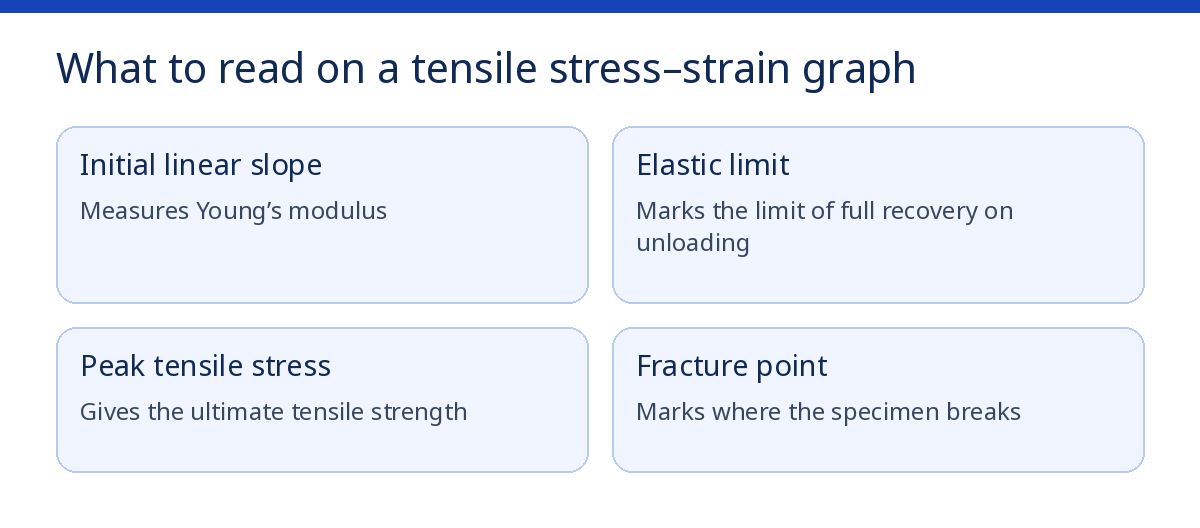
On a graph with tensile stress on the vertical axis and longitudinal strain on the horizontal axis, the initial linear slope gives Young’s modulus. A steeper slope on the same scales means greater stiffness, not necessarily greater strength. Ultimate tensile strength is the maximum tensile stress reached, while fracture is where the specimen breaks. The graph questions give you practice reading these as distinct features rather than treating the steepest line, highest point and fracture point as interchangeable.
When each elastic modulus applies
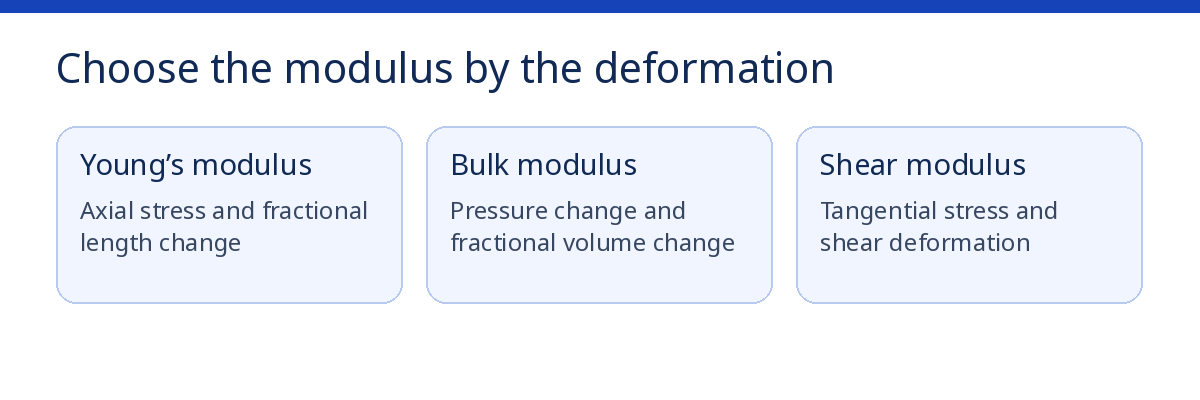
Match the modulus to the deformation. Young’s modulus relates axial stress to longitudinal strain. For a uniform wire under a constant axial tensile force in the linear elastic range, . In comparison problems, check what is held constant: a change in diameter changes the cross-sectional area according to , and a change in length need not leave the area unchanged if the volume is fixed.
Bulk modulus relates a pressure increase to a fractional volume decrease. With , the relation for small changes is . The minus sign accounts for the decrease in volume under increased pressure. Shear modulus relates shear stress to shear strain in the linear range; for a small sideways displacement of one face relative to another, the strain is the displacement divided by the separation of the faces. Poisson’s ratio connects transverse and longitudinal strains in uniaxial loading, with a minus sign when both strains are written with their signs.
Two conditions to check: loading and restraint
For a wire loaded gradually from zero in its Hookean range, the work done in stretching it is the area under the force–extension graph. The force rises from zero to its final value, so the area is triangular: . This is total work, not energy per unit volume. If a prompt asks for energy density, divide by the wire’s volume rather than reporting the total in joules.
In the thermal-stress questions, the clamps matter as much as the temperature change. A uniformly heated bar that is free to expand does not develop axial stress from that heating alone. If rigid supports prevent its length from increasing, heating produces compressive stress. Before choosing a relation, identify whether the stated displacement is free to occur or is prevented by the supports.
Use the mixed practice to diagnose mistakes
After a topic assessment, use the mixed set to see whether you can identify the governing idea without being told the topic. In assertion–reason items, judge each statement independently before deciding whether the reason explains the assertion. For a case-based item, separate the shared information from what each part asks you to find. When checking a numerical solution, distinguish a wrong physical model from an area conversion, a sign error or a misread axis.
This guide leaves out individual items with unclear wording or data, including the rubber-ball volume wording, the water bulk-modulus item that lists a volume increase under increased pressure, and the support-wire item that switches from iron to steel. It also does not use items that would require extending a linear relation to large strain or fracture without establishing that it applies there.
Spotted an error? Report a correction. Practise this in the app: notes, formula sheets and mind maps.








































Loading comments…