CBSE Class 11 Physics: Work, Energy and Power Assessment
CBSEPhysicsWork, Energy and Power
This CBSE Class 11 Physics assessment pairs topic-wise questions with mixed chapter practice and worked solutions. Use it to practise choosing the right tool: a force–displacement calculation, an energy balance, a power relation or a collision model.
Navigate the questions and worked solutions
The PDF groups practice into Work, Energy, and Power and Collision. Each topic has separate Practice Questions and Topical Understanding sets. Both include objective questions and written responses of different lengths. The mixed Chapter Practice, starting on page 29, also includes assertion–reason and case-based questions. The clickable indexes list the question and solution sections separately, so you can move between them without browsing through the entire file.
Start with one topic and attempt a mix of objective and written questions. For an objective item, write down the deciding principle before choosing an option. For a longer response, state which force or system you are analysing before substituting values. When you open the solution, compare that first decision as well as the calculation: a correct option alone does not show whether your reasoning would work in a different setup.

Work, Energy and Power | Class 11 | CBSE Assessment
In the StudentCurio app
Chapter and topic-wise assessment questions cover work, power, kinetic and potential energy, the work–energy theorem, springs, and conservation of mechanical energy. Includes objective, written and case-based practice with worked solutions for Class 11 students preparing for CBSE Physics assessments.
Work: choose the component along the motion
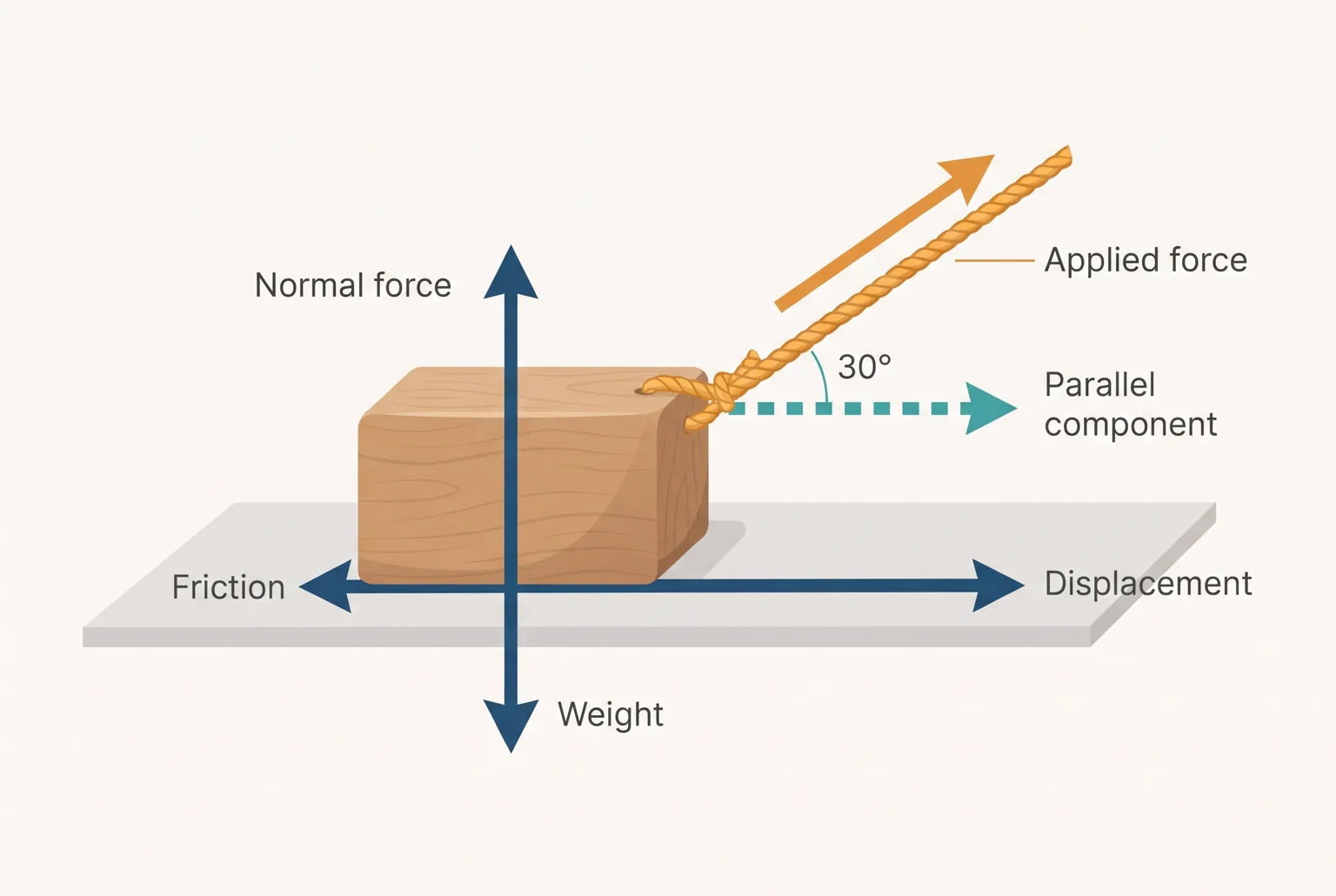
For a constant force, work is the dot product . Work is a scalar, but its sign matters. The component along the displacement gives positive work if it points with the displacement and negative work if it points against it. A perpendicular force does no work over that displacement. Apply this test to the force named in the question: the work done by one force need not equal the net work on the object.
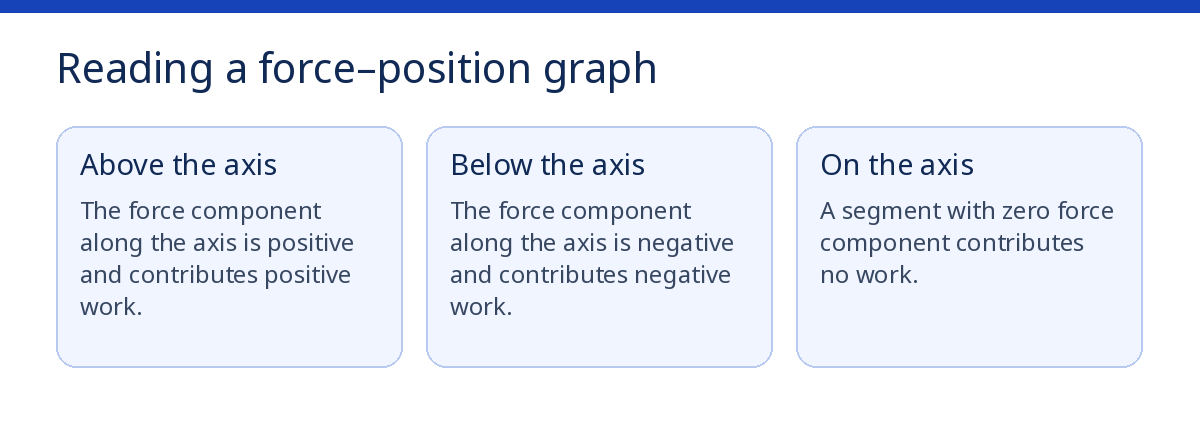
When the force component varies with position along the -axis, use . The cover diagram illustrates the link between work and area on a force–position graph. Read that area with its sign: for motion toward increasing , a region below the axis contributes negative work. In the variable-force questions, identify the limits and the force component before evaluating the integral.
Kinetic energy: check whether the question asks for net work
The work–energy theorem connects motion to the combined effect of the forces: . For a body of fixed mass in classical mechanics, . If several forces act, use their total work to find the change in kinetic energy. Individual forces can do nonzero work even when that change is zero, provided their contributions cancel. This is why a calculation of work by an applied force is not automatically a calculation of the change in kinetic energy.
The Energy section also compares kinetic energy and momentum. For a fixed mass, momentum magnitude is proportional to speed, whereas kinetic energy depends on speed squared. When the masses differ, write , with denoting momentum magnitude, to keep the mass dependence visible. In percentage-change questions, distinguish the factor by which a quantity changes from the percentage by which it increases.
Common mistake: conserving mechanical energy on a rough track
The assessment uses springs, pendulums and rough tracks to test when mechanical energy can be treated as constant. If gravity and an ideal spring are the only forces doing work, the sum of kinetic and potential energy stays constant. Gravity and the ideal spring are conservative: their work depends on the endpoints, not the path. When you account for their work through changes in potential energy, do not include it again as a separate work term in the same balance.
For an ideal spring that obeys Hooke’s law, , where is measured from the spring’s natural length. Both compression and extension store energy. If a track has both smooth and rough sections, identify where sliding friction does work rather than treating the whole track as frictionless. Mechanical energy can decrease as energy is transferred to other forms; that is not a failure of total energy conservation.
Power and collisions: distinguish rate from conservation
Power measures the rate of doing work, not the amount of work done. Average power is over the interval considered. Instantaneous power delivered by a force is , so both the direction of the force and the velocity matter at that instant. Two processes that do equal work can have different average powers if they take different times. Efficiency asks a separate question: what fraction of the input energy becomes useful output, or what fraction of input power is useful output when comparing rates on the same basis?
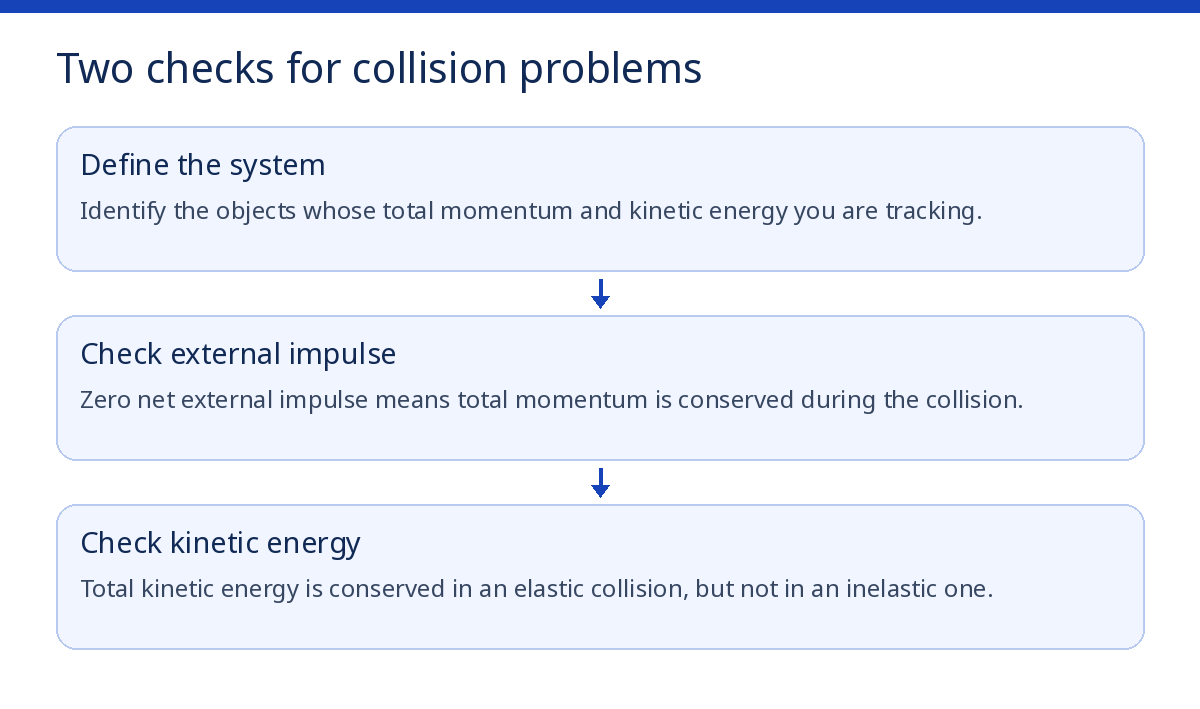
For the collision practice, define the system before deciding what is conserved. Its total momentum is conserved through the collision if the net external impulse is zero, and is approximately conserved if that impulse is negligible. An elastic collision also conserves total kinetic energy; an inelastic collision does not. The two conservation tests are therefore separate.
Quick self-check before opening a solution
Use Chapter Practice after working through the topics separately. Before looking at the solution, ask: Does the prompt name a particular force or ask for the net effect? Is the relevant force component constant? If I am using a conservation law, what condition in the setup makes it applicable? In an assertion–reason item, check each statement on its own before deciding whether the reason explains the assertion. In the case-based practice, use the conditions given in the passage rather than assuming an ideal setup.
A few isolated items are left out of this guide: the inconsistent friction wording on page 6, the repeated momentum wording on page 14 and the questionable rest-mass value on page 18. Use independently clear prompts to practise those concepts rather than guessing what the disputed wording or data was meant to say.
Spotted an error? Report a correction. Practise this in the app: notes, formula sheets and mind maps.








































Loading comments…