Class 11 Physics: Oscillations Case-Based Assessment Guide
CBSEPhysicsOscillations
This CBSE Class 11 Physics assessment uses springs, torsion wires and pendulums to test how you recognise simple harmonic motion and choose the right model. Use its linked solutions to check your reasoning as well as your calculations.
What the assessment covers
The file contains four case studies with sixteen subparts for the CBSE and NCERT Class 11 Oscillations chapter. The first uses bungee motion to introduce restoring forces and the conditions for simple harmonic motion (SHM). The second compares a spring oscillator with a torsion pendulum and brings in speed and graph interpretation. The last two use pendulum clocks and simple pendulums to examine what changes a period, including when the support accelerates.
The file mixes short-answer, multiple-choice and assertion–reason questions. Its question and solution indexes let you move between a case and its numbered explanations. There is no separate chapter-practice section, so use the case passages, diagrams and linked explanations together.

Oscillations Class 11 Physics | CBSE Case Based Assessment
In the StudentCurio app
Features case-based and assertion-reason questions on SHM, simple pendulums in accelerating frames, and torsional oscillations with detailed step-by-step solutions for Class 11 Physics.
The restoring law is what makes motion harmonic
Start by choosing an equilibrium position and measuring displacement from it. In ideal linear SHM, the acceleration obeys , where is the signed displacement and is the angular frequency. The minus sign tells you that acceleration points opposite to the displacement, not necessarily opposite to the velocity. For a constant-mass spring oscillator, this corresponds to the net force law , with . Inertia carries the object through equilibrium; the restoring force governs how its velocity changes on either side.
The bungee passage is a way to test the limits of that model. Repeated up-and-down motion alone does not establish SHM. A spring model can approximate the motion near the stretched equilibrium when the cord is taut and behaves approximately linearly. Slack, nonlinear elasticity and damping are reasons not to treat the entire jump as ideal SHM.
Common mix-up: speed is not signed velocity
For ideal SHM with amplitude , the speed at displacement is , valid for . The positive square root gives a magnitude. At an interior position, the oscillator can pass through the same point in either direction, so displacement alone does not give the sign of velocity. If you choose centimetres for both displacement and amplitude and use angular frequency in radians per second, the speed comes out in centimetres per second. A frequency in cycles per second must first be converted using .
When reading a motion description, also check whether it asks about a signed quantity or its magnitude. For acceleration, the sign describes direction in your chosen coordinate system; the magnitude describes the strength of the restoring acceleration.
From spring force to torsion torque
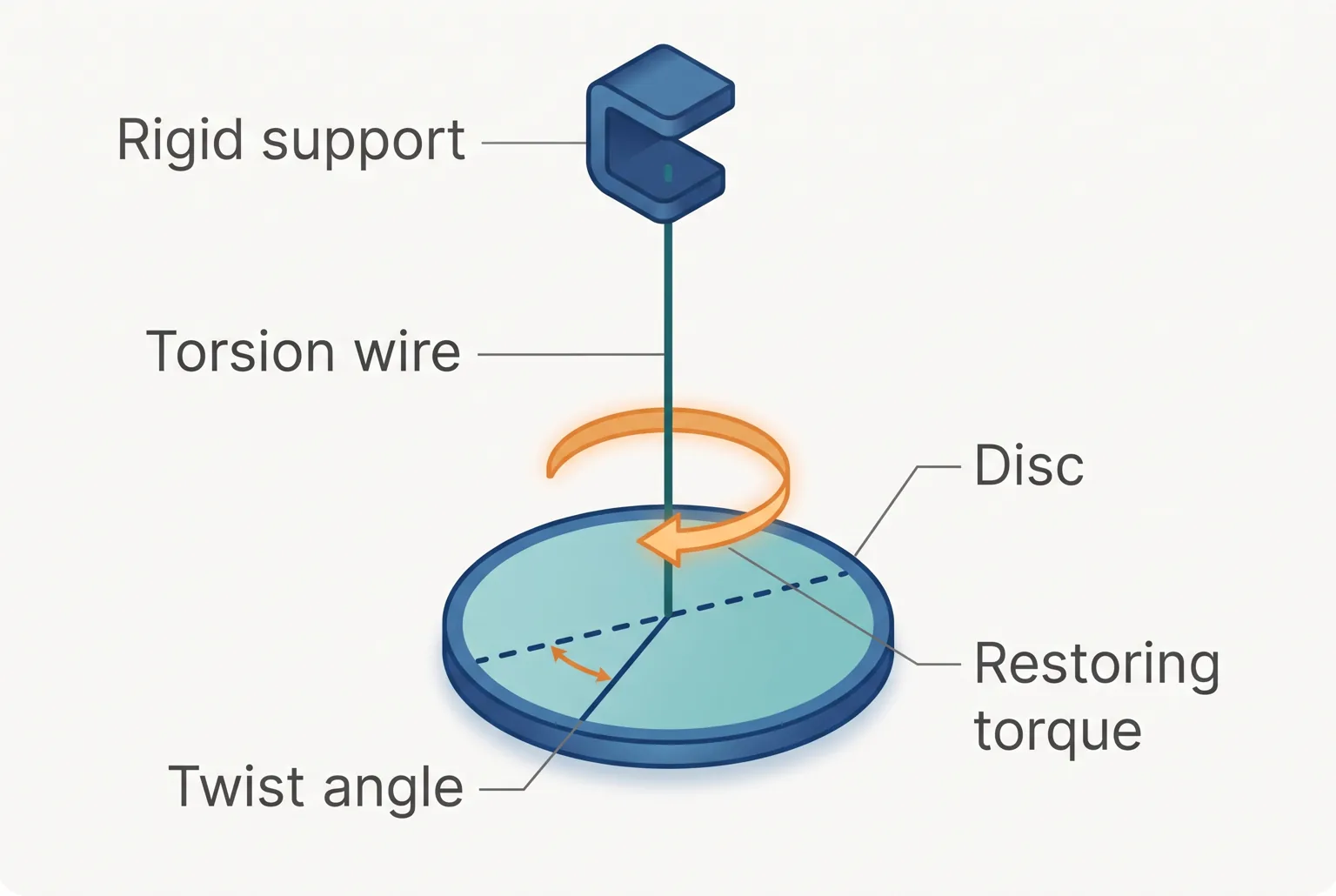
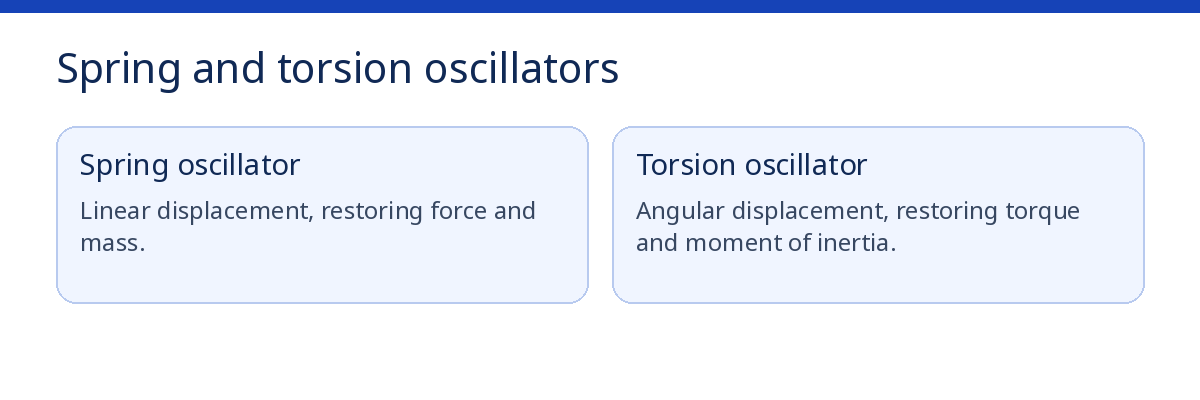
In a torsion pendulum, a body rotates back and forth about the wire axis instead of translating along a straight line. In the wire’s linear elastic regime, the restoring torque is , where is the angle from the untwisted position and is the torsion constant. The moment of inertia about the rotation axis plays the role that mass plays in translation. The period is under this linear model.
Read the axes before interpreting a torque–angle graph. For applied torque magnitude plotted against the magnitude of the twist, the slope of the calibrated straight line gives the torsion constant. That is a static measurement of the wire’s stiffness, not a measurement of the time for one oscillation. To calculate the period using the model, you also need the rotational inertia.
When the simple-pendulum period formula applies
The ideal simple pendulum has a point bob on a light, inextensible string. Its small-angle period is , where is the pendulum length and is the local gravitational acceleration, treated as uniform over the swing. The small-angle condition matters because the tangential component of gravity varies with the sine of the angle, which is approximately the angle in radians only near equilibrium.
In the clock cases, distinguish a change in local gravity from a change in effective length. The melting-bob passage illustrates why the location of the bob’s centre of gravity matters: changing the mass alone is not the same as shifting that centre relative to the pivot. The very-long-pendulum prompt raises a different issue. Extrapolating a local uniform-gravity formula to an Earth-scale length goes beyond its assumptions.
Accelerating frames: find the new equilibrium first
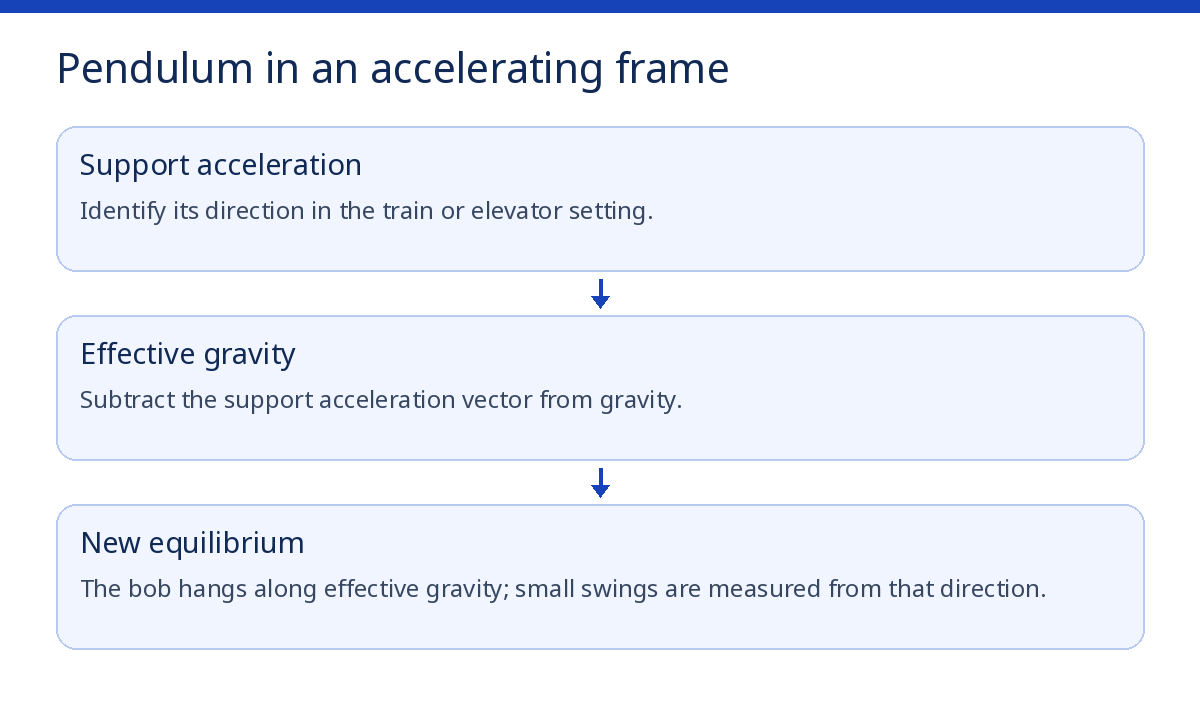
In the train and elevator settings, analyse motion relative to the support. For a frame with constant acceleration, effective gravity is the vector difference between gravitational acceleration and the frame’s acceleration. With horizontal acceleration, its direction generally tilts away from the true vertical. With vertical acceleration, both vectors lie on the same line, so their directions determine how they combine. For small oscillations about a stable equilibrium in a nonzero effective field, the period formula uses the magnitude of that field.
For assertion–reason practice, judge the two statements separately before asking whether the reason explains the assertion. Pay particular attention to whether a statement refers to frequency or period: frequency is the reciprocal of period.
Before checking the linked solutions
Write down the model, what the stem actually gives you and what it asks you to infer. In the torsion case, distinguish properties of the oscillator from initial conditions that describe how its motion begins. If a required quantity is missing, note what further information you would need instead of treating an answer choice as evidence. Then use the linked explanation to check the step where you chose the model or interpreted the data. This guide omits the disputed numerical torsion item and does not assign an answer to the ambiguously worded elevator item.
Spotted an error? Report a correction. Practise this in the app: notes, formula sheets and mind maps.








































Loading comments…