Understanding Degrees of Freedom and Kinetic Theory of Gases
CBSEPhysicsKinetic Theory of Gases
A detailed guide to Class 11 CBSE Physics Case-based Assessments focusing on the law of equipartition of energy, molecular speeds, and internal energy calculations.
The Foundation of Kinetic Theory
The Kinetic Theory of Gases serves as a vital bridge between macroscopic observations, like pressure and temperature, and microscopic behavior, such as the motion of individual molecules. This Case-based Assessment resource focuses on the fundamental laws governing these molecular interactions, specifically for CBSE Class 11 learners. At its core, the material explores how energy is distributed within a system in thermal equilibrium. According to the law of equipartition of energy, the total energy of such a system is divided equally among all its active degrees of freedom. Each degree of freedom is associated with an average energy of , where represents Boltzmann's constant and is the absolute temperature.
Learners are introduced to the concept that temperature is not merely a reading on a scale but a direct measurement of the average translational kinetic energy of a gas's molecules. For an ideal gas at a specific temperature , all molecules possess the same average translational kinetic energy of , regardless of their mass. This principle is a cornerstone for solving complex problems involving different types of gases, such as Helium or Hydrogen, which may have different total internal energies based on their molecular structure and corresponding degrees of freedom.

Kinetic Theory of Gases Class 11 |Physics | CBSE Case Based Assessment
In the StudentCurio app
CBSE case-based assessment for Class 11 Physics featuring questions and step-by-step solutions on degrees of freedom and the law of equipartition of energy.
Degrees of Freedom in Practical Models
The concept of 'degrees of freedom' refers to the number of independent ways a molecule can move or store energy. The resource utilizes specific examples to clarify this abstract concept. For instance, an ant moving on a horizontal surface is restricted to a plane. Its position is defined by two independent coordinates ( and ), giving it two degrees of freedom for its translational motion. This example helps students visualize how constraints on movement directly dictate the value of .
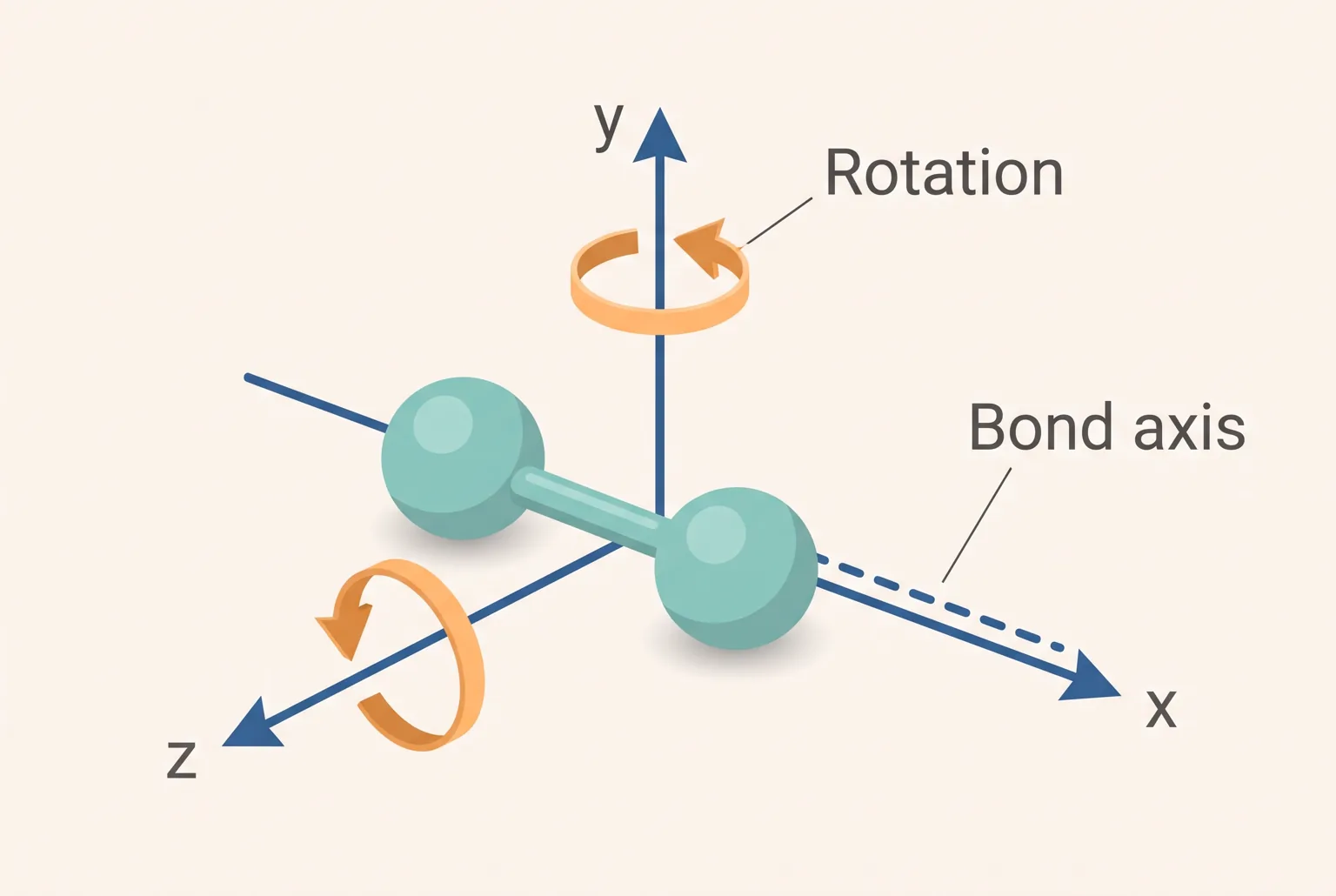
In the context of gas molecules, the resource distinguishes between monatomic and diatomic gases. A rigid diatomic molecule at moderate temperatures is shown to have five degrees of freedom: three translational and two rotational. The three translational degrees correspond to motion along the , , and axes, while the two rotational degrees represent rotation around axes perpendicular to the bond. Crucially, the resource notes that rotation about the bond axis itself is not counted in standard rigid-diatomic models. This distinction is vital for accurately calculating the internal energy of a gas using the formula for molecules or for moles.
Relating Pressure to Energy Density
One of the most significant derivations in this assessment is the relationship between the pressure of a gas and its kinetic energy per unit volume . By combining the ideal gas equation with the expression for total translational kinetic energy , the material demonstrates that . This indicates that the pressure exerted by an ideal gas is exactly two-thirds of its translational kinetic energy density.
When working through these problems, learners must be careful to distinguish between the total kinetic energy of the gas and the energy density. The resource provides a step-by-step solution that sets the volume to a unit value to simplify the derivation, but it also clarifies that the ratio holds true for any volume. This section emphasizes that the energy in this specific formula refers strictly to translational kinetic energy, excluding any rotational or vibrational components that might contribute to the gas's total internal energy.
Molecular Speeds and the Effect of Mass
The behavior of individual gas molecules is further characterized by their root mean square (RMS) speed, denoted as . The assessment materials guide students through the formula , where is the mass of a single molecule. A key takeaway for students is the mathematical relationship between speed and mass: at a constant temperature, the RMS speed is inversely proportional to the square root of the molecular mass ().
This relationship explains why lighter molecules move faster than heavier ones at the same temperature. In an exam context, students are often asked to identify the proportionality factor. The resource highlights common pitfalls in these questions, such as confusing with or . Understanding the derivation from the kinetic energy expression is essential for verifying these proportionalities during competitive and school-level assessments.
Ideal Gas Transitions and Real Gas Behavior
While the ideal gas law is a powerful tool, it is an approximation that applies only under specific conditions. The resource explains that real gases approach ideal behavior at very low pressures and high temperatures. At low pressures, the gas molecules are spread so far apart that the actual volume of the molecules themselves becomes negligible compared to the total volume of the container. At high temperatures, the kinetic energy of the molecules is so great that the attractive intermolecular forces between them have a negligible effect on the gas's behavior.
The material also explores the classical zero-temperature limit. Theoretically, at , the translational kinetic energy of a gas molecule in the classical model becomes zero. While the resource acknowledges that more advanced quantum models might show zero-point energy, for the purpose of Class 11 CBSE Physics, the intended takeaway is that molecular thermal motion ceases at absolute zero. This conceptual grounding helps students understand the limits of classical thermodynamics.
Internal Energy and Thermal Calculations
Numerical applications in this assessment include calculating the internal energy of specific gases like Helium. For a monatomic gas like Helium, the internal energy is determined solely by translational motion, leading to the formula . The resource provides a worked example for 2 moles of Helium at , reminding students that temperature must always be converted to Kelvin () before substitution into thermodynamic formulas.
A secondary focus is on thermal properties of materials, such as specific heat capacity. Using the context of cooking utensils, the material explains that materials with low specific heat capacity require less heat to increase their temperature, which is efficient for cooking. Conversely, handles are made of materials with high specific heat capacities (and low thermal conductivity) to ensure they do not reach dangerous temperatures quickly. This practical application reinforces the relationship , where a higher specific heat results in a smaller temperature change for a given amount of heat and mass .
Frequently asked questions
What are the standard degrees of freedom for a rigid diatomic molecule?
At moderate temperatures, a rigid diatomic molecule has 5 degrees of freedom: 3 translational and 2 rotational.
How does RMS speed change if the molecular mass is quadrupled at a constant temperature?
Since is proportional to , if the mass is increased by a factor of 4, the speed will decrease by a factor of , becoming half of its original value.
Why must temperature be converted to Kelvin in gas law problems?
The kinetic energy of molecules and the gas laws (like Charles's Law or the Ideal Gas Law) are based on the absolute temperature scale. Using Celsius would result in incorrect ratios and negative energy values at low temperatures.
Under what conditions does a real gas behave most like an ideal gas?
A real gas behaves like an ideal gas at very low pressure and very high temperature.
Spotted an error? Report a correction. Practise this in the app: notes, formula sheets and mind maps.








































Loading comments…