Mastering CBSE Class 11 Work Energy and Power Case Studies
CBSEPhysicsWork, Energy and Power
A comprehensive guide to solving context-based physics problems covering the work-energy theorem, mechanical conservation, and collision dynamics for Class 11 learners.
Navigating Case-Based Assessments in Physics
The StudentCurio Case-based Assessment for Class 11 Physics, Chapter 5, transitions from traditional numerical problems to context-driven scenarios. This resource contains four distinct case studies and 17 assessment items designed to test a learner's ability to apply the principles of work, energy, and momentum to real-world or theoretical situations. Unlike standard textbook questions, these items require interpreting a descriptive passage—such as a vacuum chamber experiment or a nuclear reactor moderator—before selecting the correct physical law.
The material provides a structured path through the curriculum, starting with the kinematics and energy of free-falling objects, moving through work-energy applications in resistive media, and concluding with complex momentum conservation in multi-dimensional collisions. By providing step-by-step solutions linked directly to each question, the resource allows learners to verify their conceptual reasoning and mathematical accuracy immediately after attempting a problem.

Work, Energy and Power Class 11 |Physics | CBSE Case Based Assessment
In the StudentCurio app
A collection of case-based assessment questions and step-by-step solutions for Class 11 Physics covering the work-energy theorem, mechanical energy conservation, and collisions.
Kinematics and Energy in Free Fall
The first case study focuses on gravitation and the conservation of mechanical energy. It uses the context of objects falling in a vacuum to isolate gravitational effects from air resistance. A primary takeaway is the relationship between momentum () and kinetic energy (). When comparing a light body and a heavy body with equal momenta, the resource demonstrates that the lighter body possesses greater kinetic energy. This is derived from the expression , showing that at a fixed momentum, kinetic energy is inversely proportional to mass.
Furthermore, the resource reinforces that in an ideal free-fall scenario where only gravity acts, the law of conservation of mechanical energy is never violated. As an object descends, its gravitational potential energy () decreases, but this energy is not 'lost'; it is converted entirely into kinetic energy. The total mechanical energy () remains constant throughout the trajectory, a principle that applies as long as non-conservative forces like air resistance are neglected.
Applying the Work-Energy Theorem
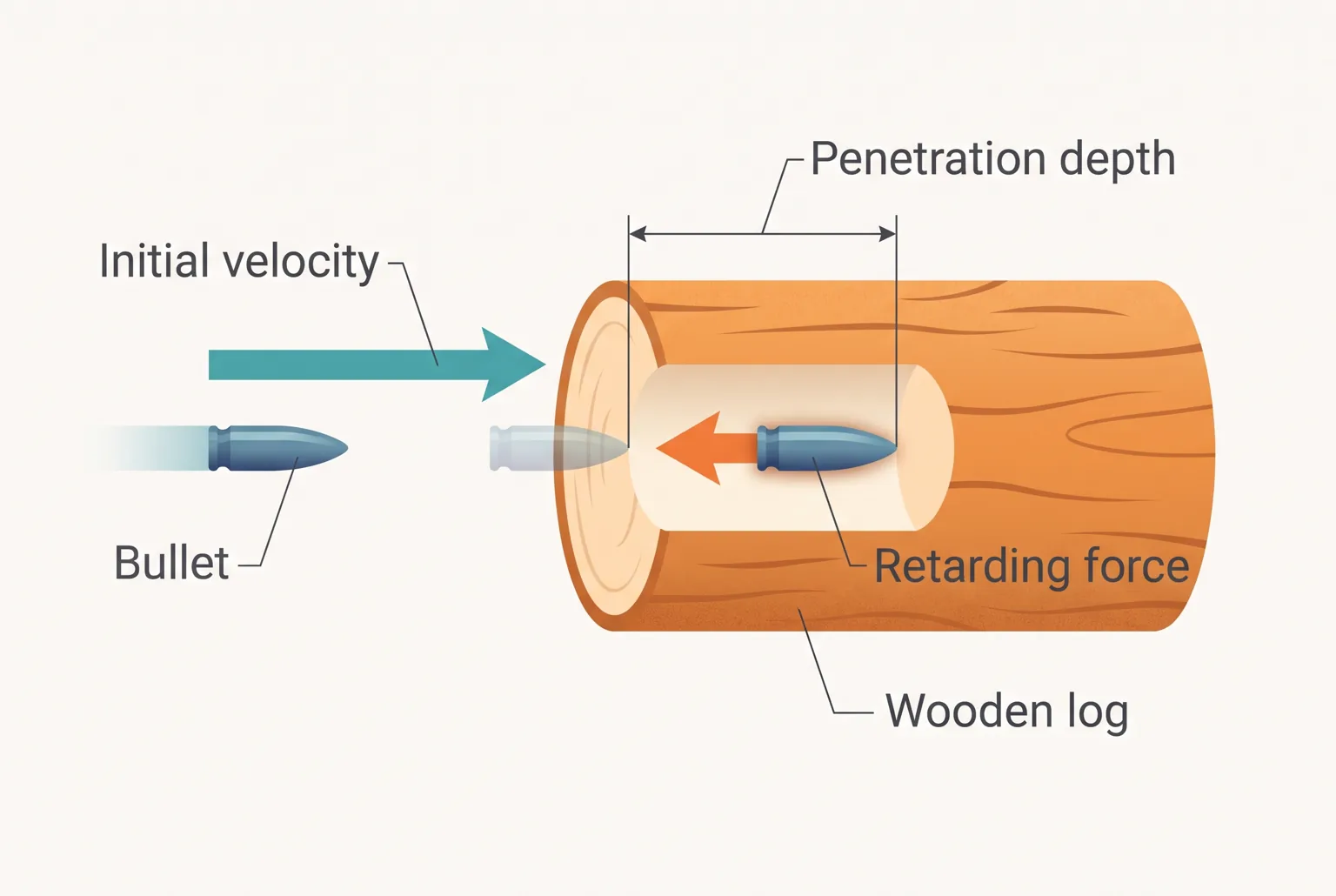
Case Study 2 examines the interaction between moving objects and resistive targets, such as a bullet penetrating a wooden log or a stationary target. These problems are solved using the work-energy theorem, which states that the work done by all forces (in this case, the retarding force of the target) equals the change in kinetic energy ().
Learners must calculate the average retarding force by determining the initial kinetic energy () and the work done over a specific penetration distance (). The material highlights the importance of unit conversion, such as changing grams to kilograms and centimeters to meters, to ensure results in Newtons and Joules. It also introduces scenarios involving air resistance, where the work done against the resistance is found by calculating the total mechanical energy lost between the point of firing and the point of impact on the ground.
Momentum Conservation in Collisions
Collisions form a significant portion of the assessment, covering both elastic and inelastic interactions. Case Study 3 and 4 explore how momentum is conserved in isolated systems regardless of whether kinetic energy is preserved. In a perfectly inelastic collision, such as two bodies sticking together, the final velocity is determined by the total initial momentum divided by the combined mass of the system.
The resource also delves into two-dimensional collisions, such as billiard balls or gas molecules hitting a wall. In these cases, momentum must be conserved independently along the and axes. For instance, when a molecule rebounds from a wall at an angle, its momentum vector changes because its direction changes, even if its speed remains constant. This distinction is vital for understanding that while the molecule's own momentum is not 'conserved' (it experiences an impulse), the total momentum of the molecule-wall-Earth system remains constant.
The Mechanics of Energy Loss and Restitution
Not all collisions are perfectly elastic or perfectly inelastic. The assessment introduces the coefficient of restitution (), defined as the ratio of the relative speed of separation to the relative speed of approach. A value of indicates a perfectly elastic collision where kinetic energy is conserved, while indicates a perfectly inelastic collision where the objects stick together.
The material provides specific examples, such as a head-on elastic collision between a moving mass and a stationary mass. It shows that the fraction of energy lost by the incident body depends on the mass ratio. In the specific case of equal masses colliding elastically and head-on, the bodies exchange velocities, causing the first body to come to a complete rest. This principle is applied in nuclear reactors, where hydrogenic materials (moderators) are used to slow down neutrons through collisions with protons of similar mass.
Common Mistakes to Avoid
- Ignoring Vector Components: In 2D collisions, remember that momentum is a vector. You must apply conservation laws separately to horizontal and vertical components.
- Unit Mismatches: Always convert mass to kg and distance to meters before calculating Energy in Joules or Force in Newtons.
- Confusing Momentum and KE Conservation: Momentum is conserved in all isolated collisions (elastic and inelastic). Kinetic energy is ONLY conserved in elastic collisions.
- Misinterpreting 'Stopping' Questions: If a question asks how much further a bullet penetrates, calculate the total distance and subtract the distance already covered.
Before You Move On
Ensure you are comfortable with the mathematical derivation of , as it is frequently used in multiple-choice questions to compare bodies of different masses. Additionally, practice setting up the work-energy equation () for different resistive scenarios. Mastery of these concepts is essential for both CBSE school exams and competitive entrance preparation, as they form the bedrock of classical mechanics.
Frequently asked questions
What is the difference between an elastic and an inelastic collision?
In an elastic collision, both momentum and total kinetic energy are conserved. In an inelastic collision, momentum is conserved, but some kinetic energy is converted into other forms of energy like heat or sound. In a perfectly inelastic collision, the objects stick together after impact.
How does mass affect the kinetic energy of two objects with the same momentum?
For a given momentum , kinetic energy is inversely proportional to mass (). Therefore, the lighter object will have more kinetic energy than the heavier one.
Does a falling object violate the law of conservation of energy as its potential energy decreases?
No. While the potential energy decreases as the object falls closer to the ground, it is converted into an equal amount of kinetic energy. The total mechanical energy (sum of and ) remains constant in the absence of air resistance.
Under what condition do two colliding bodies interchange their velocities?
This occurs during a head-on elastic collision between two bodies of equal mass. The first body comes to rest (if the second was initially stationary), and the second moves off with the first body's original velocity.
Spotted an error? Report a correction. Practise this in the app: notes, formula sheets and mind maps.








































Loading comments…