Waves and Sounds: CBSE Class 11 Physics Assessment Guide
CBSEPhysicsWaves and Sounds
This CBSE Class 11 Physics assessment combines topic-wise questions, mixed chapter practice and linked worked solutions. Use it to distinguish a travelling wave from the motion of the medium, then apply superposition and boundary conditions to sound, strings and air columns.
How the assessment is organised
The file separates practice questions from assessment questions within two topic blocks. The first, Waves and Their Superposition, starts with mechanical waves, wave equations and sound speed. The second is indexed as Stationary Waves and Doppler’s Effect; the visible questions in that block include standing waves, resonance, harmonics, beats and ultrasound. The chapter practice mixes topics and adds assertion-and-reason and case-based questions to the objective and written formats.
Use the topic practice to isolate a skill, such as reading a wave equation or identifying the boundary conditions. Then try the matching assessment without opening the answers. The separate question and solution indexes let you navigate by topic and question format; the link beside an individual question takes you straight to its worked solution.

Waves and Sounds | Class 11 | CBSE Assessment
In the StudentCurio app
Chapter-wise assessment questions and worked solutions cover wave propagation, superposition and reflection, standing waves on strings and in organ pipes, harmonics, beats, and sound. Helps Class 11 CBSE students practise conceptual and numerical questions in a range of formats.
Read a travelling wave in two ways
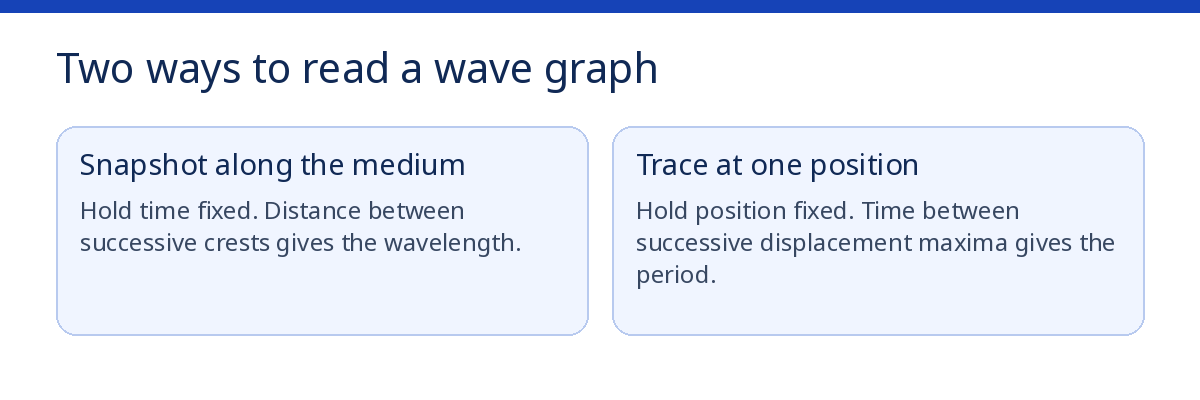
A travelling-wave equation gives displacement as a function of both position and time. Hold time fixed to see the shape of the disturbance along the medium; hold position fixed to follow one element of the medium as it oscillates. The assessment uses both viewpoints in graph and equation questions. The speed at which a crest travels is not the transverse velocity of a string element passing through its equilibrium position.
To determine the direction of a travelling profile, follow a feature at constant phase rather than reading an isolated plus or minus sign. A profile written as with travels towards increasing . That form describes translation, but it does not remove restrictions on the function: a real logarithm needs a positive argument, and a reciprocal is undefined where its denominator vanishes.
Before using a speed formula, identify the medium
For a small transverse disturbance on a uniform stretched string, the speed is , where is tension and is mass per unit length. If a question gives the total mass of a uniform string, use its stretched length to find the linear density. This is a propagation speed, not a measure of how far or how fast any point on the string moves sideways.
Sound in a gas requires a different model. The assessment asks why Laplace corrected Newton’s expression: the compressions and rarefactions are treated as adiabatic, rather than isothermal. In the ideal-gas model at fixed composition and temperature, changing pressure also changes density in proportion. That is why the pressure appearing in the sound-speed formula does not, on its own, imply that higher pressure gives faster sound.
Use superposition to connect interference and beats
In the linear model, superposition means adding the signed displacements of overlapping waves at the same position and time. Adding amplitudes alone misses the role of phase. For equal-frequency sinusoidal waves, phase determines whether the contributions reinforce or oppose each other, and complete cancellation requires equal amplitudes as well as opposite phase. Zero resultant displacement during overlap does not mean the component waves have been destroyed.
Beats use the same principle, but the frequencies are close and unequal, so their relative phase changes with time. The beat rate describes the recurring loudness variation, not the frequency of the sound oscillation itself. The worksheet’s reference to a ten-hertz difference is not used here as a universal cutoff for hearing beats.
Draw the boundaries before choosing a harmonic
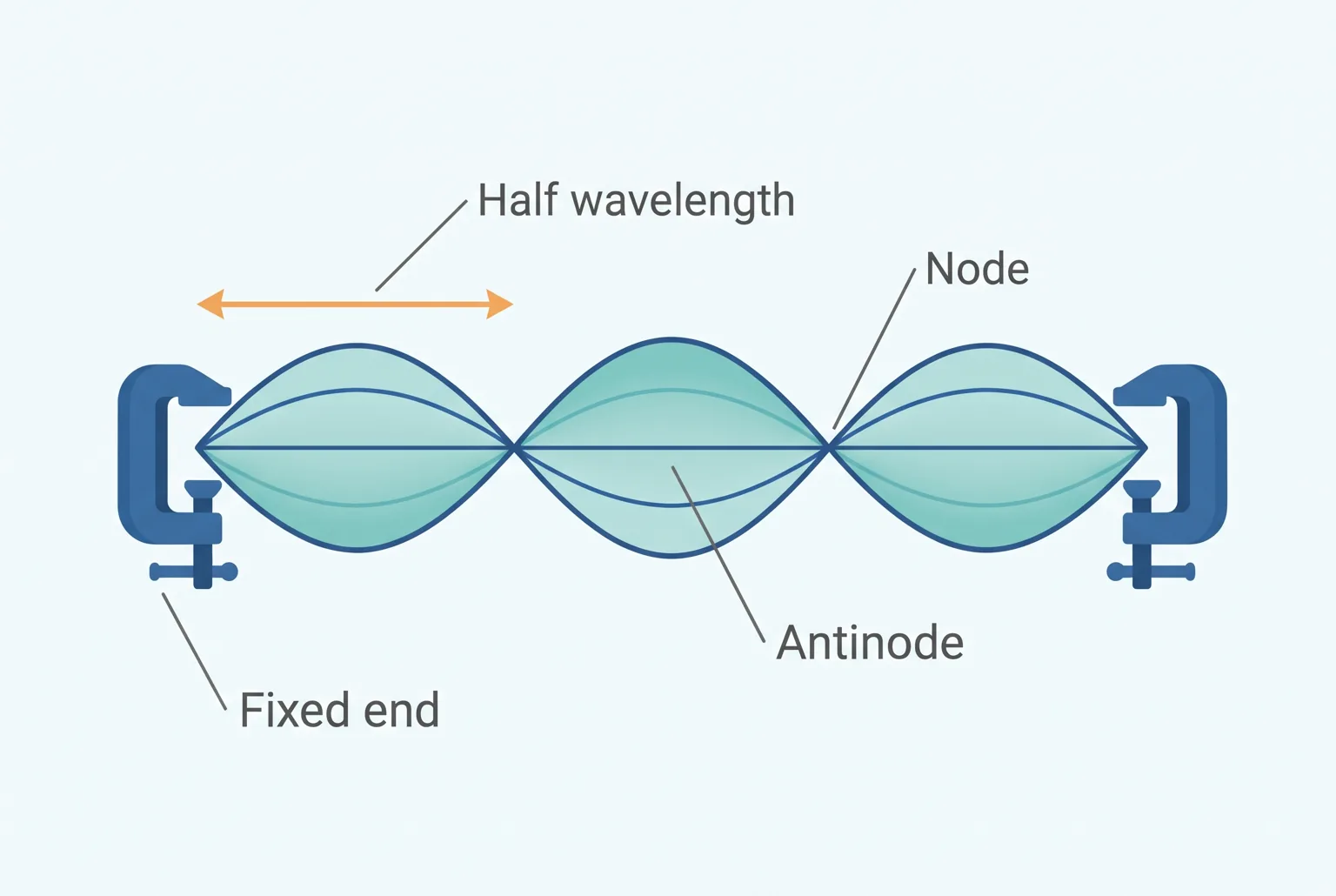
A standing wave has a fixed pattern of nodes, where displacement stays zero, and antinodes, where displacement amplitude is greatest. The cover diagram shows that adjacent nodes are half a wavelength apart. For a string fixed at both ends, both endpoints are displacement nodes, so the length must accommodate a whole number of half-wavelengths.
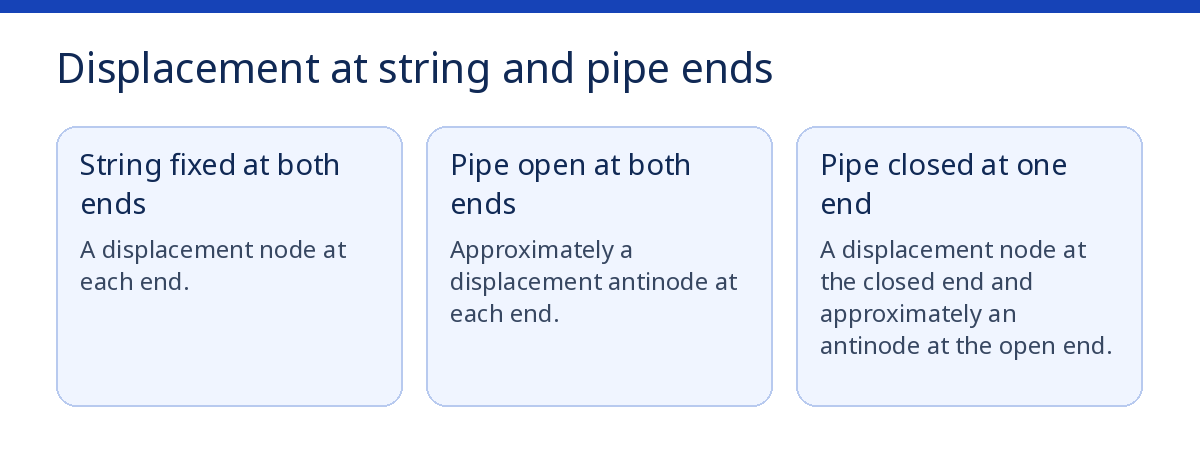
For sound in an ideal air column, a closed end is a displacement node and an open end is approximately a displacement antinode. The pressure pattern reverses those labels: a displacement node is a pressure antinode. A pipe open at both ends therefore has the full integer harmonic series, whereas a pipe closed at one end has only odd harmonics in the ideal model. The resonance-length practice also asks you to test whether neglecting the open-end correction fits the observations.
Quick self-check: what does the diagram show?
Before interpreting a graph, ask whether it shows displacement along the medium at one instant or displacement over time at one position. Which axis would let you read a wavelength directly, and which would let you read a period? For standing-wave snapshots, ask whether a point stays at zero displacement or merely passes through zero at the instant shown. An instantaneous zero alone is not enough to mark a node.
In a pipe sketch, label the pattern as displacement or pressure before marking either end. Then explain how changing one end from open to closed changes the set of patterns that can fit, rather than simply substituting the same length into another formula.
Turn the worked solutions into a second attempt
When you move to chapter practice, identify the model before calculating: propagation in a medium, overlapping waves or resonance under specific boundary conditions. For an assertion-and-reason item, judge the two statements separately before deciding whether the reason explains the assertion. For a case-based item, use the stated setup to decide which quantities or assumptions carry through to each part.
After checking a worked solution, use Back to question to revisit the prompt. If your result differed, locate the first decision that changed the outcome: perhaps you read the wrong axis, mixed length units or assigned the wrong type of endpoint. Retry from that step so you practise the reasoning rather than memorise the result.
Spotted an error? Report a correction. Practise this in the app: notes, formula sheets and mind maps.








































Loading comments…