Units and Measurements: CBSE Class 11 NCERT Physics Notes
CBSEPhysicsUnits and Measurements
These NCERT revision notes for CBSE Class 11 Physics connect three skills: expressing a measurement in the right unit, reporting it to an appropriate precision, and checking whether an equation makes dimensional sense.
What the notes cover and where to start
The clickable index divides Chapter 2 into three topics: systems of units from page 3, significant figures and rounding off from page 15, and dimensions of physical quantities from page 21. It also lists a chapter summary on page 34. If you are reading the chapter for the first time, follow that order: first establish what the unit means, then decide what the digits communicate, and finally examine how quantities are related.
For revision, use the index to locate the source of a specific mistake. A result in the wrong unit calls for a look at conversion factors. A result with too many digits calls for the arithmetic rules. An equation whose terms represent different kinds of quantities calls for a dimensional check.

Units and Measurements Class 11 Physics | NCERT Theory | Revision Notes
In the StudentCurio app
Comprehensive revision notes covering SI units, significant figures, and dimensional analysis. Designed for Class 11 students to master measurement fundamentals and physical quantity relationships.
A measurement is a number together with a unit
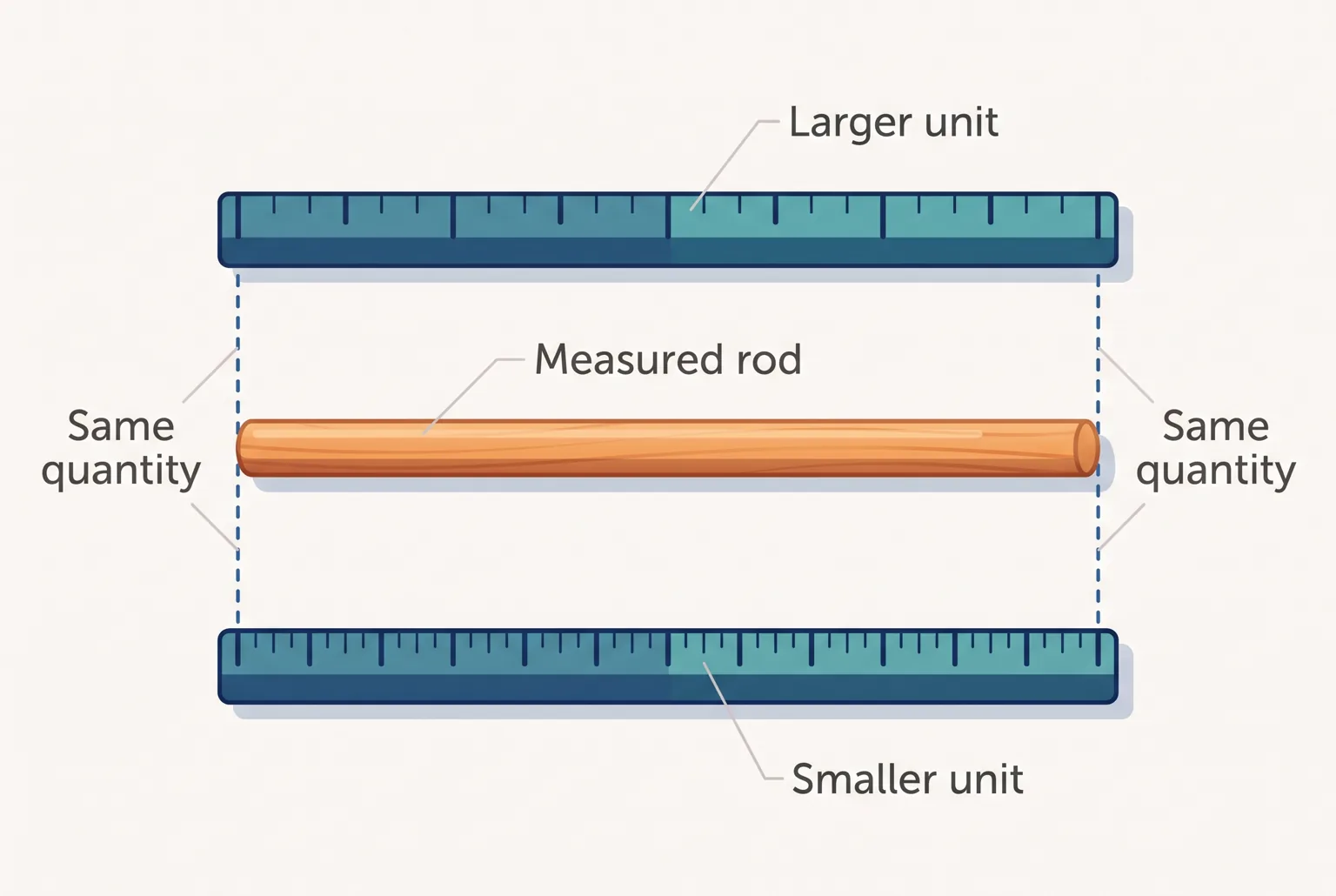
Measuring a physical quantity means comparing it with a standard amount of the same kind. The notes write this as , where is the numerical value and is the chosen unit. The number alone does not tell you the measurement. For a fixed quantity, choosing a smaller unit gives a larger numerical value because more copies of that unit are needed to express the same quantity.
The notes distinguish base quantities, such as length, mass and time, from derived quantities, such as speed. Speed is distance divided by time, so its SI unit is metre per second, . Read the negative exponent as ‘per second’. This connection between a quantity’s definition and its unit is more useful than memorising the unit on its own.
Read the SI tables as relationships
The SI base quantities listed in the notes are length, mass, time, electric current, thermodynamic temperature, amount of substance and luminous intensity. Their units are the metre, kilogram, second, ampere, kelvin, mole and candela. The derived-unit tables then show how named units connect to other units. For instance, the pascal is a newton per square metre, which reflects the relationship between pressure, force and area.
The base-unit table includes historical definitions. Use it to identify the quantities and symbols, not as a statement of all current SI definitions. The notes also explain the radian for plane angle and the steradian for solid angle under the older ‘supplementary’ label. In current SI, both are dimensionless derived units: the first comes from a length ratio, the second from a ratio of areas.
Common conversion mistake: turning the factor upside down
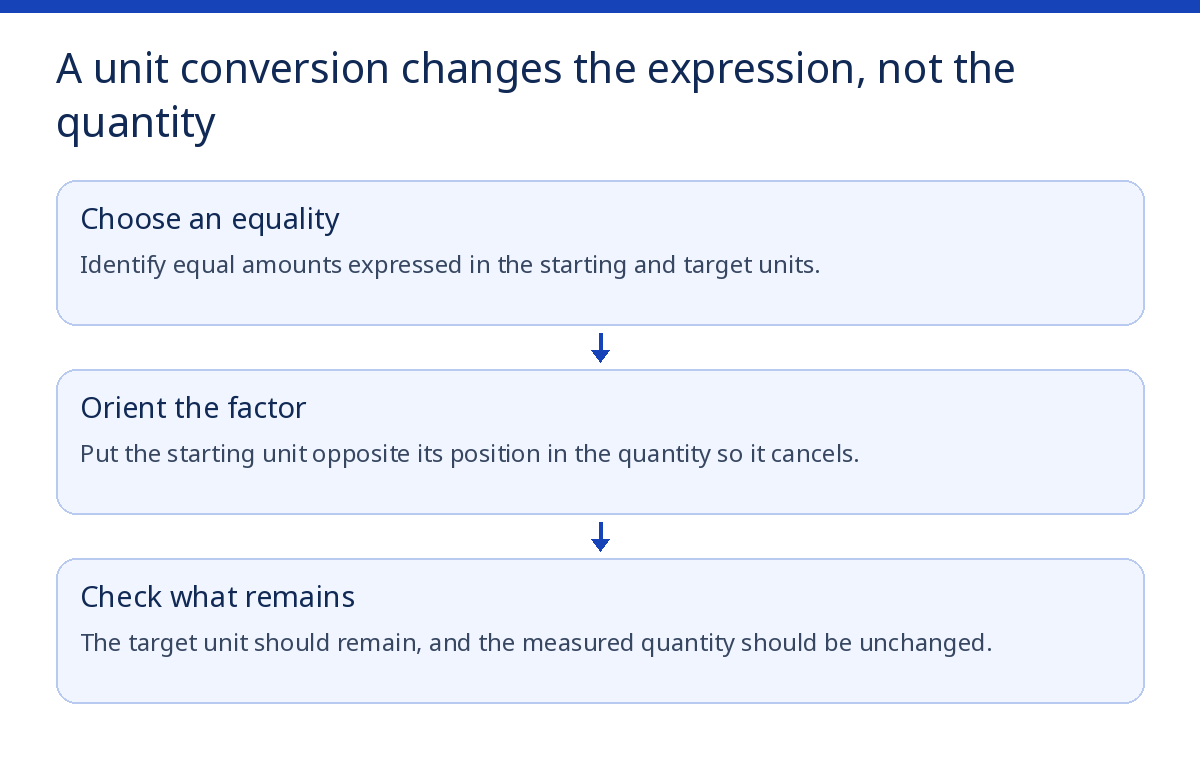
A conversion factor is a ratio of two equal quantities, so the ratio is one when the units are included. Write the factor in whichever direction cancels the unit you want to remove. When converting minutes to seconds, for example, minutes belong in the denominator of the factor. Check the unit that remains before checking the arithmetic; this often exposes an inverted factor immediately.
The prefix table is useful here because a prefix changes the scale of the unit by a power of ten. When the unit is squared or cubed, the conversion factor must also be squared or cubed. The notes’ litre entry illustrates the distinction: a cubic decimetre is because the length scale applies in all three dimensions. The printed metre-to-parsec worked result is omitted here because it does not follow from the value given in that example.
Which digits should a calculated result keep?
The index separates significant figures, rounding, arithmetic rules and uncertainty. That distinction matters: significant figures tell you which digits to report, while uncertainty describes how much a measurement or calculated result may vary. A calculator can display more digits than the original measurements justify.
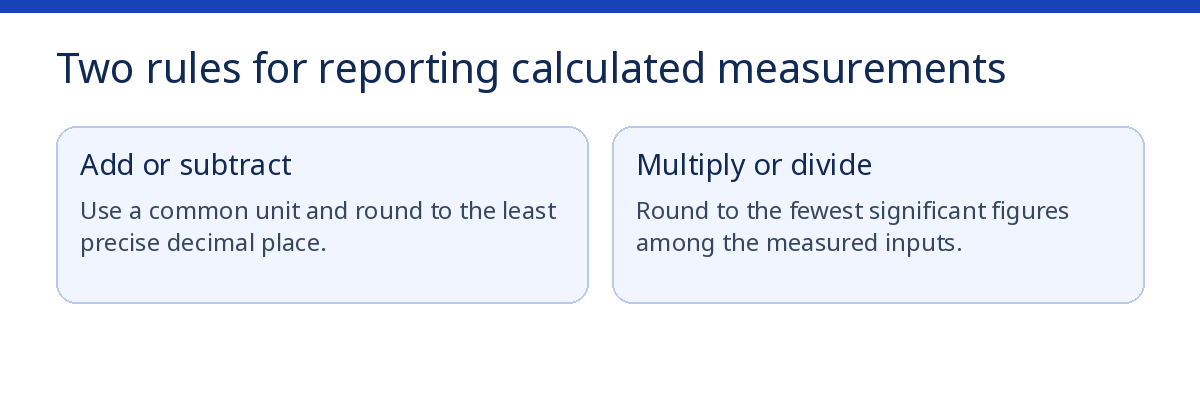
Match the rule to the operation. For addition or subtraction of measured values expressed in the same unit, round to the least precise decimal place among the inputs. For multiplication or division of measured values, round to the fewest significant figures among the inputs. Those rules answer different questions: where the last reported digit belongs, or how many significant digits to report. When comparing written measurements, remember that leading zeros only locate the decimal point; trailing zeros after a decimal point can indicate reported precision.
Quick self-check: what can dimensions actually prove?
A dimensional formula records the powers of base quantities, rather than the units chosen to express them. Speed has dimensions whether it is written in metres per second or kilometres per hour. The index points to applications in checking equations, converting between unit systems and deducing possible relationships among quantities.
For an equation to be dimensionally consistent, both sides must have the same dimensions, and terms added or subtracted must also match. Take an equation you already know and ask which terms would have to share dimensions. Then ask what the check would miss: could an incorrect numerical coefficient pass? Yes. A dimensionless numerical factor leaves the dimensions unchanged. Dimensional consistency can therefore rule out an equation, but it cannot establish that a proposed equation is physically correct.
Spotted an error? Report a correction. Practise this in the app: notes, formula sheets and mind maps.








































Loading comments…