CBSE Class 11 Physics: Units and Measurements Assessment
CBSEPhysicsUnits and Measurements
Use this Class 11 CBSE Physics assessment to practise unit conversions, significant figures, measurement errors and dimensional analysis. The file separates topic-wise practice from assessment and mixed chapter practice, with a clickable index for finding the corresponding worked solutions.
Start with the question index, not the solutions
The question index divides the assessment into System of Units, Significant Figures and Rounding Off, and Dimensions of a Physical Quantity. Each topic has a practice set and a separate assessment set. If one skill is causing trouble, start with that topic’s practice questions. Once you can explain your method without looking at a solution, try the assessment set and see whether it holds up when the quantities or question format change.
The chapter practice section mixes topics through objective, assertion-and-reason, case-based and written questions. Use it once you are ready to choose a method without a topic heading prompting you. The separate solutions index mirrors the question structure, and the individual questions shown in the excerpt also have solution links. That makes it possible to check one attempt without reading through the rest of the set.

Units and Measurements | Class 11 | CBSE Assessment
In the StudentCurio app
Chapter-wise practice questions and worked solutions cover units and conversions, significant figures, measurement errors, and dimensional analysis, with objective, written, and case-based questions. Suitable for Class 11 students revising Units and Measurements and checking their problem-solving.
System of Units: Keep the quantity fixed as the unit changes
A measurement expresses a physical quantity using a number and a unit. When you convert a measurement, the numerical value changes to compensate for the change in unit; the quantity itself stays the same. The assessment tests this idea with SI and CGS conversions and with units suited to astronomical, atomic and nuclear scales. A light-year, for example, is a unit of distance despite its name. Choosing a unit appropriate to the scale can make the number easier to read without changing what it describes.
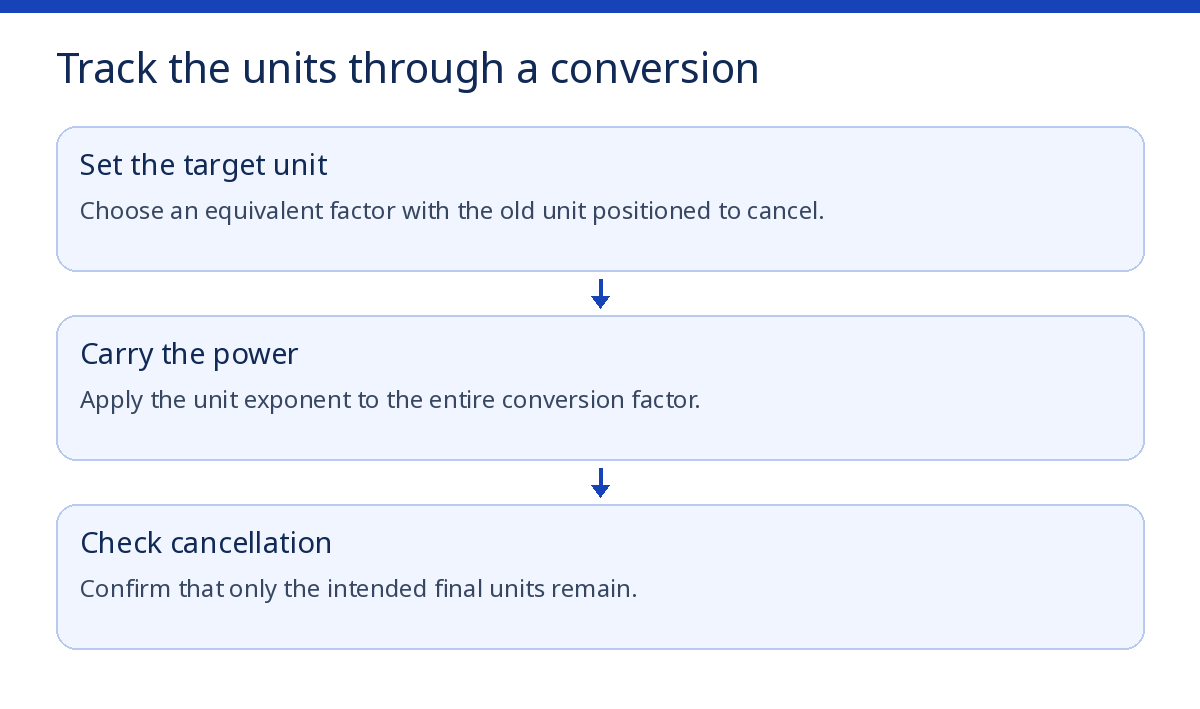
For conversions involving derived units, write the conversion factors so that the original units cancel. Apply each factor to the full power of its unit: a length conversion must be squared for area and cubed for volume. In an acceleration conversion, the time unit is in the denominator and is squared. Keeping that exponent visible is a useful check before you calculate.
Common mistake: Using one rounding rule for every operation
The significant-figures sets ask you both to interpret reported digits and to decide which digits to keep after a calculation. Leading zeros locate the decimal point and are not significant. Trailing zeros after a decimal point can communicate the precision of a reported measurement. Trailing zeros in a whole number written without a decimal point can be ambiguous; scientific notation makes the intended significant digits explicit in the coefficient.
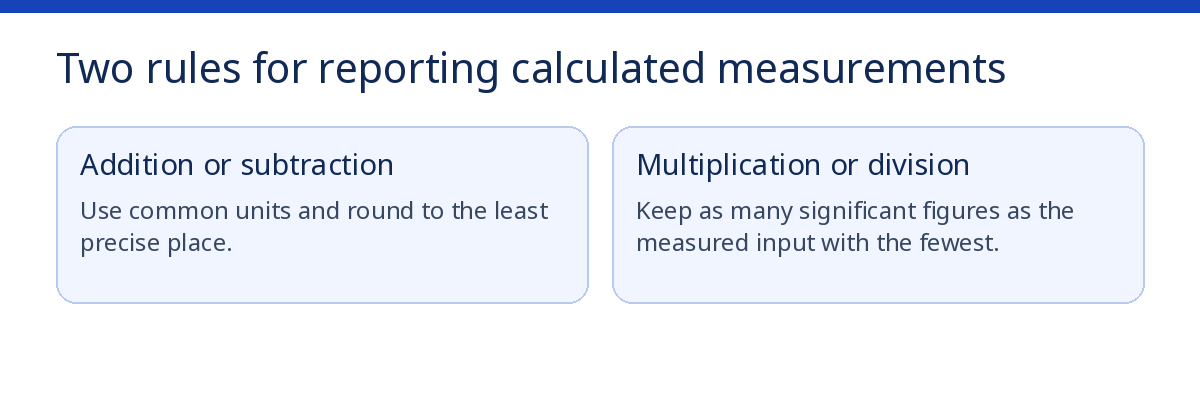
For addition and subtraction, first express measurements in the same unit, then round the result to the least precise place among the inputs. For multiplication and division of measured quantities, round to the fewest significant figures among the inputs. In a calculation with several steps, retain extra digits in intermediate values so that early rounding does not distort the final result. The objective item on page 17 that asks for a correct option among rounded sums and differences is omitted here because none of the listed options follows the applicable rule.
Read measurement uncertainty separately from rounding
The cover’s ruler illustration distinguishes two ideas: the smallest marked division describes the scale’s resolution, while the length of an object is found from the difference between its endpoint readings. A fine scale does not guarantee accuracy, which is closeness to a reference or accepted value. Precision describes how closely repeated readings agree; readings can cluster closely and still be shifted away from the reference value.
The practice questions also use measurements with stated uncertainties. An absolute uncertainty has the same unit as the measured quantity, while a fractional uncertainty compares that uncertainty with the magnitude of the measured value. Expressing the fraction as a percentage makes it easier to compare relative uncertainties across inputs. For the usual small-error, worst-case estimate in a product or quotient, add the fractional contributions; for a factor raised to a power, weight its contribution by the magnitude of that power. This estimates uncertainty, not the number of digits to retain.
What dimensional analysis can and cannot tell you
Dimensions describe how a quantity depends on base quantities, not which units you choose to report it in. In mechanics, a dimensional formula typically uses mass, length and time. The assessment asks you to obtain dimensions from familiar relations, compare quantities and infer the dimensions of constants or coefficients. Start with a defining relation you understand, replace each quantity with its dimensions and simplify the powers. A coefficient is not automatically dimensionless just because it is called a constant.
Dimensional homogeneity requires each term being added or subtracted to have the same dimensions, and the two sides of an equation must match. If they do not, recheck the relation or your substitution. Matching dimensions, however, do not prove that an equation is physically correct: the check cannot detect a missing dimensionless numerical factor. Nor does a shared dimensional formula mean two quantities describe the same physical idea.
Before you move on: Find the first step that went wrong
When checking a written response, compare the first line where your reasoning differs from the worked solution rather than starting with the final number. In a conversion question, inspect which units cancel. In a rounding question, identify the operation that governs the reported result. In a dimensions question, check whether the relation you started with actually defines or connects the quantities in the question. This helps distinguish a conceptual mistake from an arithmetic slip.
For assertion-and-reason practice, judge each statement on its own before deciding whether the reason explains the assertion. In a case-based question, identify which details supply measurements, which supply units and which state a relationship you need. Then try another question of the same type without consulting the previous solution. The aim is to reproduce the reasoning on a new problem, not simply recognise it on the page.
Spotted an error? Report a correction. Practise this in the app: notes, formula sheets and mind maps.








































Loading comments…