System of Particles and Rotational Motion: Class 11 Notes
CBSEPhysicsRotational Motion
These NCERT revision notes for CBSE Class 11 Physics connect the motion of a system’s centre of mass with the rotation of an extended body. Use this guide to see how the topics fit together and check the conditions behind the chapter’s main rules.
Why a rigid body is more than a point mass
A point-mass model can describe where an object goes, but it cannot show how the object changes orientation. The notes begin by treating an extended body as a system of particles. In the rigid-body model, distances between pairs of particles stay fixed. A wheel can be treated this way when its deformation is small enough to ignore.
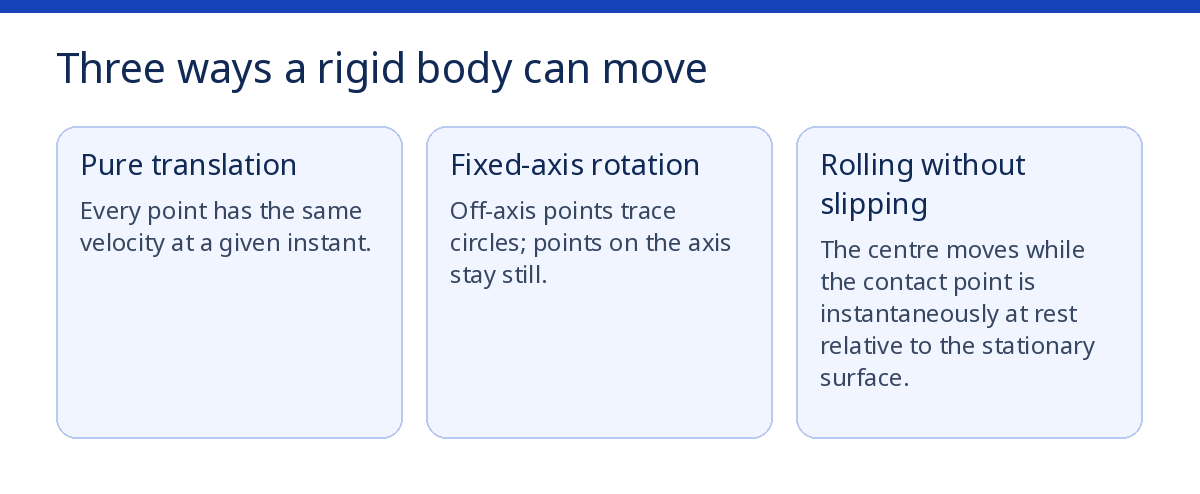
In pure translation, every point has the same velocity at any given instant. In rotation about a fixed axis, a point off the axis traces a circle in a plane perpendicular to the axis. The radius is the point’s perpendicular distance from the axis, so a point on the axis stays stationary. Rolling introduces a third description: the body turns while its centre of mass moves.

System of Particles and Rotational Motion Class 11 Physics | NCERT Theory | Revision Notes
In the StudentCurio app
Comprehensive revision notes covering rigid body dynamics, center of mass, torque, and rotational mechanics for Class 11 students and competitive exam aspirants.
Centre of mass: weight each coordinate by mass
The notes develop the centre of mass first for two particles, then for many particles and continuous bodies. For a discrete system, the x-coordinate is , where is the total mass and every coordinate is measured from the same origin. Apply the same rule separately along the other coordinate axes. For two particles, the centre of mass lies on the line segment joining them. It lies at the midpoint if their masses are equal and closer to the heavier particle otherwise.
For a continuous body, the sum becomes an integral: . The uniform thin rod in the notes illustrates why the mass distribution matters. Its mass per unit length is constant, so equal lengths on either side of the midpoint carry equal mass. The midpoint follows from uniformity, not simply from the object being rod-shaped.
What changes a system’s linear momentum?
For constant particle masses, differentiating the centre-of-mass position gives the mass-weighted average velocity. Multiplying that velocity by the total mass gives the system’s total linear momentum, . This is the vector sum of the individual momenta, not the sum of their magnitudes. Particles moving in different directions can therefore have momenta that cancel.
The corresponding force law is . Internal forces can change individual particles’ velocities, but their action–reaction pairs cancel when the forces on the whole system are added. Decide which particles belong to the system before deciding which forces are external. If the net external force is zero, total linear momentum stays constant and the centre of mass keeps its initial velocity. It stays in place only if it was initially at rest.
Good to remember: torque needs a reference point
The notes pair torque with angular momentum to explain how the turning effect of a force changes motion. A force can have zero torque about a point if its line of action passes through that point. That does not mean the force is absent or has no effect on translation. To identify the turning effect, look at the force’s line of action as well as its magnitude.
A particle’s angular momentum is , where the position vector starts at the chosen reference point. Its time derivative equals the net torque about that same fixed point. Keep the reference point consistent across the calculation. In particular, zero net external torque about a fixed point means the system’s angular momentum about that point is conserved.
Equilibrium: check force and torque separately
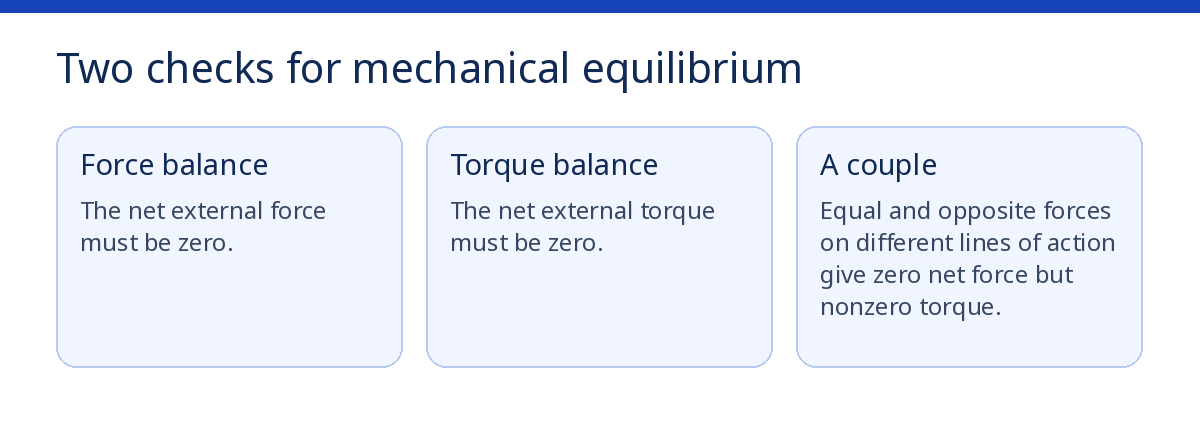
The index separates translational equilibrium from rotational equilibrium before bringing them together for a rigid body. For full mechanical equilibrium, both the net external force and the net external torque must vanish. Checking only one condition leaves open the possibility that the other is not satisfied.
A couple, also listed in the notes, makes the distinction concrete: equal and opposite forces along different lines of action cancel in the force sum but produce a nonzero torque. When reviewing the principle of moments, compare clockwise and anticlockwise moments about the same point, and check the force balance separately. The index places centre of gravity alongside this material because the point at which weight is taken to act matters when calculating its moment.
When the rolling relation applies
The second topic in the index groups moment of inertia with fixed-axis dynamics and rolling. Moment of inertia depends on how mass is distributed relative to a specified axis. Before using a value from the standard cases, check both the body’s shape and the stated axis. The same body can have different moments of inertia about different axes.
For a circular body rolling without slipping on a stationary surface, the centre-of-mass speed equals the radius times the magnitude of the angular velocity. At that instant the point of contact is at rest relative to the surface, not relative to the moving centre. If the body slips, that speed relation does not generally hold. The notes’ rolling-energy topic brings the two motions back together: count both the translational kinetic energy of the centre of mass and the rotational kinetic energy about it.
Use the checklist, index and summary together
Start with the chapter checklist, then use the clickable index to go directly to the prerequisite for a topic you want to revise. If rolling energy is unclear, revisit the moment-of-inertia and rotational-energy entries first. If equilibrium is unclear, revisit torque before the principle of moments. After reading, use the chapter summary to check whether you can state each rule with its condition, not just recall its formula.
This guide omits the worked answers to Examples 1–4, the disputed torque, electron and rolling-sphere examples, the printed boxed centre-of-mass vector formula on page 9, and the ambiguous inline external-force notation on page 12.
Spotted an error? Report a correction. Practise this in the app: notes, formula sheets and mind maps.








































Loading comments…