Case-Based Physics: Systems of Particles and Rotational Motion
CBSEPhysicsRotational Motion
Master the complexities of extended bodies, center of mass, and rotational dynamics through targeted Class 11 CBSE case studies and numerical applications.
Transitioning from Point Masses to Extended Systems
In introductory mechanics, learners often treat objects as hypothetical point masses. However, real-world objects have a definite size and shape, which necessitates the study of systems of particles. While a point mass is limited to translational motion, an extended object can undergo translational motion, rotational motion, or a combination of both. This resource provides a focused assessment on these dynamics, specifically designed for the Class 11 CBSE curriculum.
The material covers the transition from simple linear kinematics to the more complex behavior of rigid bodies. A key challenge in this chapter is that every particle within a system may move differently than its neighbors. To simplify this, physicists define the Center of Mass (COM), a unique point that describes the overall motion of the system as if all mass were concentrated there. By engaging with these case studies, students learn to distinguish between the motion of the COM and the rotation of the particles around it.

Systems of Particles and Rotational Motion Class 11 |Physics | CBSE Case Based Assessment
In the StudentCurio app
Comprehensive case-based assessment questions and detailed solutions for Class 11 Physics, covering the centre of mass, moment of inertia, and rotational dynamics.
Determining and Visualizing the Center of Mass
The center of mass of a system of particles is mathematically defined by the distribution of mass across various coordinates. For a system of particles with masses at positions , the position of the center of mass is calculated using the weighted average: . A critical takeaway from the source material is that the instantaneous position of the COM depends strictly on the masses and their relative distances, not on the external forces currently acting on the particles.
Visualizing the COM is often counterintuitive. For instance, in a uniform bangle, the COM lies at the geometric center, which is in the empty space outside the material itself. Similarly, changing the mass distribution within an object—such as filling a hollow sphere halfway with sand—shifts the COM toward the concentrated mass. The resource uses these conceptual shifts to help students understand that the COM is not always a physical point within the solid matter, but a balancing point of the mass distribution.
Kinematics of Rotational Motion
Rotational kinematics involves relating angular displacement, velocity, and acceleration to their linear counterparts. The source material emphasizes the relationship between angular velocity and linear velocity . For a particle moving in a circle of radius , the speed is given by . This is illustrated through practical examples like a Ferris wheel or a bike wheel.
When a body rotates about a fixed axis, the angular velocity vector lies along that axis according to the right-hand rule. While the magnitude of might change (angular acceleration), its direction remains constant for fixed-axis rotation. The assessment challenges students to calculate these values using the formula . For example, a full revolution corresponds to an angular displacement of radians. If the rotation is non-uniform, students must apply the equations of constant angular acceleration, such as , where is the angular acceleration in .
Moment of Inertia and Mass Distribution
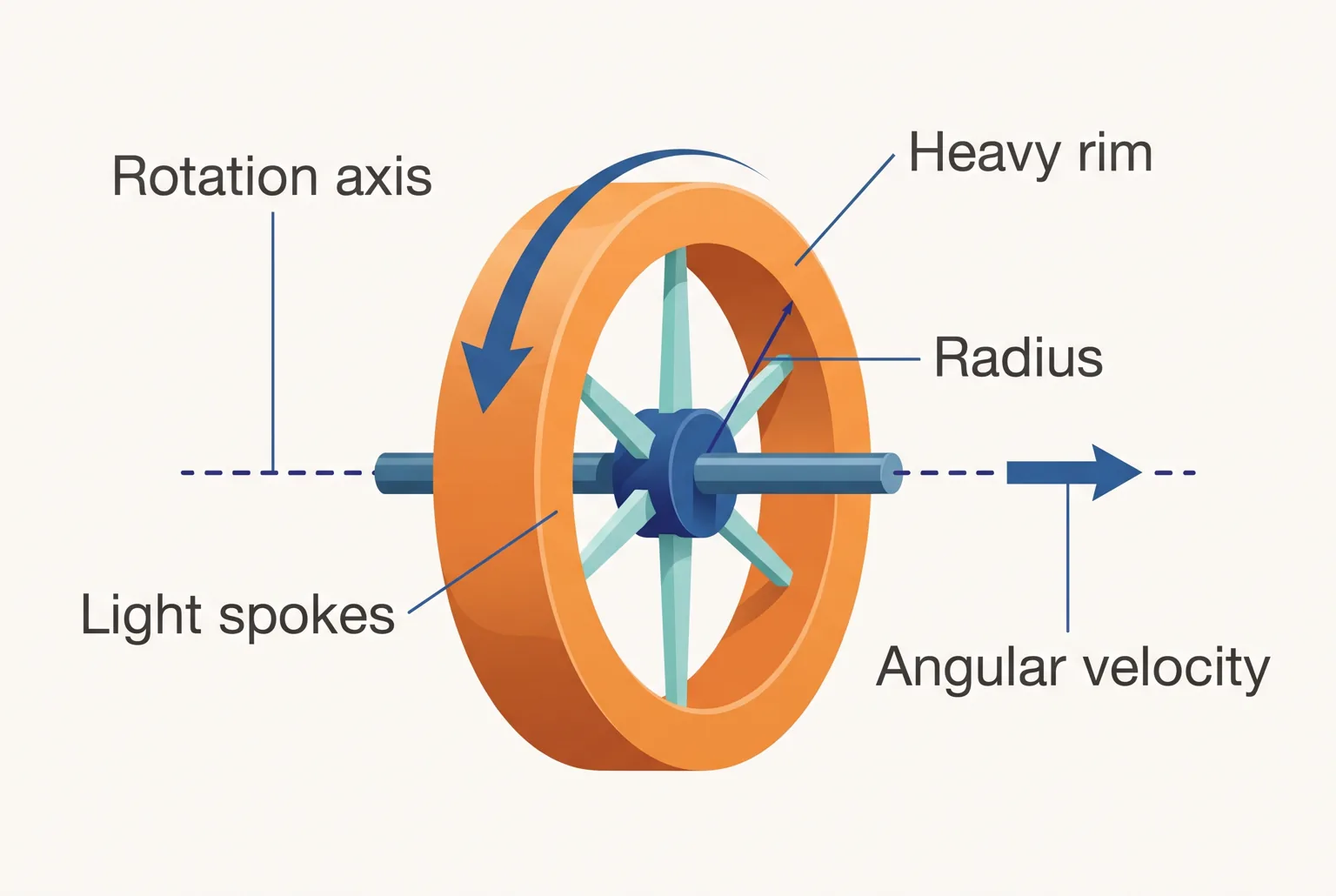
The Moment of Inertia (I) is the rotational analogue of mass in linear motion; it measures an object's resistance to angular acceleration. Unlike mass, which is a constant property of the object, the moment of inertia depends heavily on the axis of rotation. The formula shows that mass located further from the axis contributes significantly more to the total inertia than mass located near the center.
This principle is the reason behind the design of flywheels, which are constructed with most of their mass concentrated at the rim. By increasing without increasing the total mass, the wheel becomes more resistant to sudden changes in speed, effectively smoothing the motion of engines. Similarly, in a composite disc made of iron and aluminium, placing the denser iron at the exterior increases the moment of inertia compared to placing it at the center. This section of the resource helps students connect the abstract mathematical definition of to industrial design and mechanical stability.
Rotational Dynamics: Torques and Couples
Dynamics explores the forces that cause rotation. A couple is a specific arrangement of two equal and opposite forces acting along different lines of action. Because the forces are equal and opposite, the net external force on the system is zero, meaning there is no translational acceleration of the center of mass. However, the forces do not cancel out in terms of torque. They create a resultant torque of magnitude (where is the perpendicular distance between the forces).
If a system is initially at rest, a couple will produce purely rotational motion about the center of mass. This distinction is vital for solving problems involving rigid bodies. The resource also examines the behavior of objects on frictionless surfaces. On a perfectly smooth inclined plane, a wheel will slide rather than roll. Since friction is the force that usually provides the tangential torque required for rolling, its absence means the wheel has no angular acceleration , even though it accelerates linearly down the slope due to gravity.
Practical Analysis of Internal and External Forces
A recurring theme in systems of particles is the distinction between internal and external forces. Internal forces, such as two people pulling on a rope between two boats, cannot change the motion of the system's center of mass. If there is no external horizontal force (ignoring friction), the COM of the two-boat system remains at a constant velocity. If the boats start from rest, the COM remains stationary.
Consequently, the boats will always meet at the initial center of mass, regardless of whether one person pulls or both pull. This conceptual tool allows students to predict the outcome of complex interactions without needing to calculate every individual force. The assessment uses this scenario to reinforce the principle that only external forces can accelerate the center of mass of a system, a fundamental law in CBSE Class 11 Physics.
Frequently asked questions
Why does the center of mass of a bangle lie outside the object?
The center of mass is the average position of the mass distribution. For a uniform circular object like a bangle, symmetry dictates that this point is the geometric center. Since the bangle is hollow, that center point contains no physical material, but it still serves as the center of mass.
How does mass distribution affect the moment of inertia of a disc?
Moment of inertia increases when mass is placed further from the axis of rotation. In a disc made of iron and aluminium, placing the denser iron at the outer rim results in a higher moment of inertia than if the iron were at the center.
Can a couple cause translational motion?
No. By definition, a couple consists of two equal and opposite forces. The net force is zero (), so there is no acceleration of the center of mass (). It only produces rotational motion.
What happens to a wheel released on a perfectly frictionless incline?
The wheel will undergo sliding motion rather than rolling. Rolling requires a torque to produce angular acceleration, and on a frictionless surface, there is no tangential force to provide that torque.
Spotted an error? Report a correction. Practise this in the app: notes, formula sheets and mind maps.








































Loading comments…