CBSE Class 11 Physics: Oscillations Assessment Guide
CBSEPhysicsOscillations
This CBSE Class 11 Physics assessment moves from recognising periodic motion to explaining how springs, pendulums and other systems oscillate. Use the topic tests and chapter practice to check whether you can connect equations, motion graphs and physical reasoning.
How the assessment is organised
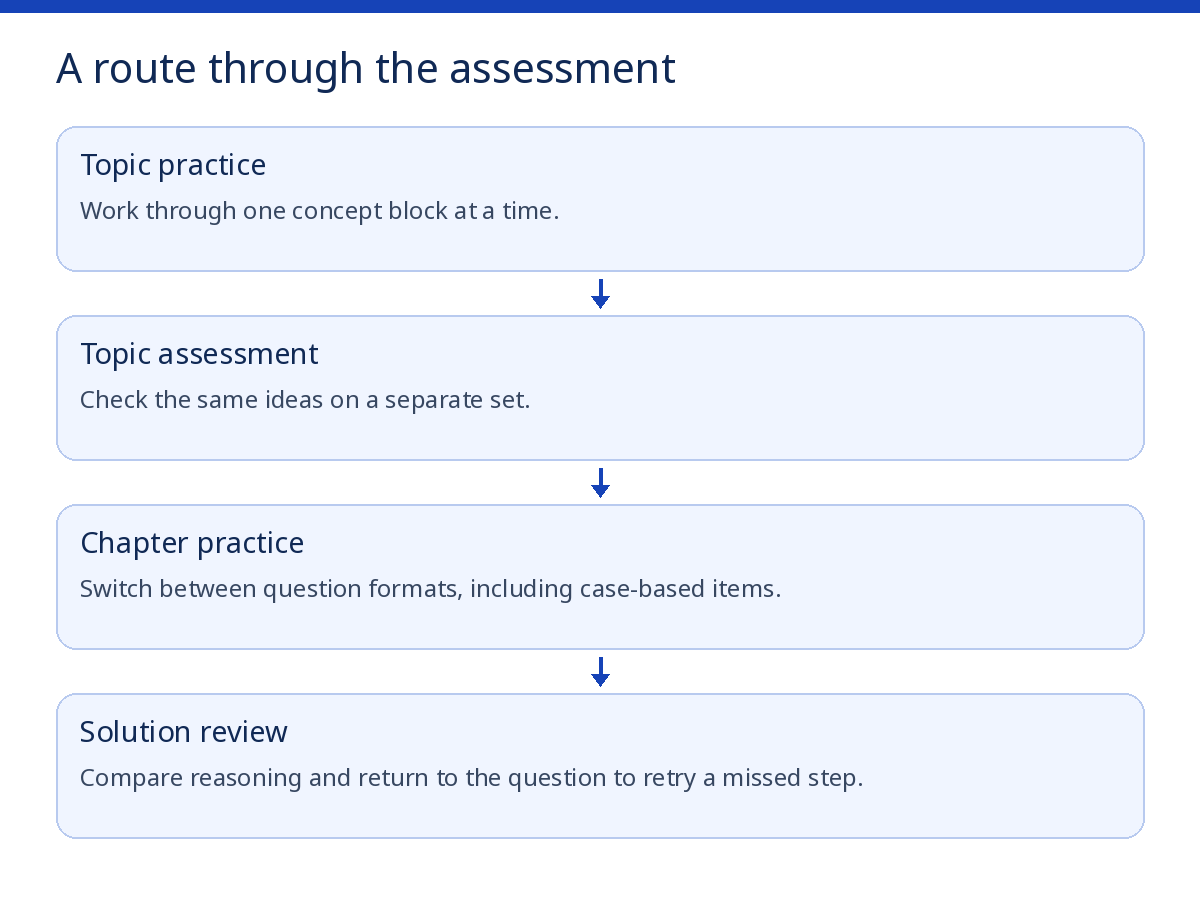
The PDF has two topic blocks. Introduction to Oscillation covers periodic motion, simple harmonic motion, phase and graphs. Force and Energy in SHM and Systems Executing SHM shifts the focus to what causes the motion and how to model different oscillators. Each block separates Practice Questions from Assessment Questions, so you can work through one set and then test the same ideas on another without immediately revisiting a solution.
The chapter practice adds assertion-and-reason and case-based questions to the objective and written formats. Use an objective item to check whether you recognise a principle, then use a longer response to practise stating why it applies. The clickable index provides separate routes to questions and worked solutions.

Oscillations | Class 11 | CBSE Assessment
In the StudentCurio app
This Class 11 assessment provides objective, short-answer, long-answer and case-based questions with worked solutions on oscillations, including simple harmonic motion, spring systems, energy, pendulums, phase and motion graphs. It helps students practise concepts and calculations and review problem-solving steps.
What makes an oscillation simple harmonic?
Periodic motion repeats after a fixed interval. Oscillatory motion is back-and-forth motion about an equilibrium position. These descriptions are not interchangeable: a periodic motion need not move back and forth along a line, and a repeating displacement graph need not describe SHM. When checking a graph for periodicity, look for the recurrence of the whole pattern, not just two points with the same displacement. An oscillator can pass through the same position while moving in opposite directions.
For linear SHM, displacement is measured from equilibrium and acceleration satisfies , with constant . The minus sign puts acceleration opposite to displacement; the constant coefficient makes its magnitude directly proportional to displacement. A restoring tendency alone is not enough to establish SHM.
Connect phase, equations and reference circles
In the form , is the amplitude, is angular frequency and is the phase at the chosen time origin. The phase tells you where the oscillator is in its cycle. An initial displacement alone may not distinguish between two ways of passing through a position; the direction of the initial velocity helps distinguish them. A sine expression and a cosine expression can represent the same motion if their phase constants account for the different conventions.
The reference-circle questions give you a geometric way to read these quantities. The radius sets the amplitude of the projection, while the marked starting point and sense of rotation determine how that projection begins to change. The projected motion is linear even though the reference point moves around a circle.
Common mistake: Reading direction from displacement
On a displacement–time graph, the vertical coordinate gives displacement; the slope gives velocity. A point above the time axis therefore tells you that displacement is positive, not that velocity is positive. For the sign questions in this assessment, mark the equilibrium and positive direction first. Then decide the sign of velocity from the direction of travel, and the signs of acceleration and net force from the restoring relation.
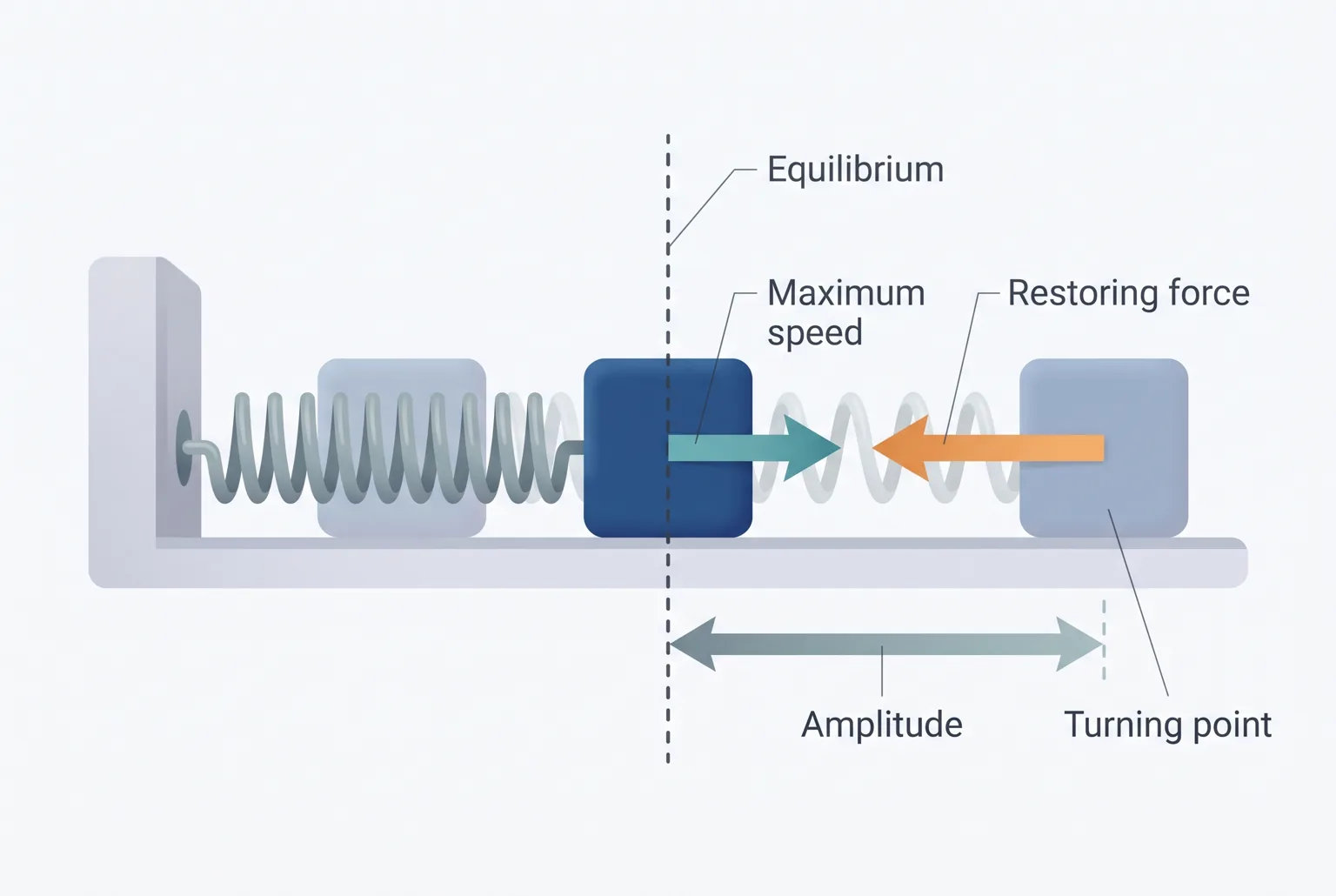
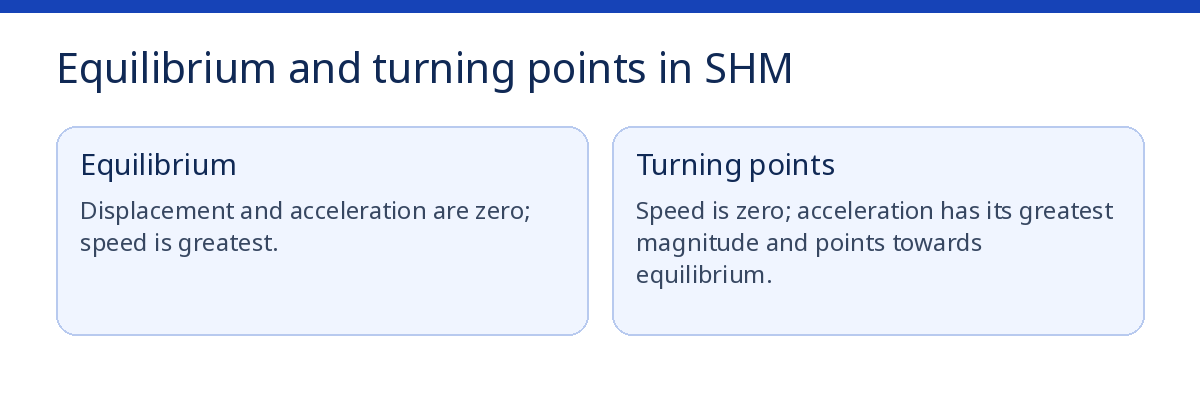
In ideal linear SHM, speed is greatest at equilibrium even though acceleration is zero there. At either turning point, velocity is momentarily zero while acceleration has its largest magnitude and points back towards equilibrium. This contrast is a useful check when an equation and a sketch seem to tell different stories.
When the spring and pendulum formulas apply
For a mass oscillating on an ideal spring with stiffness and negligible spring mass, the period is . In the vertical arrangement, distinguish the spring’s natural length from its equilibrium length under the load. Gravity shifts the equilibrium; the displacement in the SHM equation is measured from that shifted position. When a diagram shows more than one spring, first identify how the restoring forces combine for a displacement of the mass rather than applying the single-spring formula to one labelled stiffness.
For an ideal simple pendulum of length , describes small angular oscillations under gravity. Unlike the ideal spring period, this expression does not depend on the moving mass. The assessment also asks about larger angular swings, where the small-angle model no longer gives the same period. Its liquid-column and floating-body problems extend the same reasoning: identify equilibrium, then examine how the restoring effect changes when the system is displaced.
Track the exchange between kinetic and potential energy
In an undamped ideal mass–spring oscillator, kinetic energy and spring-oscillator potential energy change as the mass moves, but their sum stays constant. With potential energy measured relative to equilibrium, the energy is entirely kinetic at equilibrium and entirely potential at the turning points. This gives you another way to connect the motion graph with the changing speed without confusing a large restoring force with rapid motion.
Read energy prompts carefully for the distinction between a value at an instant and an average over a cycle. The assessment treats these as different tasks. Also remember that kinetic energy depends on speed squared: an energy calculation can give the magnitude of velocity, but it cannot by itself tell you which way the mass is moving.
Before you check a worked solution
Write down the step you want to verify before opening the linked answer. For a graph question, that might be the interval you treated as one complete repeat; for a pendulum question, it might be your reason for using the small-angle approximation. In calculations, distinguish ordinary frequency, measured in hertz, from angular frequency, measured in radians per second. Check that the units match the relation you are about to use.
When reviewing an assertion-and-reason item, judge each statement separately before deciding whether the reason explains the assertion. In a case-based item, identify which details describe the system and which specify its starting state. After comparing your reasoning with the worked solution, use the return link and try to reconstruct the step you missed without looking.
Spotted an error? Report a correction. Practise this in the app: notes, formula sheets and mind maps.








































Loading comments…