Motion in a Straight Line: CBSE Class 11 NCERT Notes
CBSEPhysicsKinematics 1D
These NCERT revision notes for CBSE Class 11 Physics connect signed quantities and motion graphs to the equations for constant acceleration. Use the chapter checklist and clickable index to revisit the distinction or method you need, whether it is displacement, instantaneous velocity or motion under gravity.
Describe motion with one coordinate
Kinematics describes how an object moves without asking what causes the motion. In one-dimensional motion, one coordinate is enough to locate the object. Begin by choosing an origin and a positive direction along the line. The sign of a position tells you which side of the origin the object occupies, not which way it is moving. An object can reverse direction without leaving that line.
The notes also introduce the point-object approximation. A train on a long journey can be treated as a point when its length is small compared with the distance it travels and its size is not needed to describe the motion. Whether the approximation is useful depends on what you are trying to track, not simply on whether the object looks large or small.

Motion in a Straight Line Class 11 |Physics | NCERT Theory | Revision Notes
In the StudentCurio app
Comprehensive revision notes for Class 11 Physics covering kinematics, equations of motion, graphical analysis, and motion under gravity with solved examples.
Common mistakes: confusing position, distance and displacement
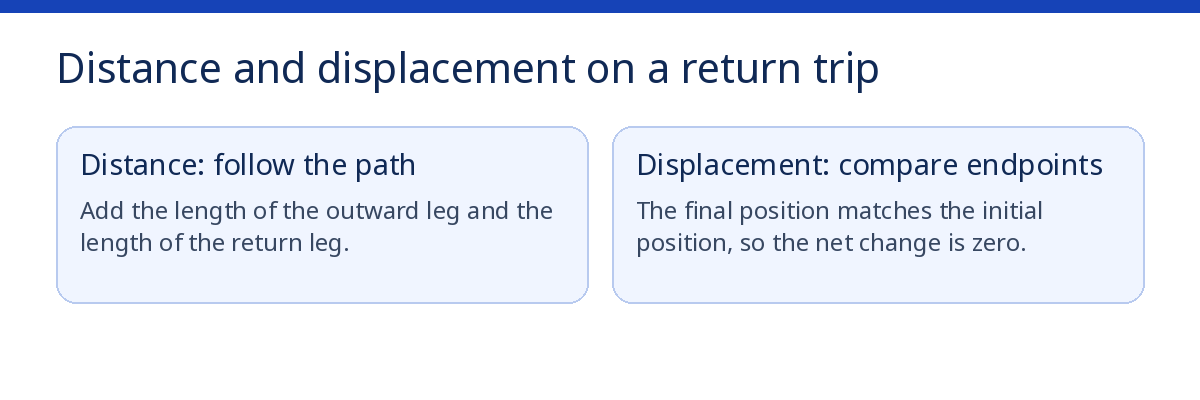
Distance is the total length of the path travelled. Displacement is the final position minus the initial position, . Both are measured in metres in SI, but distance is a scalar, while the sign of displacement in one dimension gives its direction along the chosen axis.
- Being at the origin is not the same as being at rest. A moving object can pass through . Rest over an interval means that its position stays unchanged throughout that interval.
- Returning to the starting point does not erase distance. The displacement for a round trip is zero, but the outward and return legs both contribute to distance. Over a straight-line interval with no reversal, distance equals the magnitude of displacement. If the object stays at rest throughout the interval, both are zero.
Choose the right numerator for speed or velocity
Average speed divides total distance by total elapsed time; average velocity divides displacement by that same time. Use the full interval for both calculations, including any time spent at rest within it. For a trip that ends where it started, average velocity is zero even though average speed is positive. The difference comes from what the two quantities measure, not from their units: both use metres per second in SI.
The notes then narrow the time interval to define velocity at an instant. Where the derivative exists, instantaneous velocity is , and instantaneous speed is its magnitude, . A negative instantaneous velocity means motion in the negative direction of the chosen axis; it does not mean negative speed.
A useful connection: read the slope, not the height
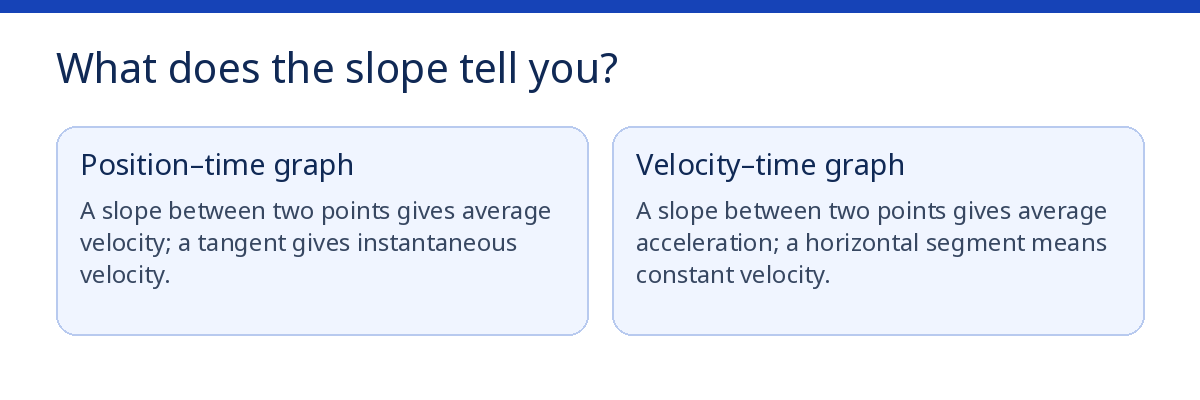
On a position–time graph, the slope of a line joining two points gives the average velocity between those times. As the second point approaches the first, the joining line approaches the tangent, whose slope gives instantaneous velocity where it exists. A downward slope means negative velocity, even if the curve lies above the zero-position line. A horizontal segment means the object stays at the same position over that interval.
On a velocity–time graph, slope instead measures acceleration: the change in velocity divided by the elapsed time between two points gives average acceleration. A horizontal segment on this graph can therefore describe steady motion, not just rest. Before interpreting any slope, check the vertical axis: position and velocity graphs can have similar shapes while describing different behaviour.
When constant-acceleration equations apply
Uniform velocity means the velocity stays the same. Uniform acceleration means the velocity changes by equal signed amounts in equal time intervals. The standard constant-acceleration equations apply only over an interval in which acceleration stays constant, including the special case of zero acceleration. Constant speed is not the condition for using them.
Keep the same positive direction for velocity, acceleration and displacement throughout a calculation. When velocity and acceleration have opposite signs, speed decreases at that instant; when they have the same sign, speed increases. A negative acceleration therefore does not by itself mean slowing down. Also distinguish displacement during the nth second, which the index lists separately, from displacement by the end of n seconds: one refers to a single one-second interval and the other to all the elapsed time from the start.
Use gravity to practise choosing signs
The index places motion under gravity after the general equations of motion. For vertical motion near Earth’s surface, when air resistance is neglected and gravitational acceleration is treated as constant, those equations can describe both the ascent and descent. Taking upward as positive makes the acceleration on both parts of the motion. At the top of an upward throw, velocity is momentarily zero while acceleration still points downward.
This is a useful check on whether you are assigning signs from the axis or from the object’s direction of travel. The index also points to Galileo’s law of odd numbers, vehicle stopping distance and reaction time. When revisiting the vehicle topics, keep the interval before braking begins separate from the interval in which the vehicle slows under braking.
What to revisit in the notes
Use the chapter checklist to locate the distinction you need to review, then use the clickable index to go to the relevant explanation. For example, if a graph question leaves you unsure whether a sign refers to position or velocity, revisit the axis convention before returning to the tangent construction. The chapter summary listed at the end gives you a place to return after working through individual topics.
Two worked examples are omitted from this guide: Example 4 mixes up the names of vector and scalar quantities, and Example 6 has graph and table values that do not support a consistent numerical result. Use the separate definitions and the general slope construction to review instantaneous velocity rather than relying on those examples.
Spotted an error? Report a correction. Practise this in the app: notes, formula sheets and mind maps.








































Loading comments…