Motion in a Plane: CBSE Class 11 Physics NCERT Notes
CBSEPhysicsKinematics 2D
These CBSE Class 11 Physics notes connect vector algebra with two-dimensional motion, from displacement in Cartesian coordinates to projectiles and circular paths. The chapter checklist and clickable index let you revisit the vector methods behind each application.
Scalars, vectors and what an arrow tells you
The notes begin with a distinction that carries through the chapter: a scalar needs a magnitude, while a vector needs both magnitude and direction. Mass and time are scalars; displacement, velocity and acceleration are vectors. For a vector drawn to scale, the arrow’s length represents its magnitude and the arrowhead shows its direction. Two vectors can be equal even if their arrows are drawn in different places, provided their magnitudes and directions match.
The notes introduce unit vectors before moving to Cartesian components. A unit vector has magnitude one and specifies a direction; the coordinate unit vectors point along the positive axes. A zero vector, by contrast, has no unique direction. That is why finding a unit vector along a given vector by dividing by its magnitude works only when the given vector is nonzero.

Motion in a Plane Class 11 |Physics | NCERT Theory | Revision Notes
In the StudentCurio app
Comprehensive study notes covering vector algebra, projectile motion, and uniform circular motion. It helps Class 11 students master two-dimensional kinematics for school exams and JEE Main.
Vector addition: three drawings, one resultant
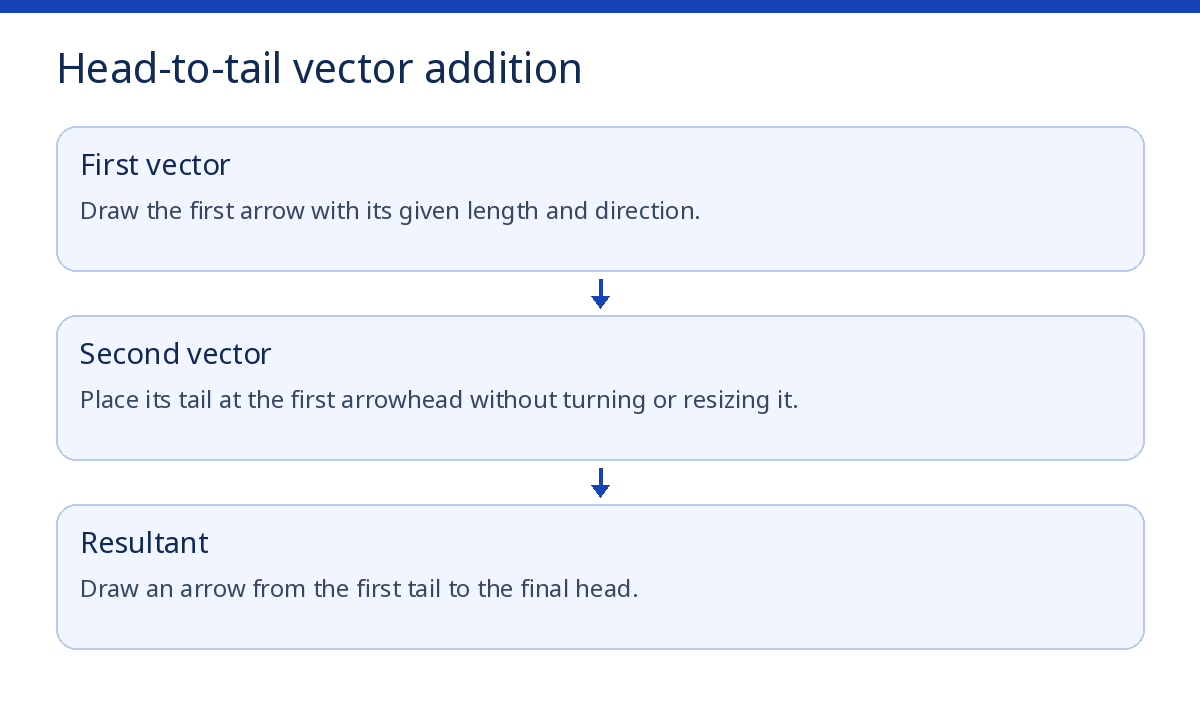
The triangle, parallelogram and polygon diagrams show how to combine vectors of the same physical kind. In the triangle method, place the tail of the second arrow at the head of the first without changing either arrow’s length or direction. The resultant runs from the first tail to the last head. In the parallelogram method, draw both vectors from a common tail and use the diagonal that starts at that tail. The two constructions produce the same sum.
The polygon method extends the head-to-tail construction to more than two vectors. If the chain returns to its starting point, the resultant is zero. For subtraction, keep the first vector and reverse the second before adding: . The order therefore matters in subtraction, even though changing the order of addition leaves the sum unchanged.
Common mistake: confusing displacement with distance
A position vector runs from the chosen origin to the object. A displacement vector runs from the initial position to the final position, whether or not the object travels along that straight line. In the notes’ coordinate treatment, displacement is final position minus initial position: . Its horizontal and vertical components are the corresponding coordinate differences. Subtracting in the opposite order gives the displacement for the reverse trip.
To find the magnitude in the plane, use . The distance travelled is the length of the actual path and cannot be smaller than this magnitude. The endpoint diagram is useful here: trace the two position arrows from the origin, then trace the displacement arrow between their heads. The third arrow compares positions; it does not trace the route.
From vector components to planar kinematics
The index takes you from graphical addition to resolution of vectors and analytical addition and subtraction. Resolving a vector means expressing it through components along chosen axes. Once the axes are fixed, combine horizontal components with horizontal components and vertical components with vertical components, keeping their signs. This gives a numerical counterpart to the arrow diagrams. The index also lists three-dimensional resolution and the dot and cross products as separate vector topics.
The motion section then moves from position and displacement to velocity and acceleration, including their instantaneous forms. Its separate entries for uniform velocity and constant acceleration are worth comparing. Uniform velocity fixes both the magnitude and direction of velocity, so acceleration is zero. Constant acceleration means the acceleration vector is fixed, not that velocity is fixed. For constant acceleration in the plane, the component equations describe the same motion over the same elapsed time.
When the projectile range result applies
The projectile section is organised around mathematical analysis, time of flight, maximum height and horizontal range. In the ideal model with negligible air resistance and uniform downward gravity, horizontal acceleration is zero, whereas vertical acceleration is downward throughout the flight. The components share the same elapsed time. At the highest point of an upward launch, the vertical velocity component is zero, but gravity still acts and the horizontal component need not vanish.
The notes give a maximum horizontal range of at a launch angle of to the horizontal, for fixed launch speed and equal launch and landing heights. Do not carry that result over to a different landing height. The index also lists a launch angle measured from the vertical: check the reference axis before assigning the horizontal and vertical components of the initial velocity.
Quick self-check: can steady speed mean acceleration?
The uniform circular motion section links time period, frequency, angular speed and linear speed before covering centripetal acceleration. The period is the time for one revolution; frequency is the number of revolutions per unit time. One full revolution sweeps through radians, which connects the period to angular speed. At a fixed radius, a greater angular speed also means a greater linear speed.
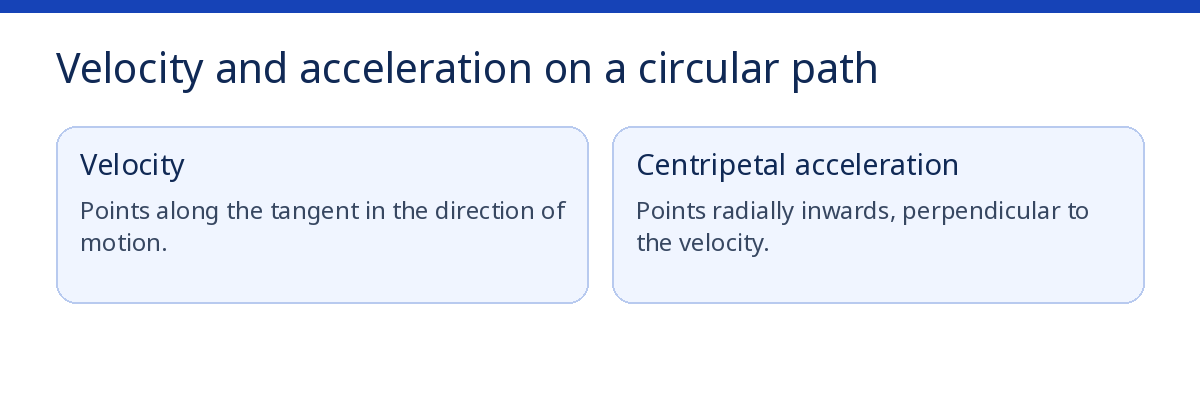
Use the direction of the arrows as a check on your understanding. At any point on the circle, velocity is tangent to the path, while centripetal acceleration points towards the centre. The speed stays constant, but the velocity direction changes. Before moving on, sketch two nearby positions on the circle and draw the velocity arrows. Can you explain why equal arrow lengths do not make the two velocities equal?
How to use the checklist, index and summary
Use the opening checklist to identify which vector step is slowing you down. If a resultant points the wrong way, compare the head-to-tail and parallelogram diagrams. If a component has the wrong sign, revisit resolution and check the chosen positive axis. Then use the clickable index to return to the relevant motion topic. The chapter summary is a useful final stop once you can state which quantities stay constant and which change in each model.
Scope note: This guide omits flagged details on page 8, numerical solutions to Examples 1–3, and the flagged lines on pages 23 and 27.
Spotted an error? Report a correction. Practise this in the app: notes, formula sheets and mind maps.








































Loading comments…