Motion in a Plane: CBSE Class 11 Case-Based Assessment
CBSEPhysicsKinematics 2D
This CBSE Class 11 Physics assessment uses three case studies to connect projectile motion, vector addition, relative velocity and kinematics. Its worked solutions help you check not just your calculations but also the assumptions that make each method valid.
What the assessment covers
The PDF contains three case studies with 14 answer items across multiple-choice, true-or-false and short-answer formats. The projectile case asks several questions about a single trajectory. The vectors case moves from the parallelogram law to forces and the apparent direction of rain. The final case combines force resultants with braking, changing velocity and free fall, so not every item requires a two-dimensional calculation.
The questions appear before the worked solutions. The clickable index lists individual items, and the Solution and Back to question links let you compare your setup with the relevant explanation without scrolling through the entire file. That is particularly useful when several parts share a diagram or when a later part depends on a quantity found earlier.

Motion in a Plane Class 11 |Physics | CBSE Case Based Assessment
In the StudentCurio app
Comprehensive case-based assessment for Class 11 Physics covering projectile motion, relative velocity, and vector treatment of motion in a plane with detailed step-by-step solutions.
Projectile motion: one time, two components
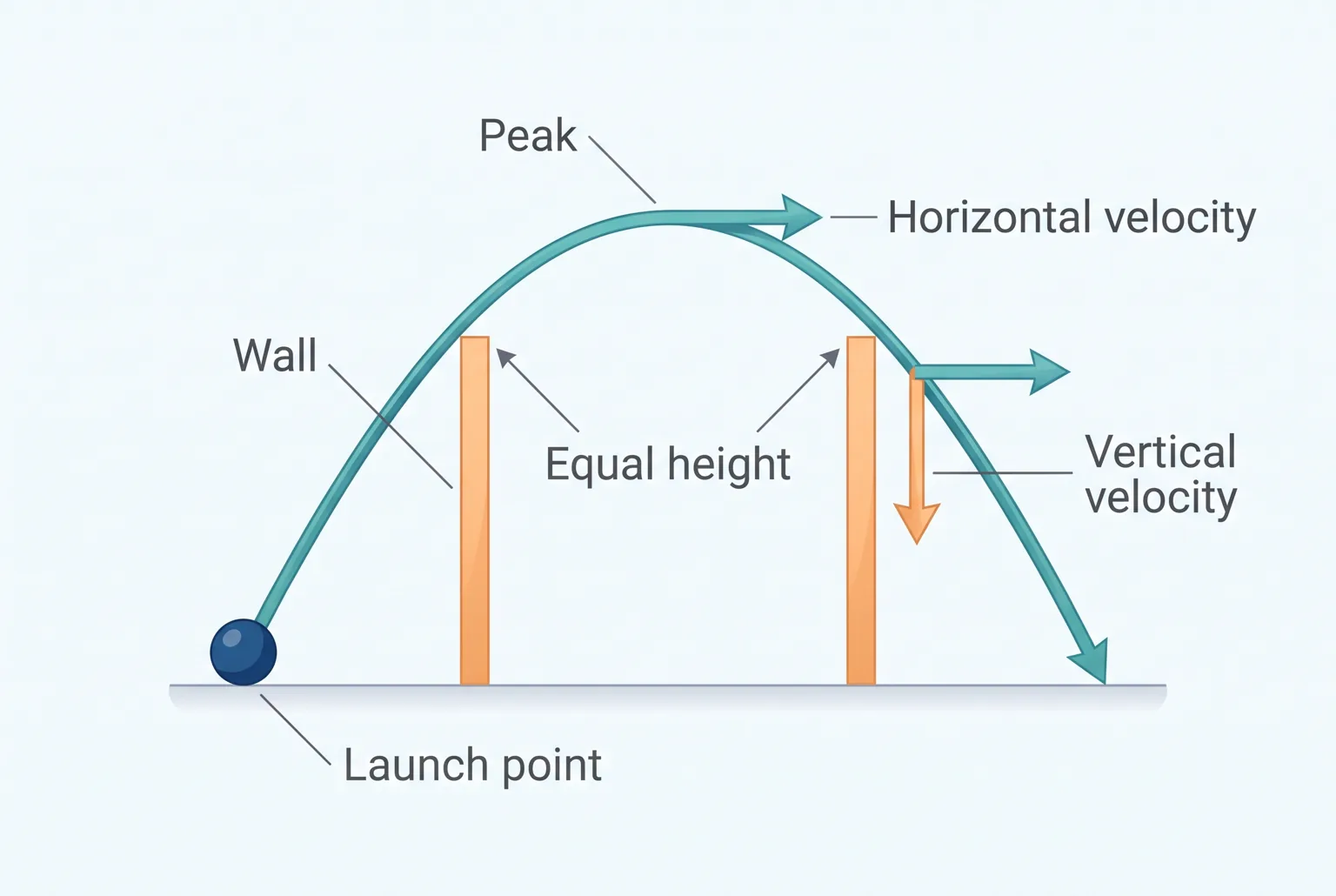
The first case follows a projectile past two walls of equal height. The horizontal and vertical motions happen at the same time, but they obey different equations. With air resistance neglected and gravity acting vertically, horizontal velocity is constant. The vertical velocity changes because the acceleration is downward. This is why the horizontal spacing between the walls can be related to the elapsed time between crossings, while the wall height must be treated as a vertical displacement.
The equal heights also make it possible to reason about symmetry. In this model, when the projectile passes the same height on the way up and down, those instants are equally far from the time at the peak. Connecting that symmetry to the total flight time requires a further condition: the projectile must return to its launch level. A landing point at a different height would change that part of the reasoning.
Vector addition: keep magnitude and direction separate
The parallelogram law represents two vectors as adjacent sides drawn from a common point. The diagonal from that point represents their sum, including its direction. The angle between the vectors matters: knowing only their individual magnitudes is not enough to find the magnitude of the resultant. In the four-force item, the compass directions make it natural to combine opposing forces along each axis before combining the perpendicular net components.
A useful check is to ask whether you have reported a magnitude or a vector. A force magnitude needs a unit, but it does not specify which way the net force acts. Similarly, the magnitude of initial velocity is initial speed, not a full description of the launch velocity. These distinctions connect the vector case to the earlier projectile questions.
Relative velocity: name the observer first
In the rain-and-bicycle item, the rain falls vertically in the ground frame, but the cyclist is moving relative to the ground. To find the rain's velocity as seen by the cyclist, subtract the cyclist's ground-frame velocity from the rain's ground-frame velocity. Reversing the subtraction answers a different question: it gives the cyclist's velocity relative to the rain.
There is another distinction between the direction in which the rain travels relative to the cyclist and the direction from which it approaches. An umbrella must face the incoming side. The motion directions in the question support a qualitative conclusion, but the bicycle speed is missing from the question, so a numerical tilt angle cannot be determined from the printed data alone.
When the kinematics rules apply
The final case contrasts motion with constant acceleration and motion in which acceleration depends on time. For constant acceleration, equal time intervals give equal changes in velocity. That relationship can be used backward as well as forward in time, provided the acceleration stays constant over the whole interval. When acceleration varies, the change in velocity comes from accumulating acceleration over the interval, not from multiplying the final acceleration by the elapsed time.
The stopping-distance comparison also depends on a model: the same constant braking deceleration must apply in both runs, and the distance is measured from when braking begins, excluding reaction distance. In the helicopter-drop item, the fall time depends on the initial vertical velocity. In the ideal model without air resistance, horizontal motion can change where the object lands without changing how long it takes to fall.
Before trusting an option, check the wording
Use the accuracy notes alongside the worked solutions, especially where the printed question and the expected response do not line up. The scalar true-or-false statement omits the qualifier needed for a definite verdict. The concept to retain is that rotating the coordinate axes does not change a scalar such as mass. In the stopping-distance item, none of the printed options agrees with the question's data under the stated braking model. Treat that as an issue with the choices, not a reason to force your calculation to match one.
Before opening a solution, note the frame of reference, the positive direction and any assumption your method requires. When you compare your work with the explanation, check those decisions before checking the arithmetic. That makes it easier to tell whether a mismatch comes from your physical model, a sign convention or a limitation in the question itself.
Spotted an error? Report a correction. Practise this in the app: notes, formula sheets and mind maps.








































Loading comments…