Class 11 Physics Guide: Mechanical Properties of Fluids
CBSEPhysicsMechanical Properties of Fluids
A detailed analysis of competency-based assessment topics for CBSE Class 11 Physics, covering fluid statics, dynamics, and conservation laws.
Competency-Based Learning in Fluid Mechanics
The study of fluids in Class 11 Physics transitions from basic definitions to complex applications involving pressure transmission and energy conservation. This StudentCurio resource is specifically structured as a Case-Based Assessment to align with the CBSE and NCERT focus on competency-based questions. Instead of rote memorization of formulas, learners are required to apply principles like Pascal’s law and Bernoulli’s theorem to real-world scenarios, such as hydraulic lifts and blood circulation. The material covers critical areas including streamlines, atmospheric pressure, and the viscosity of gases, providing solved examples that bridge the gap between theoretical physics and practical engineering or biological systems.

Mechanical Properties of Fluids Class 11 |Physics | CBSE Case Based Assessment
In the StudentCurio app
This document features solved case-based questions for Class 11 Physics, covering topics such as Pascal's law, hydraulic lifts, and Bernoulli's principle. It is designed to help students master competency-based questions for CBSE examinations.
Understanding Streamlines and Steady Flow
Fluid dynamics begins with the concept of the streamline, which serves as a pathway for fluid particles in steady motion. A critical property of a streamline is that a tangent drawn at any point on the curve indicates the direction of the instantaneous fluid velocity at that specific point. In steady flow, these pathways remain stationary even as the liquid moves through them. One fundamental rule of fluid mechanics is that two distinct streamlines cannot intersect. If they were to cross, the fluid would possess two different velocity directions at a single point simultaneously, which is physically impossible in a stable flow field. This resource emphasizes that streamlines are most relevant in laminar flow, where fluid layers move smoothly without the chaotic mixing characteristic of turbulent flow.
Pascal’s Law and Hydraulic Systems
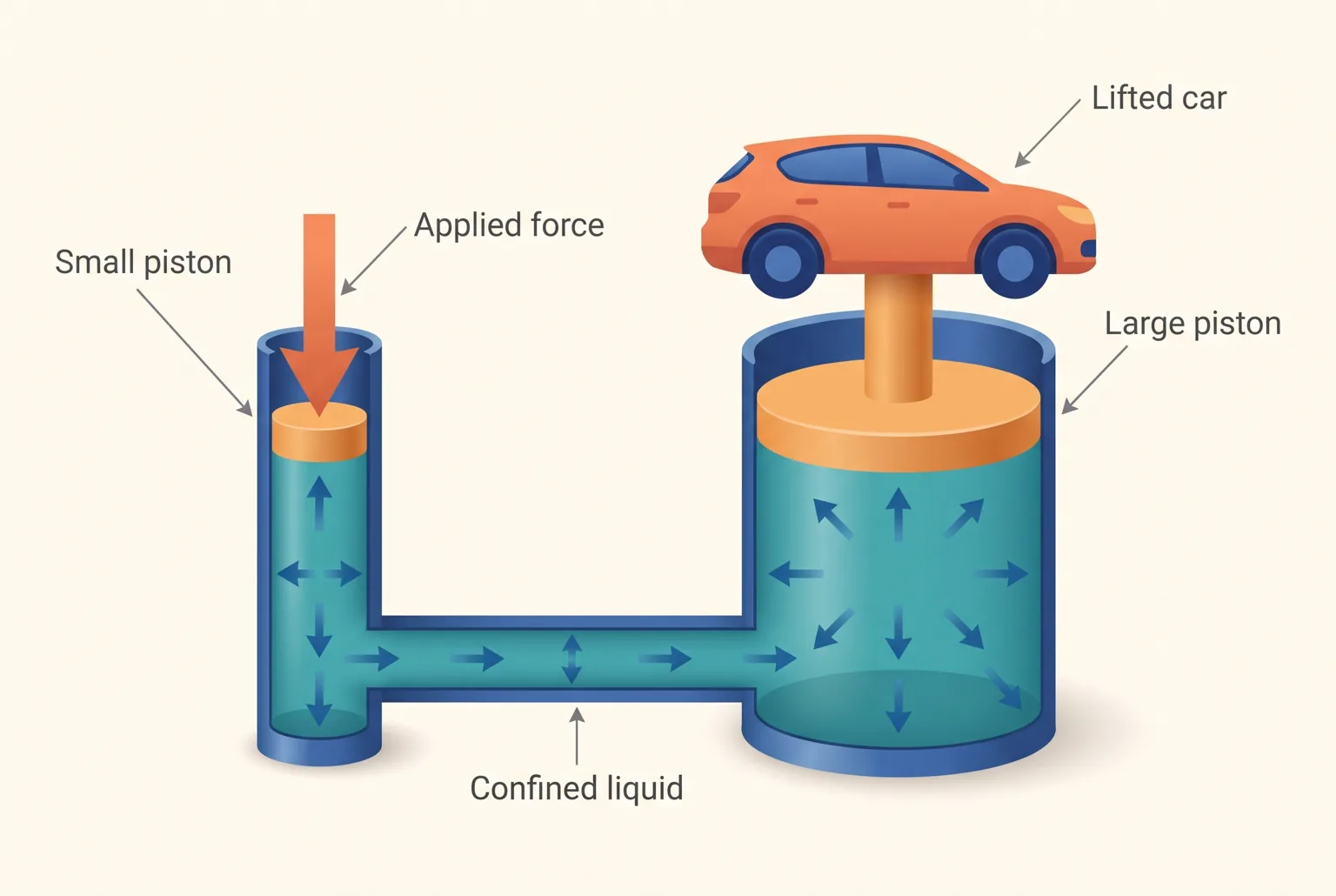
Pascal’s law is the cornerstone of hydraulic mechanics. It states that any change in pressure applied to an incompressible, confined liquid is transmitted undiminished in every direction throughout the fluid. This principle allows for mechanical advantage in devices like hydraulic lifts and presses. By applying a relatively small force to a piston with a small cross-sectional area, a high pressure is generated. This same pressure, when transmitted to a larger piston, exerts a significantly greater force capable of lifting heavy loads, such as automobiles. The resource provides specific calculations, such as determining the force required on a piston to lift a mass on an piston, demonstrating the direct relationship between force, area, and transmitted pressure ().
Hydrostatic Pressure and the Influence of Depth
A common point of confusion for students is the relationship between the volume of a liquid and the pressure it exerts. According to hydrostatic principles, the gauge pressure () at a certain depth depends strictly on the density of the liquid (), the acceleration due to gravity (), and the vertical depth (), represented by the formula . The resource clarifies that the total surface area or the total volume of the water body does not affect the pressure at a specific depth. For instance, the water pressure one meter below the surface of a tiny pond is identical to the pressure one meter below a massive lake, provided the water density and atmospheric conditions at the surface are the same. This highlights the independence of hydrostatic pressure from the shape of the container.
The Continuity Equation in Biological Networks
The equation of continuity () describes the conservation of mass in fluid flow. It implies that for a fluid moving through a pipe, the product of the cross-sectional area () and the flow velocity () remains constant. Learners often encounter a paradox when applying this to human blood flow: while an individual capillary is much narrower than an artery, blood actually moves slower in the capillaries. The resource explains this by considering the total effective area. Although a single capillary is small, the human body contains millions of them. Their combined total cross-sectional area is far greater than that of the arteries. Consequently, according to the continuity principle, the velocity must decrease across this massive network of capillaries to maintain a constant volume flow rate.
Bernoulli’s Theorem and Energy Conservation
Bernoulli’s principle is an application of the law of conservation of mechanical energy to flowing fluids. It relates pressure, velocity, and elevation, stating that for an incompressible, non-viscous fluid in steady flow, the sum of pressure energy, kinetic energy, and potential energy per unit volume is constant along a streamline. This theorem explains why, in a horizontal pipe, the pressure is lowest where the fluid velocity is highest (at the narrowest sections). The resource specifies that this theorem is strictly applicable to streamline and irrotational flows. Furthermore, it addresses practical implications such as pressure loss in municipal water systems; water may fail to reach the top floors of distant houses because of the loss of pressure caused by friction and the fluid's viscosity during its transit through long pipes.
Fluid Properties: Capillarity and Gas Viscosity
The material also touches upon specialized fluid behaviors like capillarity and gas viscosity. Capillarity involves the rise or fall of liquids in narrow tubes due to surface tension. A notable case discussed is the behavior of a liquid in a capillary tube of insufficient length: rather than overflowing, the liquid simply reaches the top of the tube, and the curvature of its meniscus adjusts to maintain equilibrium. In the context of viscosity, there is a distinct difference between liquids and gases. While the viscosity of most liquids decreases as they get warmer, the viscosity of gases actually increases with a rise in temperature. This is a crucial distinction for students to master when analyzing fluid behavior under varying thermal conditions.
Frequently asked questions
Why is blood pressure higher at the feet than at the brain?
This is due to the hydrostatic pressure exerted by the column of blood in the human body. Because the feet are at a greater vertical depth from the heart than the brain when standing, the pressure is increased by the factor .
What happens if two streamlines intersect?
Two streamlines cannot intersect in a steady flow because the tangent at the point of intersection would imply two different directions for the fluid velocity at the same instant, which is physically impossible.
On what conservation principle is Bernoulli’s theorem based?
Bernoulli’s principle is based on the conservation of mechanical energy for a moving fluid.
How does temperature affect the viscosity of a gas?
Unlike liquids, the viscosity of gases increases as the temperature increases.
Spotted an error? Report a correction. Practise this in the app: notes, formula sheets and mind maps.








































Loading comments…