Mechanical Properties of Fluids: Class 11 NCERT Notes
CBSEPhysicsMechanical Properties of Fluids
These CBSE Class 11 Physics notes cover fluids at rest, effects at liquid surfaces and fluids in motion. Use the chapter checklist, clickable index and worked examples to revise not just what each rule says, but when it applies.
Find the right part of the notes
The file is organised into hydrostatics, surface tension and surface energy, and hydrodynamics. The opening checklist names the main concepts, the clickable index points to individual topics, and a chapter summary sits at the end. If you are revising a specific doubt, use the index to find the comparison you need: atmospheric versus gauge pressure, a liquid drop versus a soap bubble, or critical versus terminal velocity.
If you are reading the chapter in order, start with the distinction between thrust and pressure. The notes return to it in the pressure–depth derivation and the hydraulic lift. When you reach a worked example, pause before the substitution and identify the surface, the force and the pressure reference. That tells you more about the method than checking the final number alone.

Mechanical Properties of Fluids Class 11 |Physics | NCERT Theory | Revision Notes
In the StudentCurio app
Comprehensive revision notes for Class 11 Physics covering fluid statics, surface tension, and hydrodynamics. It provides detailed explanations of Pascal's law, Archimedes' principle, and Bernoulli's theorem for exam preparation.
How pressure changes in a fluid at rest
Thrust is a normal force; pressure describes how much normal force acts per unit area. When that force is distributed uniformly over a flat area, . The average pressure over an area need not equal the pressure at every point. Pressure is a scalar, measured in pascals in SI, even though the force the fluid exerts on a surface acts perpendicular to it.
The notes derive the pressure difference by balancing forces on an imaginary cylinder of fluid. The upward force on its lower face balances the downward force on its upper face plus the cylinder’s weight. For a static fluid of uniform density and constant gravitational acceleration, a point a vertical distance below another is at higher pressure by . This explains the hydrostatic paradox: with the same liquid and the same pressure at its surface, equal depths give equal pressures even when the vessels hold different amounts of liquid.
Pressure readings: check the reference
Absolute pressure is the actual pressure. Gauge pressure measures the difference from atmospheric pressure: . At depth in a liquid of uniform density open to the atmosphere, the gauge pressure is , while the absolute pressure also includes . Gauge pressure can be negative when the absolute pressure is below atmospheric pressure; it is not another name for the total pressure.
Compare the barometer and open-tube manometer diagrams in the notes. The barometer uses a mercury column to measure atmospheric pressure. The open-tube manometer compares the vessel pressure with atmospheric pressure through a difference in liquid levels. In either diagram, track the vertical height difference and identify where the pressure is known before following the calculation. This guide leaves out the notes’ isolated claims about atmospheric extent and the latitude in the pressure-unit entry; neither is needed to use these diagrams.
Pascal’s law and buoyancy explain different forces
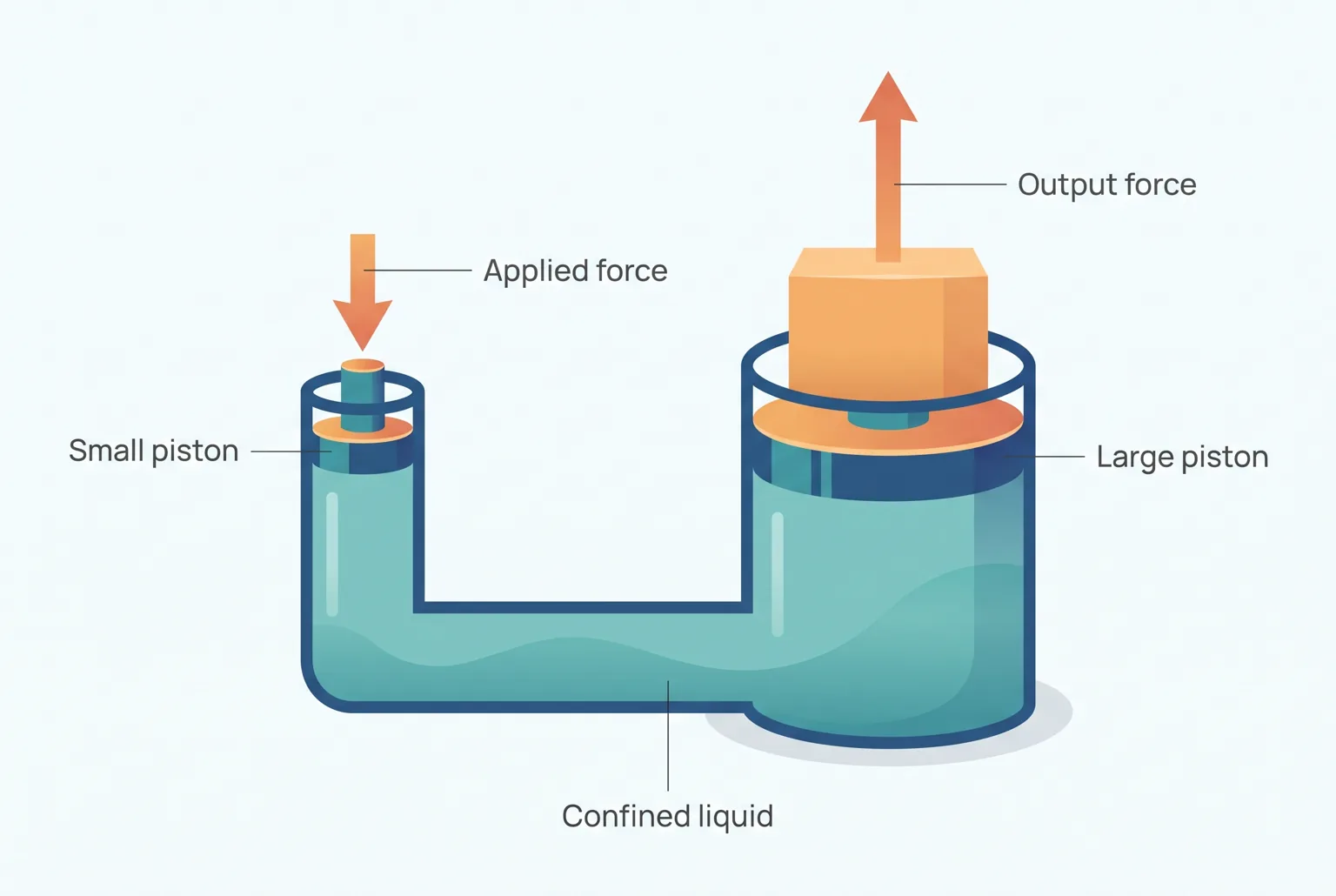
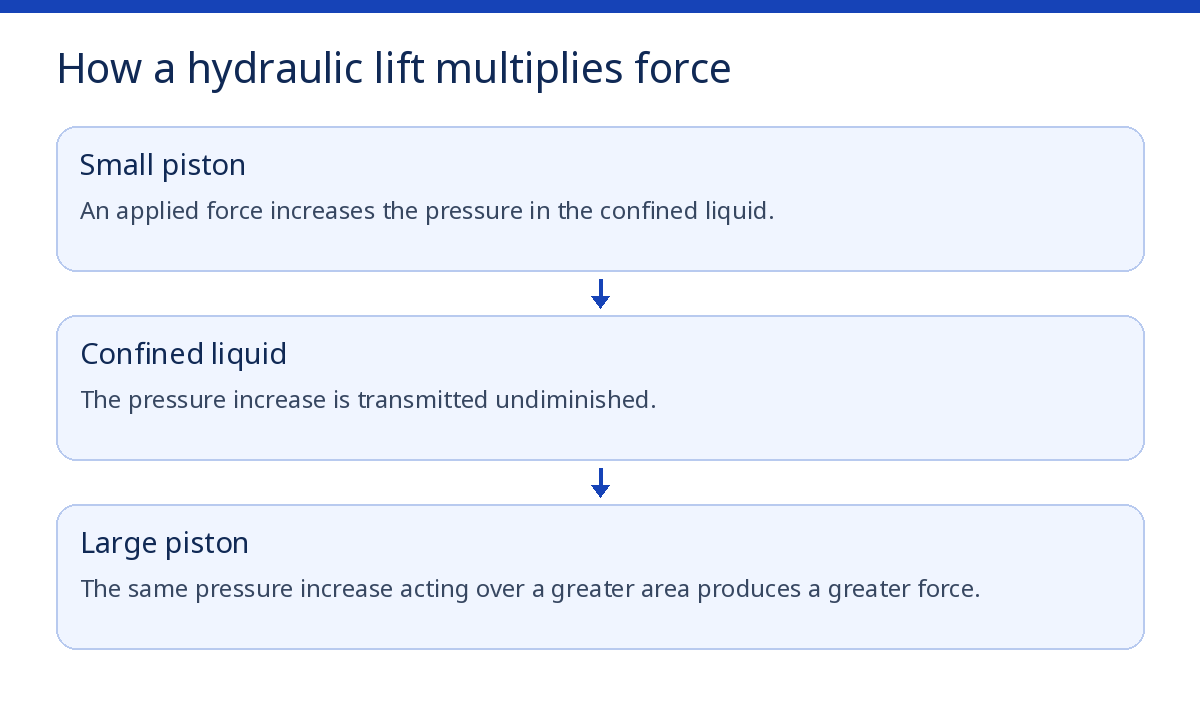
In a confined fluid at rest, an applied change in pressure is transmitted undiminished. In the ideal hydraulic lift shown in the notes, a force acting on a piston of area produces a pressure increase of . That same increase acting over the larger area gives a force . The larger piston gains force because of its area, not because the fluid multiplies the pressure.
Buoyancy instead comes from the pressure difference across an immersed object: the fluid pressure is greater lower down. Archimedes’ principle states that the upward buoyant force equals the weight of fluid displaced. Keep the two ideas separate when revising: the lift uses an applied pressure change, whereas buoyancy can arise in a stationary fluid without a piston.
Why liquid surfaces need their own model
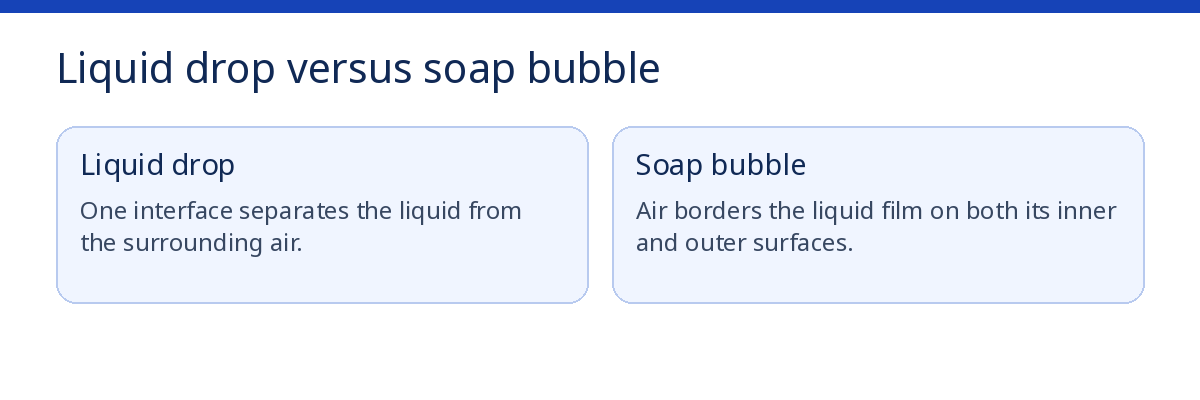
The surface section links surface tension to the energy required to increase a liquid’s surface area. It then considers contact angle, excess pressure and capillarity. Read the entries for a liquid drop and a soap bubble side by side. A drop has one liquid–air interface, while a soap bubble has two. That distinction is why their excess-pressure expressions differ even when their radii and surface tensions are the same.
The angle of contact is measured through the liquid at the point where the liquid surface meets the solid. In the capillarity discussion, use that angle to connect the shape of the meniscus with the direction of the level change. In a narrow tube, a wetting liquid can rise, while a non-wetting liquid can be depressed.
Before using Bernoulli’s theorem, check the flow
The hydrodynamics section moves from flow patterns to Bernoulli’s theorem, then to viscosity and its consequences. In the usual Class 11 form, Bernoulli’s theorem relates pressure, speed and elevation along a streamline in steady, incompressible flow with negligible viscosity. A higher speed corresponds to lower pressure in that model when the two points are at the same elevation. If the elevations differ, the height term cannot be dropped.
Use the later headings to distinguish two different kinds of speed. Critical velocity concerns the onset of turbulence in a flow; terminal velocity is the constant speed an object reaches when the forces on it balance as it moves through a fluid. For a quick self-check before turning to the chapter summary, ask what is moving in each case: the fluid whose flow regime you are describing, or the object moving through it?
Spotted an error? Report a correction. Practise this in the app: notes, formula sheets and mind maps.








































Loading comments…