Mechanical Properties of Fluids: CBSE Class 11 Assessment Guide
CBSEPhysicsMechanical Properties of Fluids
This CBSE Class 11 Physics assessment pairs topic-wise questions with worked solutions and a mixed chapter practice set. Use it to practise deciding which model fits a situation: a fluid at rest, a liquid interface or a fluid in motion.
How the assessment is organised
The file divides Chapter 10 into Hydrostatics, Surface Tension and Surface Energy, and Hydrodynamics. Each topic has two sets: Practice Questions and a Topic Assessment. The clickable Questions and Solutions indexes mirror one another, so you can find the same topic, set and response type on either side. The separate Chapter Practice section starts on page 27, with its worked solutions starting on page 68.
Use the Practice Questions to identify where your reasoning breaks down, then attempt the corresponding Topic Assessment without keeping the solutions open. When you review, check the choice of principle and the assumptions before comparing the arithmetic. A correct numerical result is less useful as a progress check if you cannot explain why the method applies.

Mechanical Properties of Fluids | Class 11 | CBSE Assessment
In the StudentCurio app
Chapter-wise assessment questions and worked solutions cover fluid pressure, buoyancy, viscosity and flow, Bernoulli’s principle, and surface tension. Objective, written-response, assertion–reason, and case-based formats help Class 11 students practise concepts and applications.
Hydrostatics: Separate pressure, force and buoyancy
The hydrostatics sets cover pressure at depth, hydraulic devices, manometers, barometers and floating bodies. For a liquid at rest with uniform density and constant gravitational acceleration, the pressure increase from the surface to depth is . That is a pressure difference: if a question asks for absolute pressure, identify the pressure at the surface before adding the contribution from depth. Gauge pressure instead measures pressure relative to the surrounding atmosphere.
For container and piston diagrams, distinguish the pressure at a location from the total force on a surface. Multiplying pressure by area gives the normal force when pressure is uniform over that area. Pascal’s law concerns the transmission of an applied pressure change through an enclosed fluid; it does not say that different-sized pistons experience the same force. Buoyancy is a different calculation: the upward force equals the weight of the displaced fluid. In a floating-body problem, identify the submerged volume separately from the body’s total volume before writing a force balance.
Surface tension: Read the interface before the equation
This topic uses thin films, droplets, bubbles and capillary tubes to test different consequences of surface tension. In a film-and-slider diagram, first identify the length along which surface tension acts. A surface-energy question instead asks you to track the area of the liquid interfaces. For a process at constant surface tension , the change in surface energy is , where is the change in total interfacial area, not just the change in the area enclosed by a frame.
The distinction between a single liquid–gas interface and a thin soap film with two interfaces also matters in excess-pressure problems. Read excess pressure as the difference between the pressures immediately inside and outside the curved surface, not as the inside pressure itself. For a bubble beneath a liquid surface, its surroundings are the liquid at the bubble’s depth. In capillarity questions, inspect the contact angle as well as the tube size: the angle, measured through the liquid, helps determine whether the level rises or falls.
Hydrodynamics: Choose between continuity, energy and drag
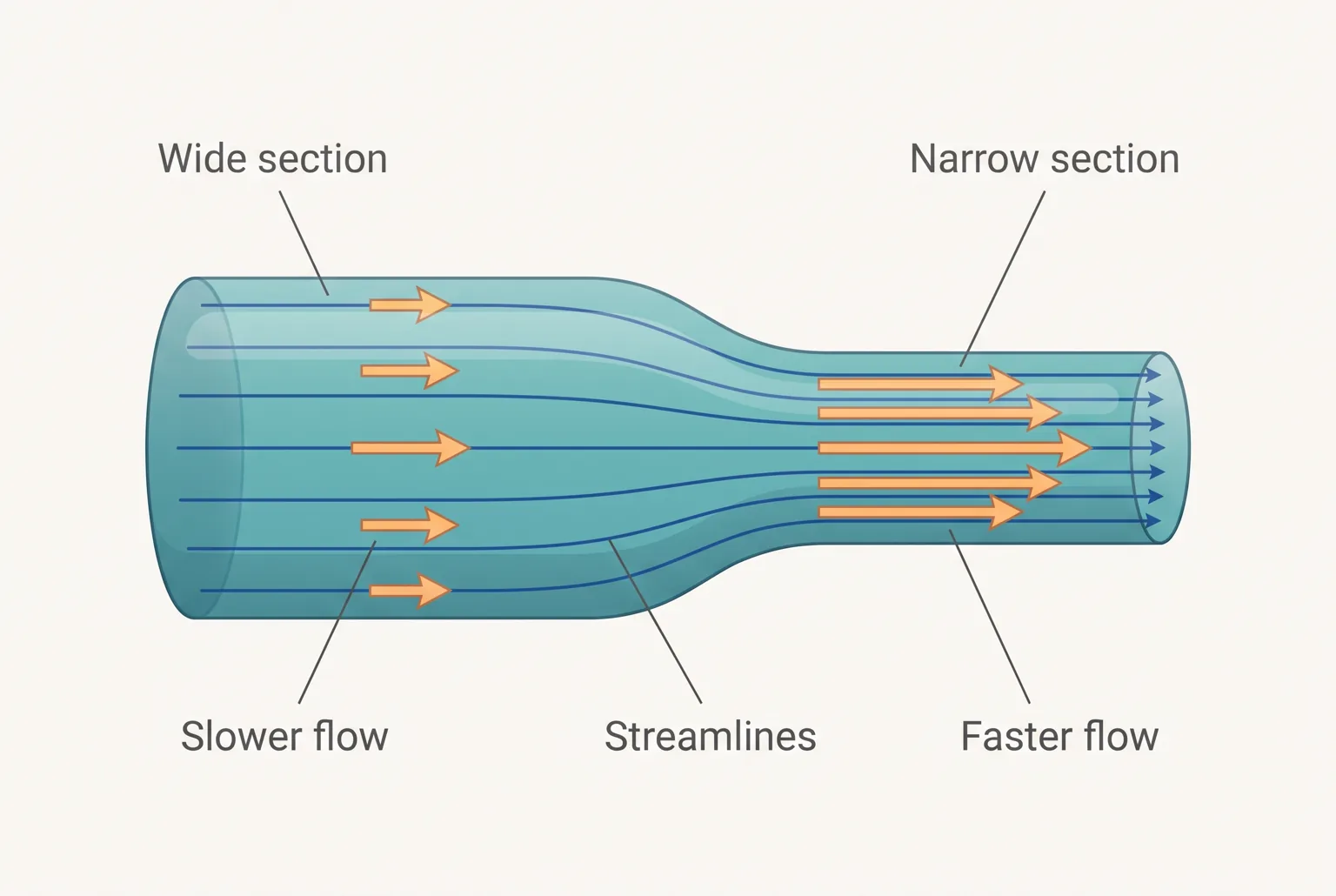
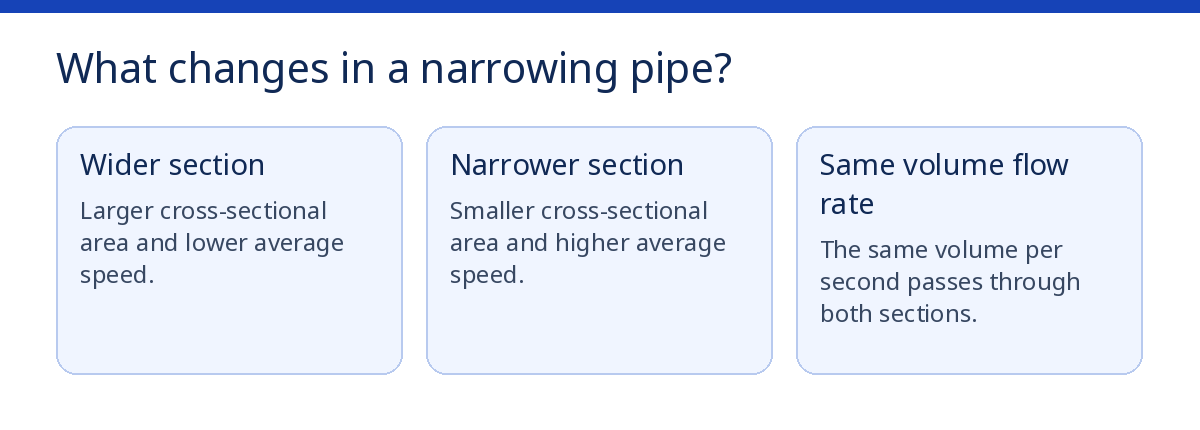
The cover’s narrowing-pipe sketch illustrates continuity. For steady incompressible flow through an unbranched pipe, the volume flow rate is the same at both cross-sections, so , with denoting the average speed across a section. The smaller cross-section therefore has the greater average speed. This argument uses conservation of mass and does not on its own give the pressure difference.
Bernoulli’s principle relates pressure, speed and elevation along a streamline for steady, incompressible flow when viscous effects are negligible. Check the elevation before drawing a conclusion about how a speed change relates to a pressure change. The assessment also lists viscosity, terminal speed and Reynolds number. These call attention to effects that an ideal-flow model leaves out. For example, a terminal-speed graph represents motion that settles to a constant speed: the acceleration tends to zero because the forces balance, not because drag disappears.
Quick self-check: Do the diagram and units agree?
Before comparing a written response with its solution, make these checks on your own setup:
- In a pressure-column diagram, mark the vertical height difference. A distance measured along a slanted tube is not the height used in the hydrostatic pressure relation.
- If a pipe or capillary dimension is given as a diameter, label it as such. Convert it to a radius before using a radius-based expression, and convert lengths before computing an area in square metres.
- In a surface-energy calculation, keep surface tension and area in compatible units. With surface tension in newtons per metre and area in square metres, their product is in joules.
Use chapter practice to test your choice of model
The final set mixes objective, assertion–reason, case-based and written-response questions. That mix lets you test whether you can recognise the relevant principle without relying on a topic heading. In an assertion–reason item, judge each statement separately before deciding whether the reason explains the assertion. In a case-based item, connect each response to the relevant detail from the passage or diagram. For a longer response, make your assumptions explicit so that the worked solution can help you distinguish a modelling error from a calculation slip.
This guide leaves out the density table with an uncertain printed unit, the surface-energy item that switches between drop and bubble terminology, the breakup item that presupposes energy release, and the isolated boiling-point prompt. None is needed to use the independently supported practice topics.
Spotted an error? Report a correction. Practise this in the app: notes, formula sheets and mind maps.








































Loading comments…