Laws of Motion: CBSE Class 11 Physics Assessment Guide
CBSEPhysicsLaws of Motion
This CBSE Class 11 Physics assessment combines topic-wise questions, mixed chapter practice and worked solutions. Use it to practise setting up a force or momentum equation before checking how the solution handles directions, units and assumptions.
Start with the topic that needs work
The PDF splits the topic-wise assessment into Newton’s Laws of Motion and Common Forces in Mechanics and Circular Motion. Each topic has a Practice Questions set and a separate Topical Understanding set. The clickable indexes let you navigate to the question and solution sections by topic and question format. That makes it possible to revisit a particular skill without working through the entire file in order.
Start with the first topic if you tend to confuse velocity with acceleration or struggle to decide which forces belong in an equation. If those distinctions are clear but contact forces are harder to model, start with the second topic. Save the mixed Chapter Practice for a pass where you choose the governing principle without a topic heading to cue you.

Laws of Motion | Class 11 | CBSE Assessment
In the StudentCurio app
Chapter-wise assessment questions and worked solutions cover friction, Newton’s laws, force balance, momentum, connected bodies, inclined planes and circular motion. Objective, short-answer, long-answer, assertion–reason and case-based practice helps Class 11 students apply the laws of motion.
Read Newton’s laws through a force diagram
The first topic uses situations such as lift scales, stacked objects and motion graphs to test different parts of the same reasoning. Begin by naming the body you are analysing. Draw only the external forces on that body, then choose a positive direction. For a constant-mass body in an inertial frame, the net external force equals mass times acceleration; a single force is not necessarily the net force.
The distinction matters even when there is no acceleration. Zero net force means the velocity stays constant, not that the body must be stationary or that no forces act. A scale reading adds another distinction: a platform scale measures the normal force on the person, which need not equal the person’s weight when the person accelerates vertically.
Common mix-up: balancing forces and third-law pairs
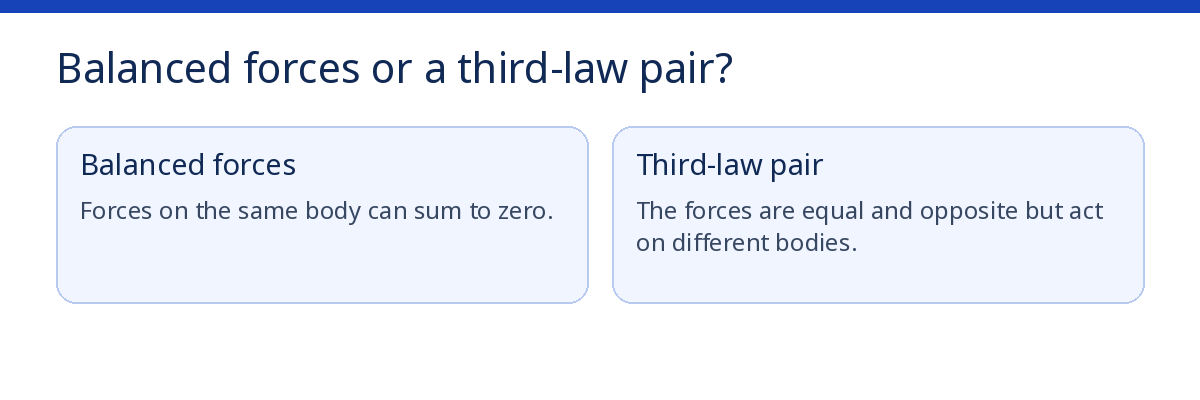
Two forces may balance when they act on the same body. A Newton’s third-law pair, by contrast, consists of equal and opposite forces that two bodies exert on each other. To test whether you have found a pair, name both bodies in each statement: the force of A on B pairs with the force of B on A. These forces belong on different free-body diagrams.
That distinction helps when working through the assessment’s contact-force and connected-body questions. If you draw separate diagrams, represent the interactions on the appropriate bodies. If you instead treat the bodies as one system, forces between them are internal and cancel in the sum for that system. The system equation still needs every relevant external force.
Momentum and impulse: keep track of direction
The first topic includes rebounds, collisions, catches and position–time graphs. In each setting, change in momentum means final momentum minus initial momentum, with direction included. Choose a positive direction before subtracting in one dimension. When motion changes direction in two dimensions, use vector components rather than subtracting speeds. If the starting point is a position–time graph, read velocity from its slope before working with momentum.
The net impulse over a time interval equals the change in momentum. For the same change in momentum, a longer interval corresponds to a smaller magnitude of the average net force. Momentum conservation is a separate check: the total momentum of the chosen system is conserved over the interval if the net external impulse on that system is zero.
When the friction limit applies
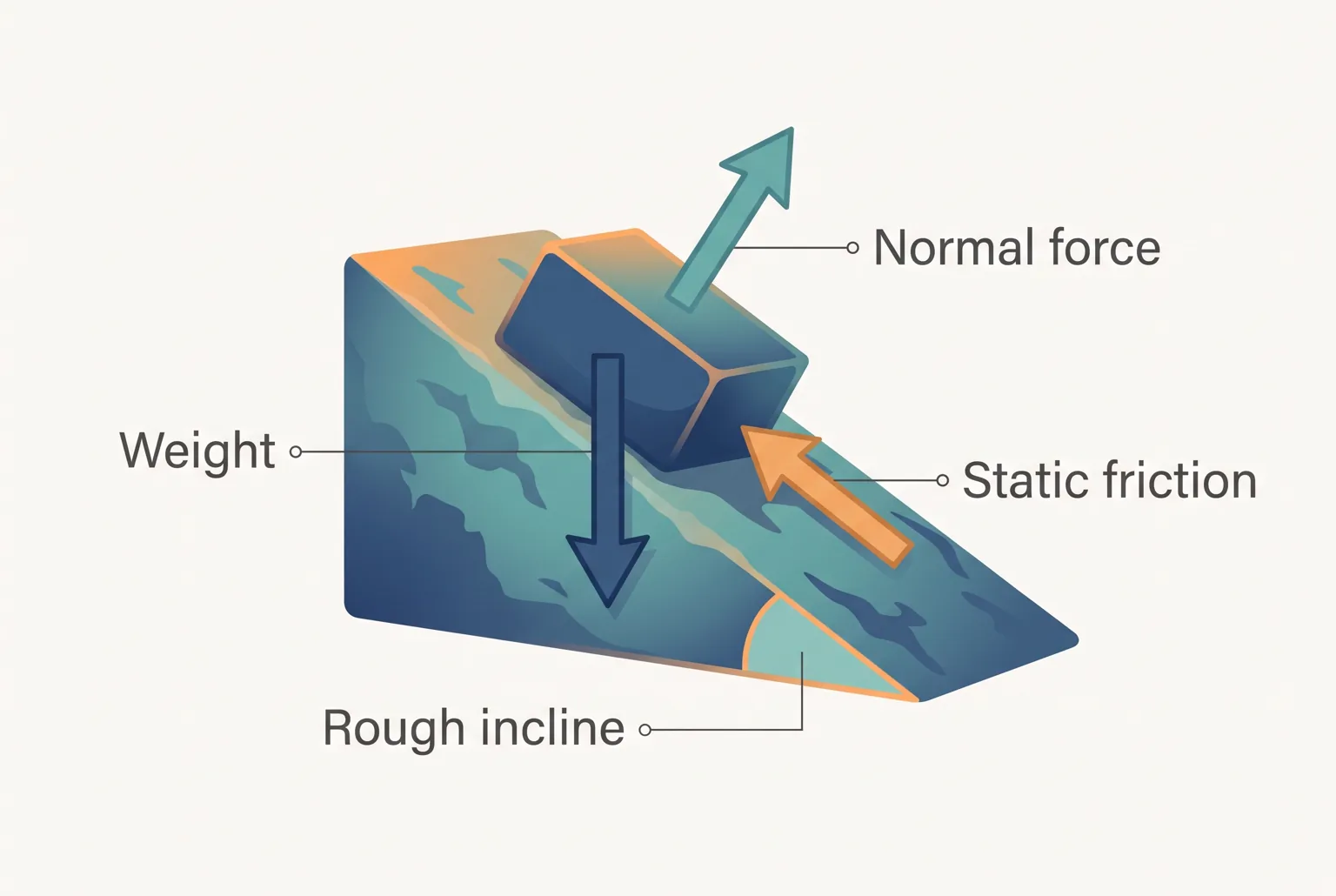
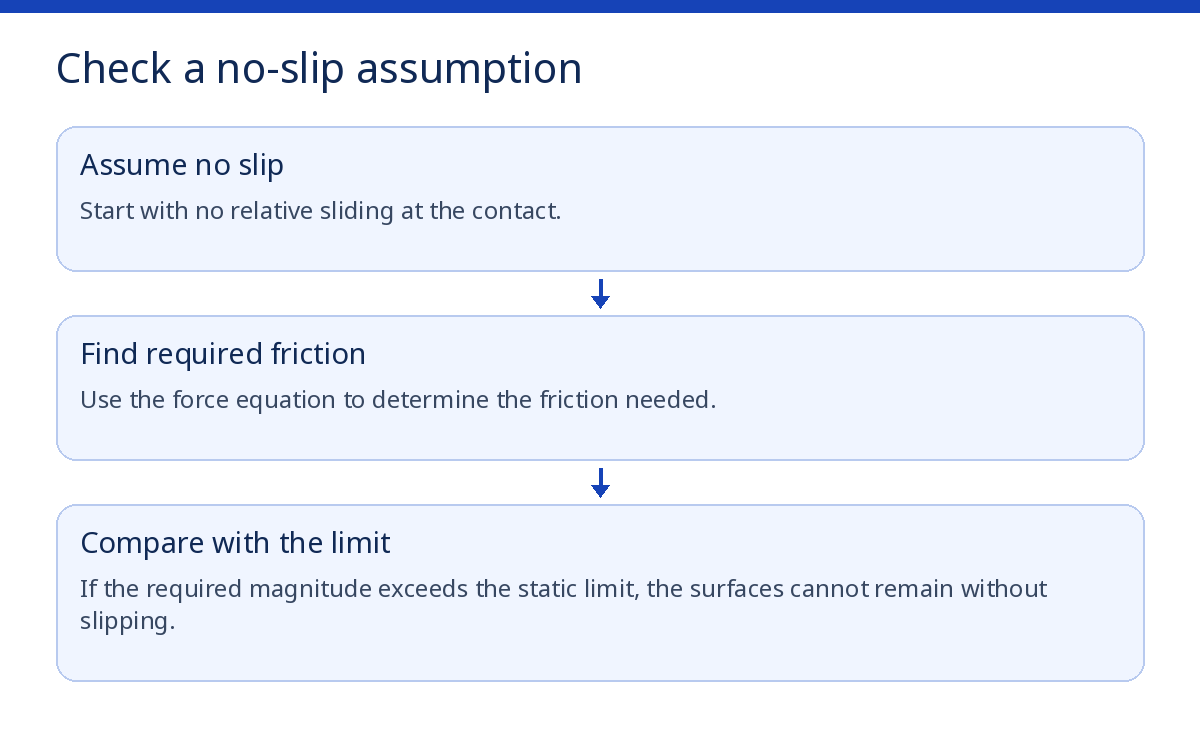
The second topic includes rough inclines, a block pressed against a wall and objects carried by accelerating surfaces. For contacts that are not slipping, static friction adjusts to what the motion requires, up to the limiting magnitude . Use equality at impending slip, not automatically whenever the surfaces are at rest relative to each other. If the required friction exceeds that limit, the no-slip assumption fails.
Decide which way the surfaces would tend to slip relative to each other before assigning the direction of static friction. Also find the normal force from the forces and acceleration perpendicular to the contact surface instead of assuming it equals the weight. When the surfaces slide relative to each other, kinetic friction opposes that relative sliding.
Circular motion: identify what acts inward
The circular-motion material ranges from turning vehicles and banking to objects on strings. Constant speed does not mean constant velocity on a circle, because the velocity changes direction. For a body following a circle, the inward acceleration has magnitude . The inward component of the net force produces that acceleration: centripetal force is not an extra force to add to the diagram.
For each setup, mark the direction toward the centre and project the actual forces along it. On a banked turn, the tilt of the surface allows the normal force to have an inward component. If speed changes as well, distinguish tangential acceleration from inward acceleration. One printed item gives an unclear unit for the rate of change of speed; this guide omits that item’s calculation.
Use the solutions to find the first wrong step
Chapter Practice includes objective, assertion–reason, case-based, very short, short and long-answer questions. In assertion–reason practice, judge each statement before deciding whether the reason explains the assertion. For a case-based prompt, separate the shared facts from what each part asks; for a longer calculation, write the body or system, the force directions and the governing equation before substituting values.
Open the worked solution after making an independent attempt. Compare the setup before comparing the result: a wrong system boundary, a reversed sign or an unchecked friction limit can affect every later line. If the setup agrees, check conversions and arithmetic. This guide also leaves out the short-answer item whose force unit appears as “lf”; the supplied excerpt does not establish what that notation means.
Spotted an error? Report a correction. Practise this in the app: notes, formula sheets and mind maps.








































Loading comments…