Kinetic Theory of Gases: CBSE Class 11 NCERT Notes
CBSEPhysicsKinetic Theory of Gases
These Class 11 Physics notes connect the pressure and temperature of a gas to the motion of its molecules. Use the gas-law graphs and the wall-collision derivation to see where the formulas come from and what assumptions make them valid.
What the notes cover
The notes divide Kinetic Theory into two parts. The first moves from the molecular nature of matter to the behaviour of gases, the ideal gas laws and the kinetic explanation of pressure. The second lists degrees of freedom, equipartition of energy, specific heat capacity, mean free path and Brownian motion. The file contains worked examples and lists a chapter summary after the two parts.
The chapter works at two scales. Pressure, volume and temperature describe the gas as a whole; molecular speeds, collisions and energies describe what its particles are doing. The ideal gas equation connects the bulk quantities, while kinetic theory explains why those quantities are related. That distinction gives you a way to organise the chapter without treating each formula as a separate fact.

Kinetic Theory of Gases Class 11 |Physics | NCERT Theory | Revision Notes
In the StudentCurio app
Comprehensive revision notes for Class 11 Physics covering ideal gas laws, kinetic interpretation of temperature, degrees of freedom, and specific heat capacities.
When the ideal gas equation applies
The notes write the equation of state in two forms: when you count particles, and when you measure the amount in moles. Here is the number of particles, is the amount in moles, and is the absolute temperature in kelvin. Boltzmann’s constant and the molar gas constant are related by , where is the Avogadro constant. An immediate consequence is that equal volumes of ideal gases at the same pressure and temperature contain equal numbers of particles.
An ideal gas is a model. A real gas generally comes closer to it at low pressure and at temperatures well above those at which it liquefies. On the notes’ graph of against pressure, the ideal gas gives a horizontal line at . Read the real-gas curves by looking at how far they sit from that line.
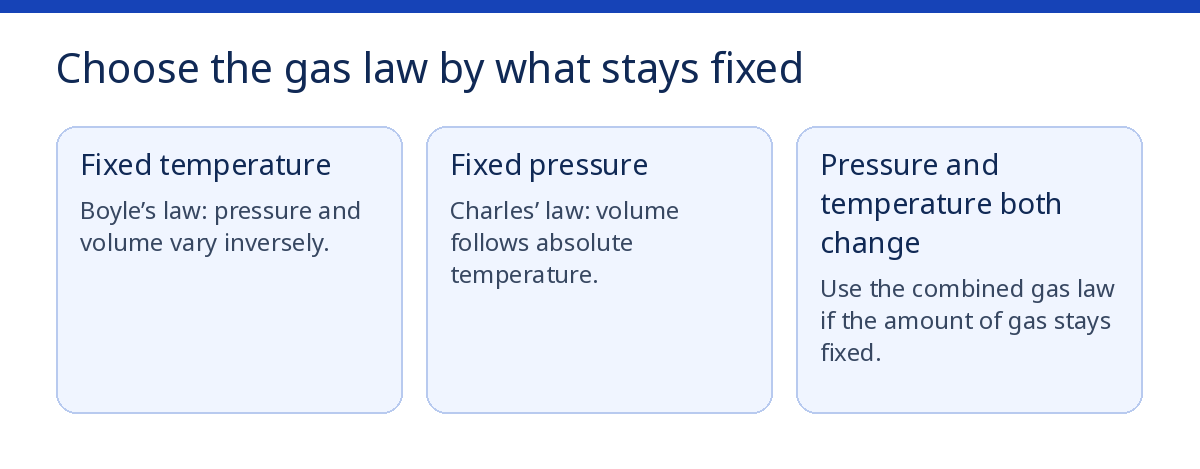
Common mistake: choosing a law without checking what stays fixed
For a fixed amount of ideal gas, Boyle’s law keeps temperature constant: stays constant, so pressure increases as volume decreases. Charles’ law keeps pressure constant: stays constant, so volume is proportional to temperature on the kelvin scale, not the Celsius scale. If both pressure and temperature change but the amount of gas stays fixed, compare the two states using rather than applying either law alone.
Dalton’s law concerns a mixture of ideal gases rather than a change between two states. Its total pressure is the sum of the partial pressures. A component’s partial pressure is what it would exert if it alone occupied the full container at the mixture’s temperature. The full volume matters: a component is not assigned its own smaller compartment.
How molecular collisions produce pressure
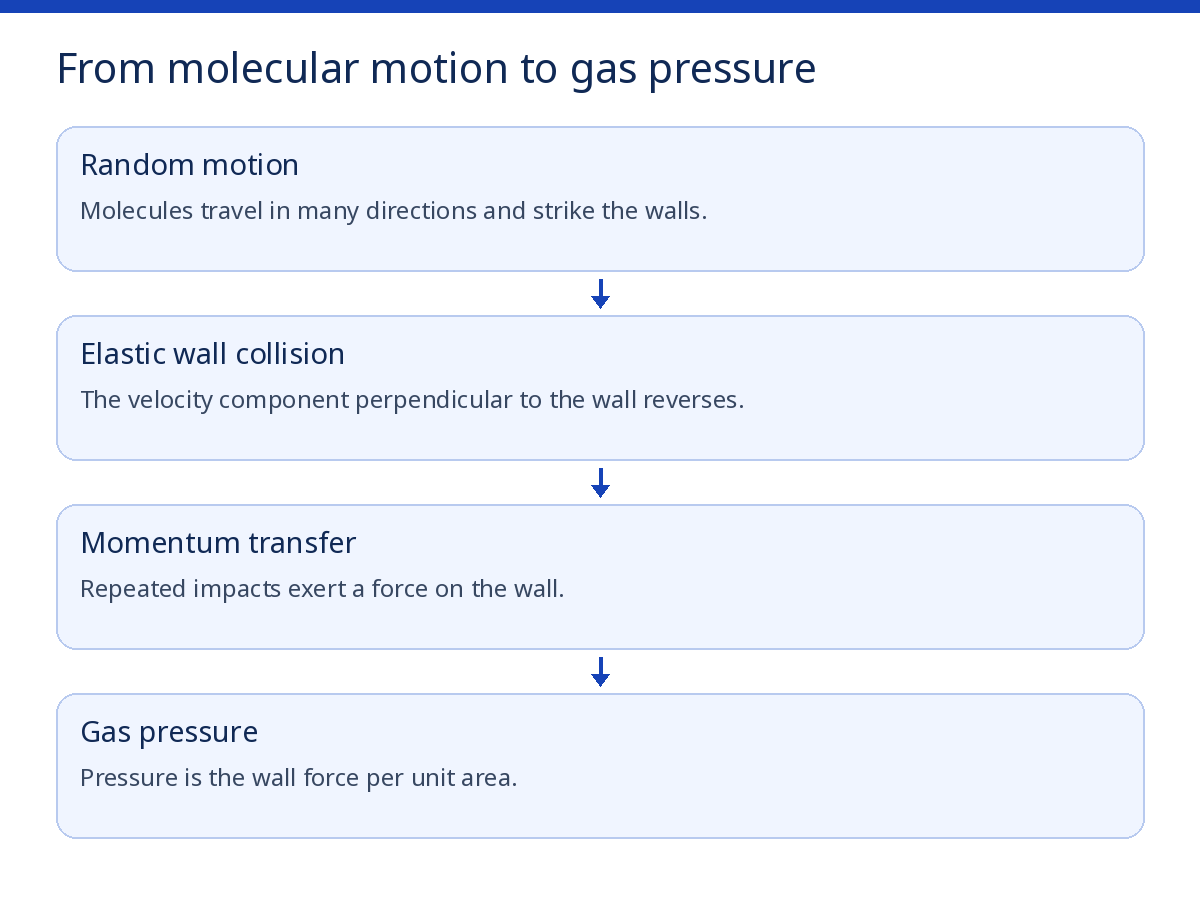
The derivation starts with molecules moving randomly, with negligible intermolecular forces between collisions. When a molecule strikes a stationary wall elastically, the velocity component perpendicular to the wall reverses, while the parallel components stay unchanged. The molecule therefore transfers momentum to the wall without losing kinetic energy in the collision. The repeated transfers of momentum from many molecules give a force on the wall; force per unit area is pressure.
The notes obtain , where is number density, is the mass of one molecule and is the mean square speed. The factor of one third comes from the absence of a preferred direction: the three mean squared velocity components contribute equally to the mean square speed. That equality is an average over the gas, not a requirement on each molecule’s motion.
A useful connection: temperature and molecular energy
Combine the pressure result with the particle form of the ideal gas equation. Since , the mean translational kinetic energy per molecule is . Temperature fixes this average, not the speed of each molecule. It also follows that two ideal gases at the same temperature have the same mean translational kinetic energy per particle, even though their root-mean-square speeds differ if their molecular masses differ.
This connection sets up the later topics listed in the contents. Translational motion is motion through space; molecules can also have other ways of storing energy, such as rotation. Degrees of freedom and equipartition help explain why different gases can require different amounts of heat for the same temperature rise under the same heating condition.
Mean free path and Brownian motion are different ideas
The opening pages introduce mean free path as the average distance a molecule travels between successive collisions. It is a distance, not the time between collisions or the spacing between neighbouring molecules. The notes list a fuller treatment later in the chapter, followed by Brownian motion. Brownian motion is the irregular motion of a suspended particle caused by the surrounding molecules striking it unevenly. Keep track of which object is moving in each description: mean free path here concerns a gas molecule, while Brownian motion concerns a particle being jostled by molecules.
Before you move on: read the examples for their assumptions
Use the gas-law examples to practise identifying what stays fixed before choosing an equation. Then return to the wall-collision diagram and explain why only the perpendicular velocity component enters the momentum transfer. If you can explain that step and distinguish mean square speed from the square of mean speed, you have the reasoning needed to read the pressure derivation.
This guide leaves out the compression-work passage because its exponent and work convention are unclear. It also omits worked results with ambiguous assumptions, labels, units or conclusions, and does not rely on the historical attribution in the opening pages.
Spotted an error? Report a correction. Practise this in the app: notes, formula sheets and mind maps.








































Loading comments…