Kinetic Theory of Gases: CBSE Class 11 Physics Assessment
CBSEPhysicsKinetic Theory of Gases
This CBSE Class 11 Physics assessment takes you from gas laws and molecular speeds to equipartition, heat capacities and collisions. Use its topic-wise sets to isolate a weak concept, then use chapter practice to check whether you can recognise the right model without a topic heading as a cue.
How the assessment is organised
The PDF divides the chapter into Behaviour and Kinetic Interpretation of Gases and Motion of Gas Molecules. Each topic has separate practice and assessment sets, with objective, very short, short and long-answer questions. A separate Chapter Practice section also includes assertion–reason and case-based questions. The change in format matters: recognising a principle in an objective question is different from naming its assumptions and explaining why it applies in a written response.
The clickable index separates questions from solutions. Start with the question set, write your reasoning, and then use the Solution link beside the question to open its worked answer. The Back to question link lets you return to the prompt and check whether you addressed everything it asked.

Kinetic Theory of Gases | Class 11 | CBSE Assessment
In the StudentCurio app
Chapter-wise assessment questions and worked solutions cover ideal-gas behaviour, molecular pressure and temperature, RMS speed, degrees of freedom, equipartition, heat capacities and mean free path. Helps Class 11 students review concepts and practise objective and written questions.
Before using a gas law, identify what stays fixed
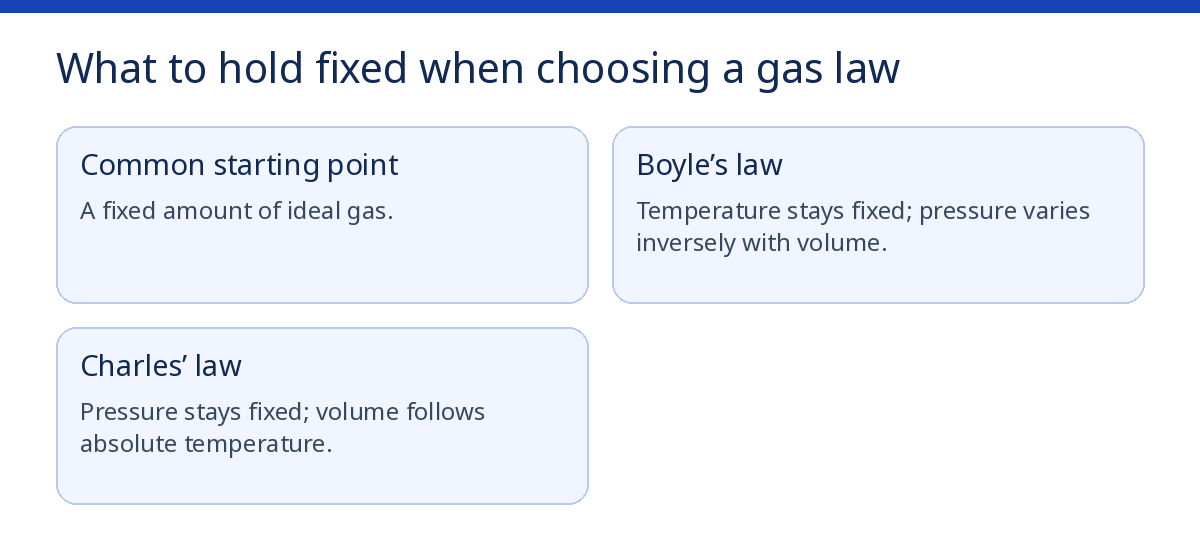
The first topic connects the ideal-gas equation, , with graphs and changes of state. Boyle’s law is a special case: for a fixed amount of ideal gas at constant temperature, pressure and volume vary inversely. For Charles’ law, it is pressure that stays fixed; the volume of a fixed amount of ideal gas is proportional to its absolute temperature. In both cases, the amount of gas matters. If gas enters or leaves a container, a fixed-amount relation cannot be carried unchanged from one state to the next.
On a graph, read the axes before interpreting a curve. A plot of pressure against volume is not the same as a plot of the product of pressure and volume against pressure. The assessment uses graph questions to test this distinction and to compare real gases with the ideal model. Real gases generally approach ideal behaviour at low pressure and sufficiently high temperature, when molecular volume and intermolecular attractions are less important.
From collisions to pressure and temperature
The kinetic model explains pressure through momentum transfer: molecules striking a container wall change their momentum, exerting a force on the wall. Pressure is that force per unit area. The ideal-gas model treats collisions as elastic and neglects intermolecular forces between collisions. When you write a kinetic explanation, distinguish those model assumptions from what the model explains.
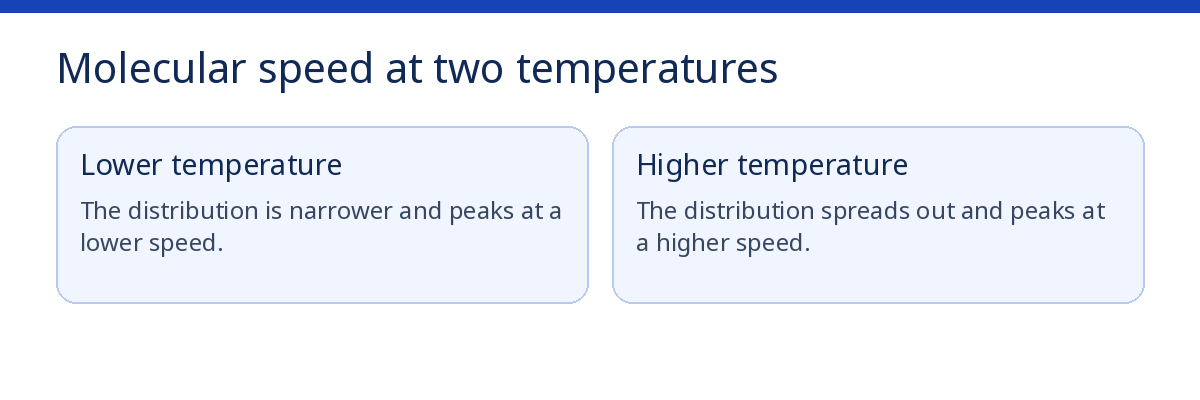
Absolute temperature, in turn, measures the mean translational kinetic energy per molecule in an ideal gas. It does not specify the speed of any one molecule. The speed-distribution sketch on the cover makes this distinction visible: for the same gas at a higher temperature, the distribution spreads out and its peak moves towards higher speeds. The vertical axis represents fraction per unit speed, so the peak marks the most probable speed, not a speed shared by all molecules.
Common mistake: averaging before squaring
Root-mean-square speed is the square root of the mean of the squared speeds, not the arithmetic mean speed. When a table gives counts or percentages, those values determine how much weight each speed receives. The most probable speed is a different statistic: it corresponds to the peak of a continuous speed distribution or the most populated entry in a discrete table.
For an ideal gas in thermal equilibrium, , where is the molar mass. With the gas constant in SI units, use molar mass in kilograms per mole and temperature in kelvin. Before making a comparison, decide whether it concerns speed or translational energy. The speed relation depends on mass as well as temperature, whereas mean translational energy per molecule depends on temperature alone.
When equipartition predicts heat capacity
The second topic connects degrees of freedom with internal energy. In classical equipartition, each active quadratic energy term contributes an average of per molecule. Translation and rotation are distinct ways of storing energy. If a vibrational mode is active, it has both a kinetic and a potential energy term. This is why a rigid-molecule approximation need not predict heat capacity equally well at all temperatures.
For heat-capacity questions, identify the process before choosing a relation. At constant volume, a gas does no expansion work; at constant pressure, heating can also cause it to expand and do work. The resource includes mixture questions, where another distinction matters: a molar heat capacity is quoted per mole, whereas a mass-specific heat capacity is quoted per unit mass. Keep the basis consistent when combining contributions from different gases.
A useful connection: fast molecules, slow spreading
Mean free path is the average distance a molecule travels between successive collisions. In the dilute hard-sphere model, it decreases as number density increases at fixed molecular diameter, and larger collision diameters shorten it at fixed number density. Frequent collisions redirect the molecules, so rapid molecular motion does not imply equally rapid spreading across a room. Brownian motion offers a related observation: a suspended particle moves irregularly because molecular impacts do not balance exactly at every instant.
Use chapter practice to test your choice of model
After a topic set, label each missed question by the decision that caused trouble: what was held fixed, whether energy or speed was being compared, or which molecular modes the model treated as active. Then try a different question format in Chapter Practice. For assertion–reason items, judge the two statements separately before deciding whether the reason explains the assertion. For a case-based or written item, use the given conditions to justify your choice of principle before consulting the worked solution.
This guide leaves out individual items with unclear speed options, a questionable density-table unit or an unspecified heat-capacity condition. Those details are not used to explain the chapter.
Spotted an error? Report a correction. Practise this in the app: notes, formula sheets and mind maps.








































Loading comments…