Motion in a Plane: CBSE Class 11 Physics Assessment
CBSEPhysicsKinematics 2D
This CBSE Class 11 Physics assessment pairs topic-wise questions and mixed chapter practice with worked solutions. Use it to connect vector methods with projectile, relative and circular motion, and to check the reasoning behind your answers.
How the assessment is organised
The file divides Chapter 4, Motion in a Plane, into two topics: Scalars and Vectors and Motion in a Plane. Each topic has its own practice and assessment sets, with objective questions and written responses of different lengths. The chapter practice mixes topics and adds assertion–reason and case-based questions, so you have to recognise which idea applies without a topic heading to cue you.
The clickable question index is on page 2, and the separate solutions index is on page 3. Since question numbering restarts across sets, identify an item by its topic, set and question number before opening the solution. This also makes it easier to return to the same problem after reviewing a concept.

Kinematics 2D | Class 11 | CBSE Assessment
In the StudentCurio app
This assessment resource contains practice questions and worked solutions on vectors, motion in a plane, projectile motion and relative motion, with some circular-motion applications. It helps Class 11 students practise and review two-dimensional kinematics through objective, case-based and written questions.
From vector diagrams to components
The first topic moves from identifying scalars and vectors to adding vectors, resolving them along axes and selecting the appropriate vector product. For a displacement problem, sketch the arrows before calculating. A route can have several legs, but the resultant displacement connects the starting point to the endpoint. The total distance instead follows the route itself. This distinction also lets you tell whether a question calls for average speed or average velocity.
When adding vectors by components, choose one pair of perpendicular axes and use it for every vector. Add the signed components along each axis separately, then use the resulting components to find the magnitude and direction if both are required. A diagram helps you check the quadrant: an inverse tangent alone does not always distinguish opposite directions. The vector-product questions test a different choice: the dot product gives a scalar, while the cross product gives a vector and can describe an area through its magnitude.
When the level-ground range formula applies
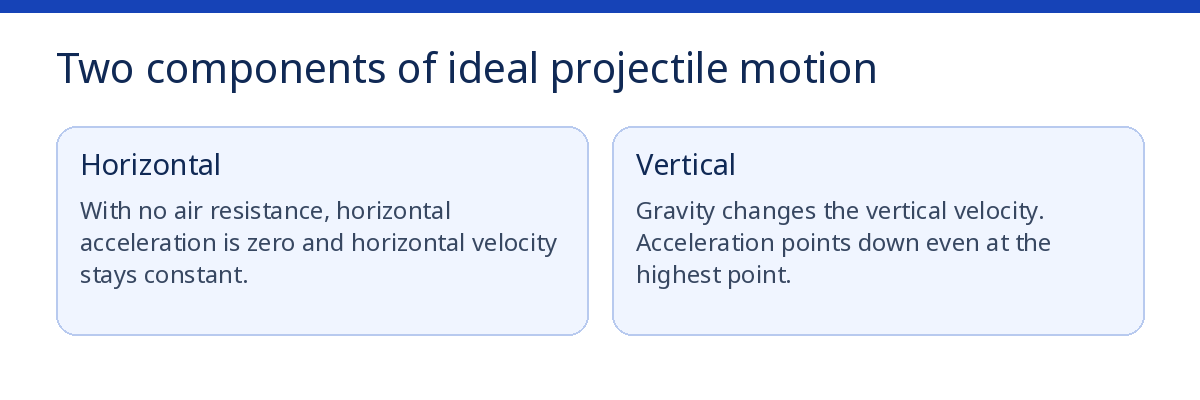
The projectile questions include oblique launches, horizontal launches from a height and motion under a ceiling constraint. In the model used for ideal projectile motion, air resistance is neglected and gravity is taken as constant. With the positive vertical axis pointing upwards, the acceleration components are and . The horizontal velocity stays constant, while the vertical velocity changes. The two component equations describe the same motion and therefore use the same elapsed time.
The familiar range expression assumes that the projectile lands at its launch height, with the launch speed and the launch angle above the horizontal. Check the landing height before using it. For a launch from a table or cliff, use the vertical displacement to determine the time to the floor or ground before finding the horizontal distance. A ceiling, by contrast, restricts how high the trajectory may rise; it is not a landing condition.
Relative motion starts with the observer
The assessment uses examples such as rain with a sideways velocity component and a stone dropped inside an accelerating railway carriage. For any relative-motion question, label the observer before comparing quantities. The velocity of an object relative to an observer is the object's velocity minus the observer's velocity, with both measured in the same reference frame. In two dimensions that subtraction must account for directions; subtracting the two speeds is not generally enough.
The carriage example shifts the focus from velocity to acceleration. If the carriage accelerates relative to the ground, describing the stone from the carriage is not the same as describing it from the ground. Keep the two descriptions separate in your written work so it is clear which frame each acceleration refers to.
Common mix-up: turning and slowing down
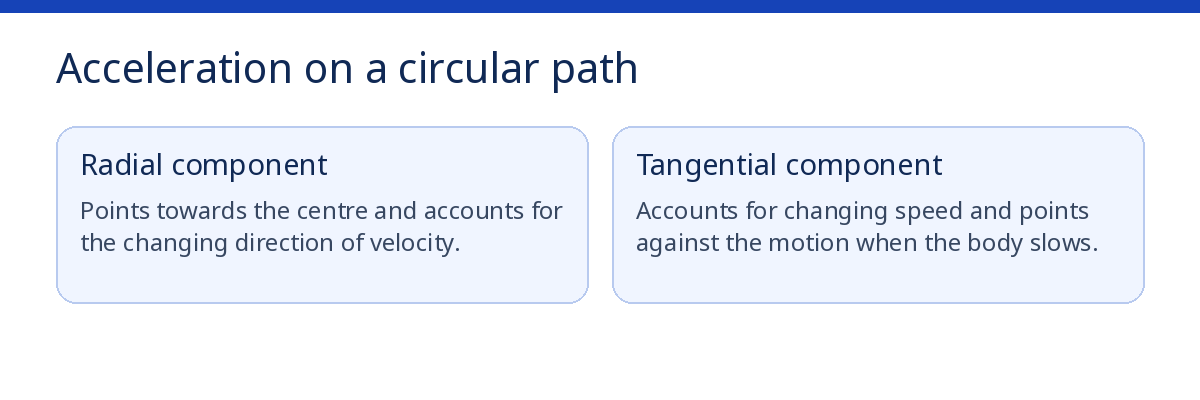
The circular-motion questions distinguish a change in direction from a change in speed. The instantaneous velocity is tangent to the circle. Its direction changes as the body moves, so even at constant speed there is an inward acceleration of magnitude , where is the speed and is the radius.
Treat that expression as the radial component, not automatically as the magnitude of the total acceleration. When the speed changes, there is also a tangential component. The assessment's slowing-cyclist question is an opportunity to practise drawing both components before describing the net acceleration. For slowing motion, the tangential component points opposite the instantaneous velocity.
Use the solutions to check the setup
Start with the practice set for whichever topic is less secure. Before opening a worked solution, mark the quantities that determined your method: an angle measured from an axis, a landing height, the observer's frame or a statement that speed is constant. Then compare the setup as well as the result. If the first difference is in a component sign or a height condition, correct that step and try the rest again before reading on.
Use the topic-wise assessment next without consulting the solutions mid-attempt. In mixed chapter practice, evaluate an assertion and its reason separately before deciding whether the reason explains the assertion. For a case-based question, identify the information in the scenario that controls the model. For written responses, make the diagram, sign convention or condition visible rather than leaving the method implicit.
This guide leaves out isolated items with unclear transcribed notation, including the repeated vector relation on page 5 and the inequality list on page 7.
Spotted an error? Report a correction. Practise this in the app: notes, formula sheets and mind maps.








































Loading comments…