Class 11 Gravitation: NCERT Physics Revision Notes Guide
CBSEPhysicsGravitation
Use these CBSE Class 11 Physics notes to connect Kepler’s laws, Newton’s law of gravitation and the behaviour of objects near Earth. This guide shows where to start in the PDF and which assumptions to check before using a formula.
Find the right part of the Gravitation notes
The PDF opens with a chapter checklist and a clickable index. The first block starts on page 3 with planetary motion, then moves to the universal law of gravitation, superposition and Cavendish’s torsion balance. The second starts on page 15 with Earth’s gravity and leads into gravitational field, potential and potential energy. The third starts on page 29 with escape speed and continues to Earth satellites, orbital energy and weightlessness. The index lists a chapter summary on page 38.
Use the checklist to identify the distinction you need to revise, then jump to the relevant explanation. If you can state the inverse-square law but cannot tell which distance goes in it, for instance, revisit the force diagram before moving to the section on gravity above Earth’s surface.

Gravitation Class 11 |Physics | NCERT Theory | Revision Notes
In the StudentCurio app
Comprehensive revision notes for Class 11 covering Kepler's laws, variation in g with altitude and depth, gravitational potential, and satellite mechanics.
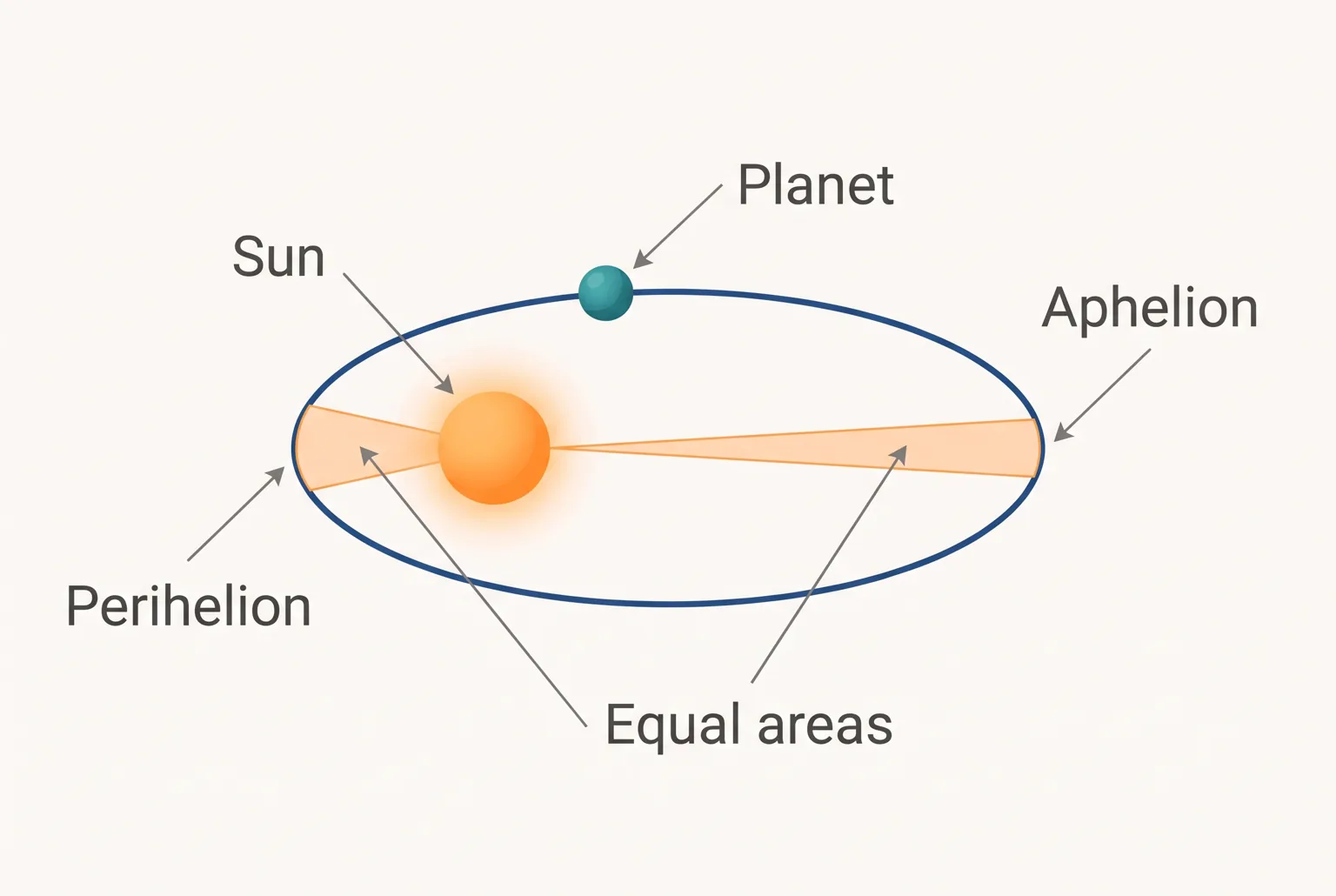
Read each of Kepler’s laws against the orbit diagrams
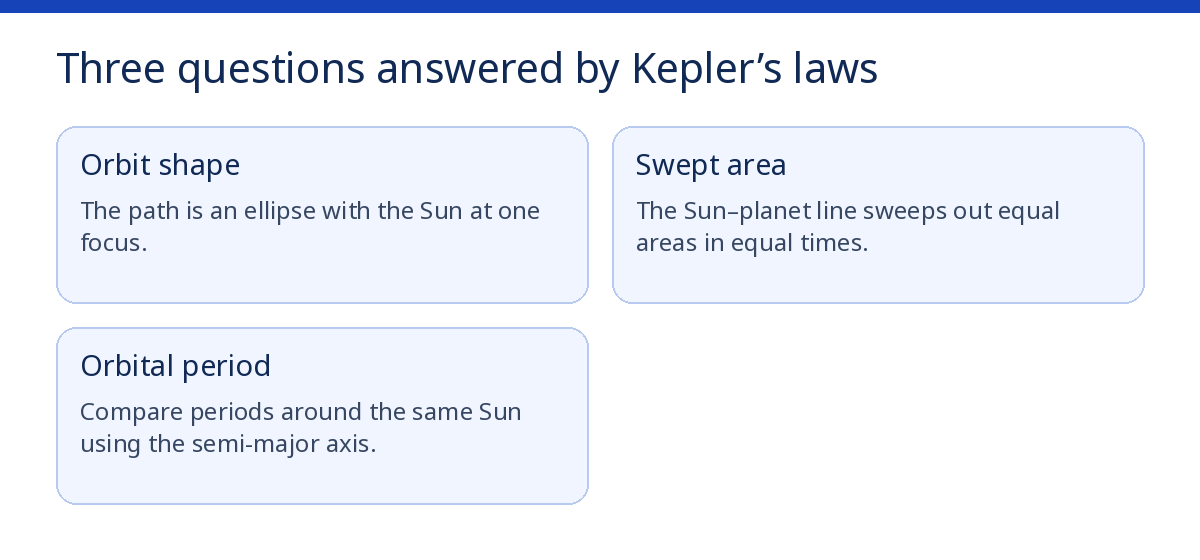
Kepler’s first law describes the shape of a planet’s orbit: an ellipse with the Sun at one focus, not at the centre. On the diagram on page 3, locate perihelion, the closest point to the Sun, and aphelion, the farthest. The semi-major axis is half the sum of those two Sun–planet distances; it is not the planet’s instantaneous distance from the Sun.
The second law describes how the planet moves along that ellipse. The line joining the Sun and planet sweeps out equal areas in equal times, not equal lengths of orbit. The notes connect this result to angular momentum: gravity acts along the line joining the bodies, so its torque about the Sun is zero in this model. At a general point on the ellipse, the radius and velocity vectors need not be perpendicular; they are perpendicular at perihelion and aphelion.
The third law, , compares orbital periods for planets around the same Sun. Here is the semi-major axis. A circular orbit is the special case in which that length is the orbital radius.
Build the net gravitational force one vector at a time
Newton’s law gives the magnitude of the attractive force between two point masses as , where is their separation. The force on either mass points towards the other. Those two forces have equal magnitudes and opposite directions, but they act on different bodies, so they are not added when finding the net force on just one body.
The notes’ treatment of superposition starts by choosing the body whose net force is required. Draw a separate arrow towards each attracting mass, then add the forces as vectors. When using components, check which ones oppose one another before adding magnitudes. The Cavendish section offers a related distinction: forces can produce a turning effect even when the net force on the bar is zero. The torsion balance uses the twist of the suspension fibre to infer the gravitational interaction.
When the formula for Earth’s gravity applies
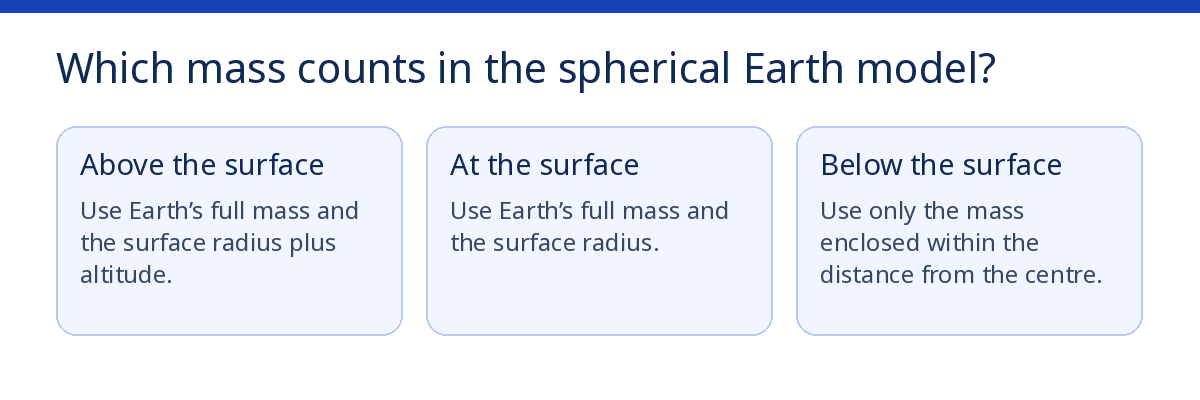
Capital is the universal gravitational constant; lowercase is the local acceleration due to gravity. In the spherical Earth model, the gravitational pull at an exterior point is the same as if Earth’s mass were concentrated at its centre. Thus outside Earth, with measured from the centre. At altitude above a surface of radius , use , not . This is why the model predicts weaker gravity at greater altitude.
Below the surface, the same calculation cannot use Earth’s full mass. The spherical shells outside the observation point contribute zero net field there. The enclosed mass is the one that enters the force law. In the uniform-density model introduced on page 15, enclosed mass scales as the cube of the distance from the centre, so the inverse-square factor leaves proportional to that distance. The linear decrease with depth depends on the uniform-density assumption.
A useful connection: field, potential and potential energy
The index lists these as separate topics because they answer different questions. Gravitational field gives force per unit mass, including its direction. Gravitational potential gives potential energy per unit mass, while gravitational potential energy refers to the energy of the mass in that field. At a fixed position, changing the test mass changes its potential energy but does not change the potential due to Earth.
As you move from the field section to the potential section, check what each quantity describes before using it. A field tells you which way a freely falling body accelerates. Potential is a scalar, and its value is stated relative to a chosen zero. These distinctions matter when the notes shift from force diagrams to energy arguments.
Quick self-check: orbiting, escaping and feeling weightless
The index points to an energy-conservation treatment of escape speed and a separate discussion of orbital energy. Read them side by side: escape asks whether the object can get arbitrarily far away without further propulsion, while an orbit keeps it in motion around Earth. Before comparing speeds, ask whether the situation describes a bound orbit or the threshold for escape.
Then use the weightlessness section to check whether you can explain why a satellite occupant can feel weightless even though gravity still acts. The key is that the satellite and occupant fall together, so the occupant need not be supported by a floor. This connects the apparently weightless experience to orbital motion rather than to an absence of gravity.
Spotted an error? Report a correction. Practise this in the app: notes, formula sheets and mind maps.








































Loading comments…