Class 11 Gravitation: Case-Based Physics Assessment Guide
CBSEPhysicsGravitation
Master core concepts of planetary motion, escape velocity, and gravitational variation through 17 solved case-based questions designed for Class 11 CBSE and NCERT curricula.
Understanding Case-Based Assessments in Physics
Case-based assessments (CBAs) are a vital component of the modern CBSE Physics curriculum, designed to test a student's ability to apply theoretical concepts to practical or descriptive scenarios. This StudentCurio resource focuses on Chapter 7: Gravitation, providing Class 11 learners with 17 linked answer items distributed across four distinct case studies. Unlike standard numerical problems, these questions require learners to extract relevant data from a narrative or diagrammatic context before applying the laws of physics.
The material covers four essential pillars of the chapter: the variation of gravity across Earth’s surface and interior, the geometric and temporal laws of Kepler, the dynamics of satellite orbits and free fall, and the energetics of escape speed. By using the clickable index and solution links, students can navigate between problems and worked answers, ensuring they understand not just the 'what' of a solution, but the 'how' and 'why' behind the application of various gravitational formulas.

Gravitation Class 11 Physics | CBSE Case Based Assessment
In the StudentCurio app
This resource features 17 solved case-based assessment questions for Class 11 Physics, covering Kepler's laws, variation in acceleration due to gravity, and escape velocity.
Spatial Variations in Acceleration Due to Gravity
The first case study examines why acceleration due to gravity () is not a universal constant on Earth. It introduces the Earth as an ellipsoid rather than a perfect sphere, noting the 21 km difference between equatorial and polar radii. This section challenges students to calculate gravity at specific altitudes and depths. A key conceptual takeaway is the relationship between height () and depth (); for instance, near the surface, the gravity at a depth is approximately equivalent to the gravity at an altitude where .
Learners must also account for Earth's rotation and the resulting centripetal effects, which further reduce the effective gravity at the equator. This leads to interesting real-world applications, such as why a commodity weighed on a spring scale appears to 'weigh' more at the poles than at the equator, even though its mass remains constant. This distinction between mass and weight is critical for scoring well in CBSE conceptual questions.
Kepler’s Laws and Orbital Dynamics
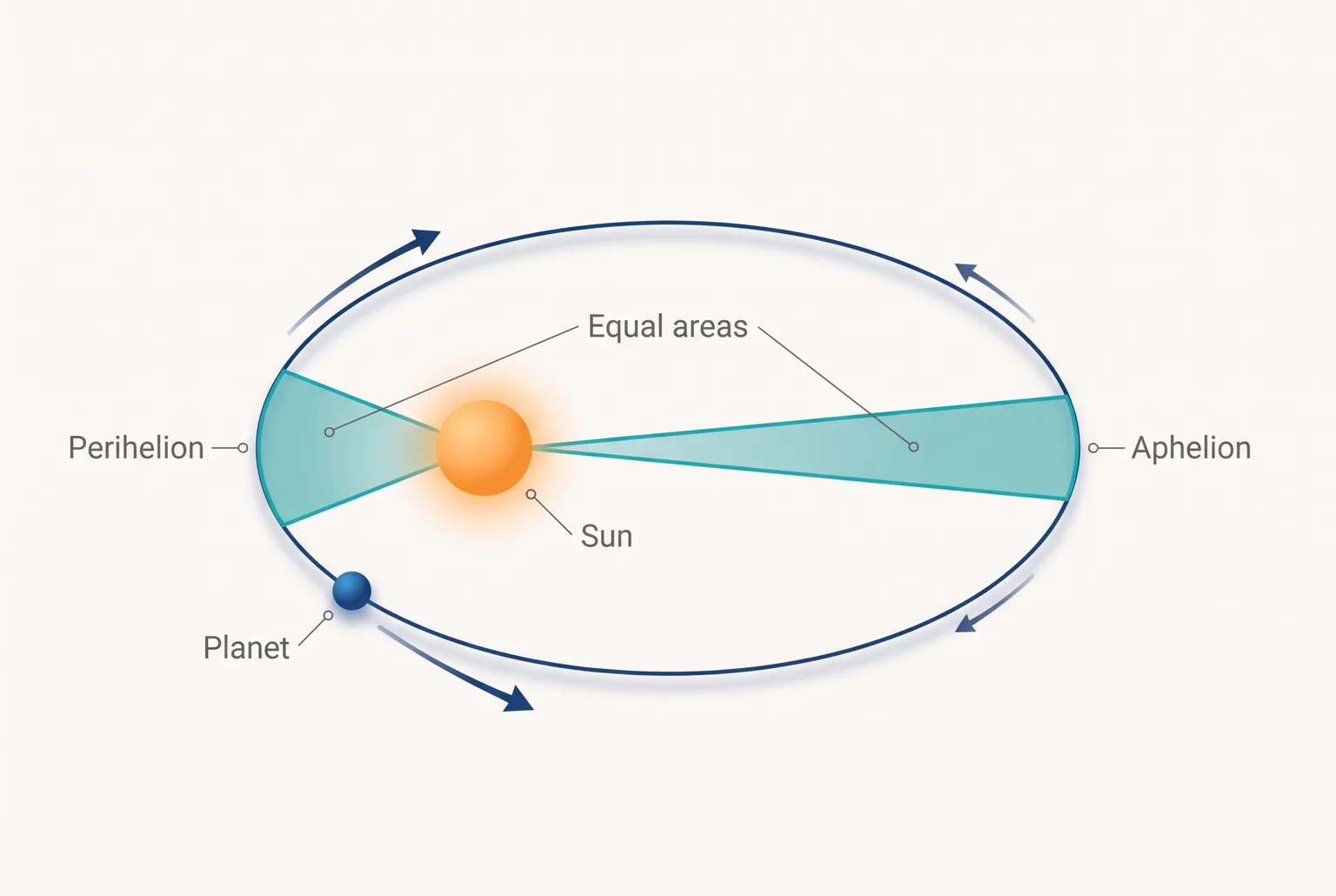
Kepler’s three laws form the backbone of planetary motion studies. This resource provides five specific items (Case Study 2) to test these laws. The Law of Orbits and the Law of Areas are explored through the lens of conservation laws. Specifically, it is established that Kepler’s second law—the areal velocity being constant—is a direct consequence of the conservation of angular momentum about the Sun.
The third law, the Law of Periods (), is applied to scenarios where orbital distances are modified. For example, if the distance between the Earth and the Sun were reduced to one-third of its current value, the period of a year would decrease significantly. The material also emphasizes speed variations in elliptical orbits; using the vis-viva relation or angular momentum conservation, learners can deduce that a planet travels faster when it is nearer to the Sun (perihelion) and slower when it is further away (aphelion).
Satellite Motion and the Energy of Free Fall
Case Study 3 transitions from natural planetary motion to artificial satellites. It explains the delicate balance between a satellite's momentum and the Earth's gravitational pull. A recurring theme in this section is the energy required to change an orbit or to escape it entirely. For a satellite in a circular orbit, the resource shows that the additional speed needed to escape is times the orbital speed ().
This section also introduces a rigorous 'stopping' scenario: what happens to the speed of a satellite if it is suddenly brought to rest and allowed to fall freely toward Earth? By applying the law of conservation of mechanical energy, learners can calculate the impact speed at Earth's surface. Furthermore, the material explores the detection of gravity in large space stations. While a small spaceship provides an environment of apparent weightlessness, a sufficiently large station allows for the detection of tidal forces, which are differences in gravitational acceleration across the station's dimensions.
Escape Speed and Atmospheric Constraints
The final case study focuses on escape speed (), defined as the minimum velocity required for a body to break free from a planet's gravitational influence. A critical verified fact presented here is that depends only on the mass and radius of the planet, not the mass of the escaping object. Furthermore, the escape velocity magnitude is independent of the launch angle; whether a rocket is launched vertically or at 45 degrees, the energy required to reach infinity remains the same.
Practical applications of these formulas include comparing escape speeds to the thermal speeds of gas molecules. This explains why the Moon lacks an atmosphere: its escape speed is low enough that gaseous molecules, moving at their respective thermal speeds, can easily escape into space. The material guides students through calculations involving planetary contraction, showing that if a planet's radius decreases while its mass remains constant, the escape speed increases because is inversely proportional to the square root of the radius.
Common Mistakes to Avoid
- Confusing Height and Radius: When calculating gravitational acceleration at an altitude , always use the distance from the Earth's center, , in the denominator of the inverse-square law.
- Ignoring Energy Conservation: In free-fall problems involving satellites, do not forget to include the initial potential energy at the orbital height when setting up the conservation of energy equation.
- Incorrect Ratios: When using Kepler’s third law to find new orbital periods, ensure you cube the distance ratio before taking the square root to find the period ratio.
- Mass Independence: Do not assume a heavier object needs a higher escape velocity; the in the kinetic energy term cancels the in the potential energy term, making mass-independent for the escaping body.
Quick Self-Check
- Can you explain why the areal velocity of a planet remains constant even though its linear velocity changes?
- If a planet's radius were to double while its mass stayed the same, what would happen to its surface escape velocity?
- Under what specific conditions does the approximation hold true for equal values of ?
- Why does an astronaut feel weightless in a small orbiting station even though the force of gravity there is nearly as strong as it is on the surface?
Frequently asked questions
How does the Earth's shape affect weighing commodities at different latitudes?
Earth is an ellipsoid with a larger radius at the equator. This, combined with rotation, makes gravity slightly weaker at the equator than at the poles. Consequently, an object weighed on a spring scale will show a higher reading at the poles.
What is the relationship between orbital speed and escape speed near a planet's surface?
The escape speed () is exactly times the orbital speed () for a satellite orbiting very close to the planet's surface ().
Does the angle of projection affect the escape velocity of a rocket?
No. The escape velocity magnitude depends only on the initial and final energy states. As long as the trajectory is not obstructed, the launch angle does not change the speed required to escape the gravitational field.
Spotted an error? Report a correction. Practise this in the app: notes, formula sheets and mind maps.








































Loading comments…