Gravitation: CBSE Class 11 Physics Assessment Guide
CBSEPhysicsGravitation
This CBSE Class 11 Physics assessment pairs topic-wise questions with worked solutions and ends with mixed chapter practice. Use it to distinguish the models behind planetary motion, changes in gravity, gravitational potential, escape speed and satellite orbits.
Find the right question set in the PDF
The file has separate clickable indexes for Questions and Solutions. It groups the chapter into three topics: theory of planetary motion; acceleration due to gravity and gravitational potential energy; and escape speed and satellites. Each topic has a Practice Questions set and a Topical Understanding set, with objective and written-response items. The Chapter Practice section also includes assertion–reason and case-based questions.
When checking your work, match the topic, set name and question number: numbering restarts across sets. If you can recall a formula but are unsure when it applies, start with the shorter items and write down the assumption that makes each relation valid. Then try a longer response in the same set to see whether you can carry that assumption through a calculation.

Gravitation | Class 11 | CBSE Assessment
In the StudentCurio app
This Class 11 assessment provides objective, written-response and case-based questions with worked solutions on gravitation, including gravitational fields and potential, variation of gravity, Kepler’s laws, escape velocity and satellite motion. It helps students practise conceptual and numerical questions with step-by-step explanations.
Connect Newton’s force law to Kepler’s laws
Newton’s law describes how two masses attract; Kepler’s laws describe features of orbital motion. For point masses, the magnitude of the gravitational force follows an inverse-square law in their separation. In the ideal planetary model, the force on the planet points towards the Sun. Because that force has no torque about the Sun, the planet’s angular momentum about the Sun is conserved. Kepler’s law of areas expresses a consequence of that conservation: the line from the Sun to the planet sweeps out equal areas in equal times, not equal lengths of orbit.
For period comparisons in the usual Class 11 model, where the orbiting masses are negligible compared with the same central mass, use . Here is the semi-major axis of an ellipse; it becomes the orbital radius for a circle. An instantaneous distance from the Sun is not a substitute for the semi-major axis.
Common mistake: using one gravity rule above and below Earth
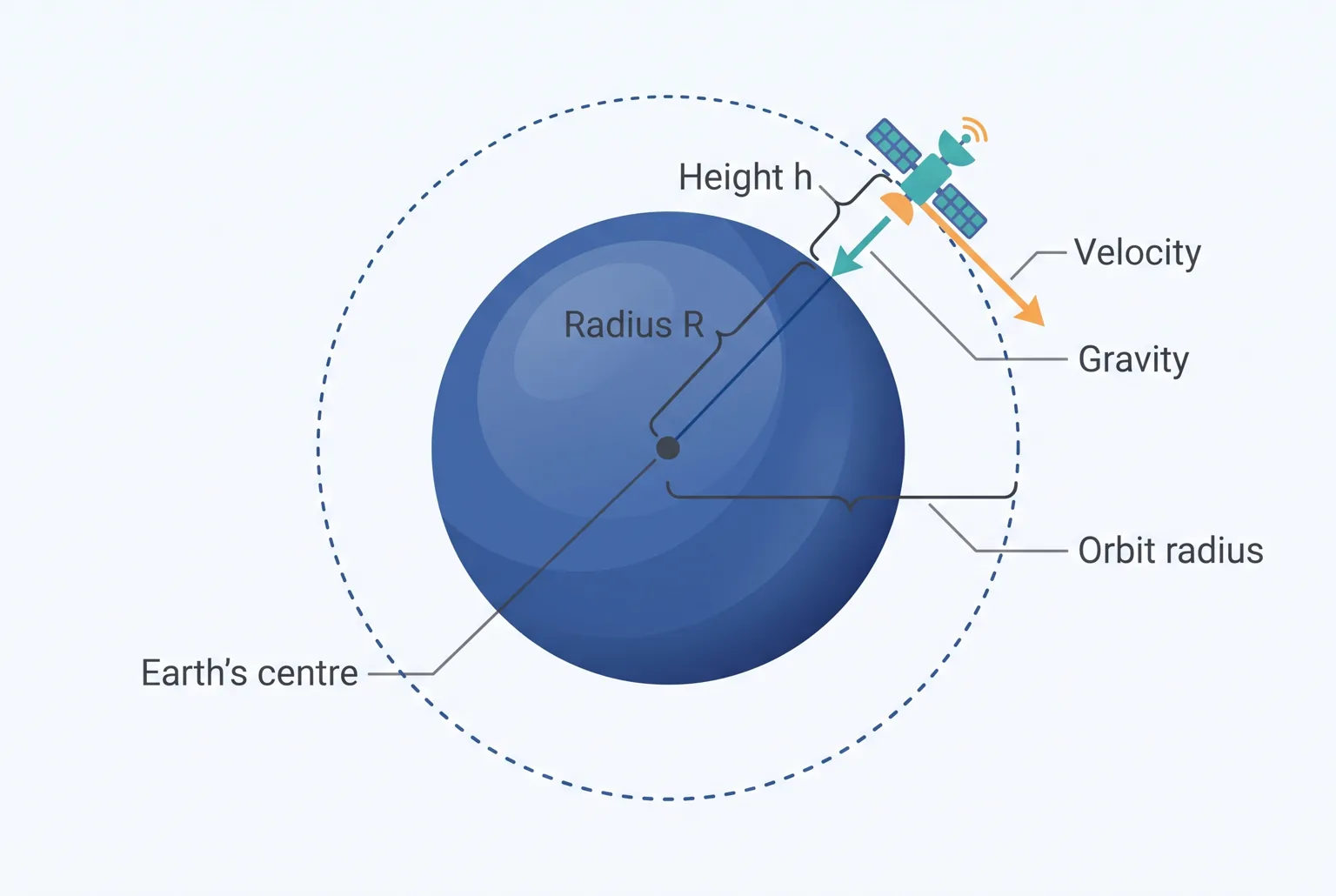
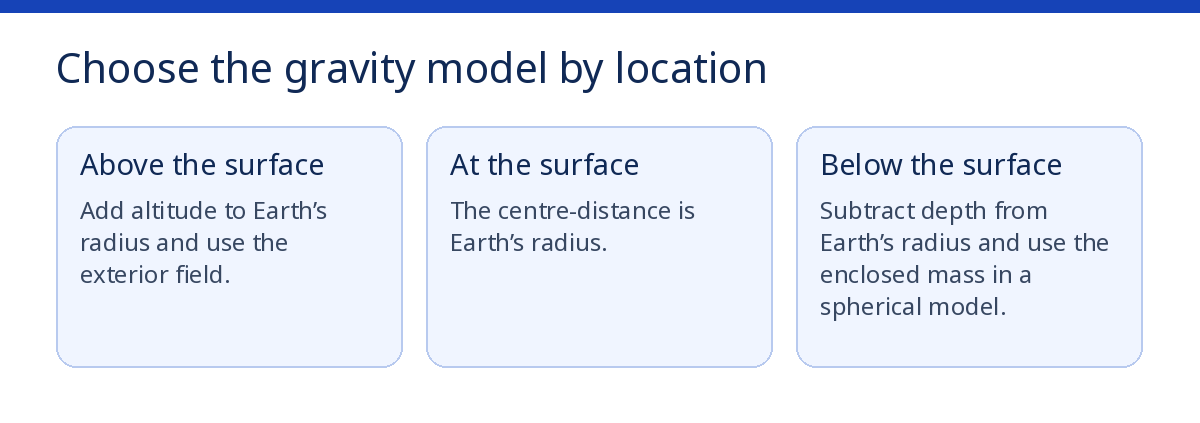
First mark Earth’s centre and surface on a sketch. At altitude , the distance from Earth’s centre is , where is Earth’s radius. In a spherical, non-rotating Earth model, the gravitational acceleration outside Earth falls with the square of that centre-distance. Height above the surface is not the distance to put in the denominator.
At depth , the centre-distance is , but the exterior formula cannot simply be reused with the full mass of Earth. In a spherically symmetric model, only the mass enclosed within that radius contributes to the field there. The simple linear decrease of gravity with depth assumes uniform density. For questions comparing the poles and equator, check whether the prompt is asking about Earth’s shape, its rotation, or both before choosing an explanation.
Keep gravitational field, potential and energy separate
The gravitational field is force per unit test mass and has a direction. Gravitational potential is potential energy per unit mass, measured in joules per kilogram; gravitational potential energy is measured in joules and depends on the mass placed in the field. When more than one source mass is present, field contributions add as vectors, while potential contributions add as scalars. This is why field cancellation alone does not establish that the potential is zero.
For a spherical source of mass , with zero potential at infinity, the exterior potential is , where is measured from the centre. The energy of a test mass there is . For a small change in height near Earth’s surface, approximates the change in potential energy because is nearly constant. For a substantial altitude change, compare the potential energies at the two positions instead.
Quick self-check: orbit or escape?
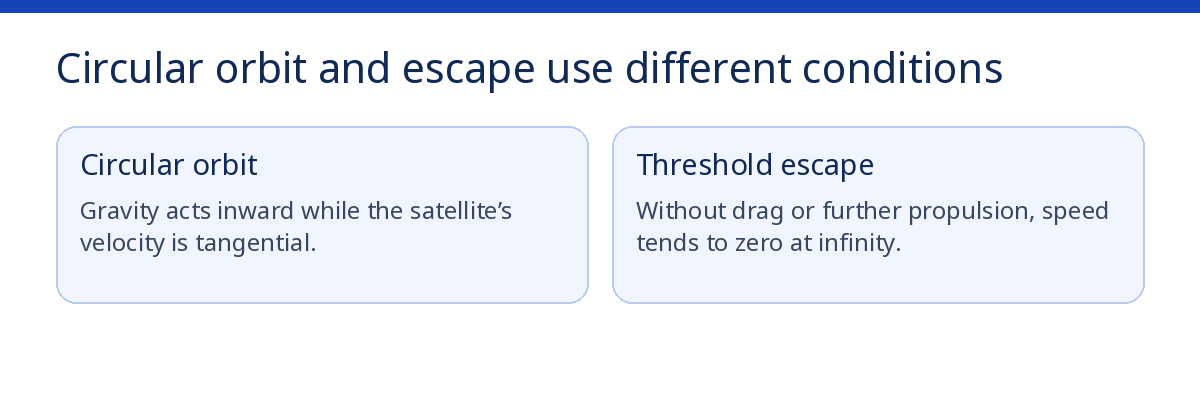
Before choosing a speed formula, ask what the object is meant to do. In a circular orbit, the satellite’s velocity is tangential, but gravity acts inward and provides the acceleration that changes the direction of that velocity. The orbital radius is measured from the centre of the attracting body, not from its surface.
Escape speed uses a different condition. In the ideal model with no air resistance or further propulsion, it is the minimum launch speed at a specified distance that allows the object to reach arbitrarily far away. At that threshold, its speed tends to zero at infinity. As a self-check, explain why matching inward acceleration to circular motion and setting the threshold for escape are different tasks even when the starting distance is the same.
Use chapter practice to test your choice of model
In mixed practice, the section no longer tells you which principle to use. For an assertion–reason item, judge each statement independently before deciding whether the reason explains the assertion. For a case-based item, identify which details set the model and which supply numerical inputs. In written calculations, label centre-distances and convert quantities to compatible units before substituting.
When comparing your attempt with a worked solution, find the first step where your reasoning differs. A wrong starting model needs a different correction from a unit conversion error or a missed sign. The stellar-collision item on page 15 is not discussed here because its transcribed starting separation is smaller than the stated stellar radii.
Spotted an error? Report a correction. Practise this in the app: notes, formula sheets and mind maps.








































Loading comments…