Class 11 Physics Guide: Case-Based Analysis of Laws of Motion
CBSEPhysicsLaws of Motion
A comprehensive guide to solving CBSE case-based assessments on Newton's laws, impulse-momentum, and friction using vector analysis and force-balance equations.
Conceptual Framework of Laws of Motion
The Laws of Motion form the cornerstone of classical mechanics in the Class 11 Physics curriculum. This resource focuses on the application of Newton’s three laws through various real-world and laboratory scenarios. It moves beyond simple formula substitution to require a deep understanding of how forces interact. The material covers critical topics including the product of force and time—defined as impulse—and the rate of change of momentum. By exploring these concepts through case studies, learners can see how the second law, , generalizes the relationship between external forces and acceleration.
Learners are encouraged to use this resource to practice distinguishing between different types of friction—static, kinetic, and rolling—and to solve problems involving system equilibrium. Each case study provides a narrative context, such as a bird in a cage or a vehicle braking, followed by subparts that test specific mathematical and conceptual nuances. The solutions provided are structured to show the step-by-step logic required for CBSE assessments, emphasizing the vector nature of quantities like momentum and force.

CBSE Laws of Motion Class 11 |Physics | CBSE Case Based Assessment
In the StudentCurio app
A comprehensive set of case-based questions for Class 11 Physics, covering Newton's laws, impulse-momentum, and friction with detailed step-by-step solutions for CBSE exams.
Impulse and Momentum in Collisions
Case Study 1 introduces the concept of impulse, which is the measure of a force's effect over a specific time duration. It is mathematically equivalent to the change in momentum of a body. This is particularly relevant in impulsive force scenarios, where a large force acts for a very short duration, such as a ball striking a wall. The resource specifically analyzes the vector components of momentum during such reflections.
When a ball of mass strikes a wall at an angle, the impulse imparted is calculated by finding the change in the momentum component normal to the surface. If the angle is measured relative to the wall surface, only the perpendicular velocity component reverses, while the parallel component remains unchanged. This section also explores Conservation of Linear Momentum through nuclear disintegration. In a closed system where a nucleus at rest splits into two fragments, the total initial momentum is zero. To satisfy conservation, the two resulting fragments must move in exactly opposite directions so that their vector sum remains zero. This demonstrates that internal forces, no matter how explosive, cannot change the total momentum of a system.
The Mechanics of Friction and Equilibrium
Friction is often misunderstood as a simple constant, but Case Study 2 clarifies its role as a self-adjusting tangential force. Static friction () opposes the impending motion and can vary from zero up to a maximum value known as limiting friction. Once relative motion begins, kinetic friction () takes over, which is typically slightly less than the limiting static friction.
The resource applies these principles to practical problems like the shortest stopping distance of an automobile. By equating the maximum available frictional force () to the deceleration needed to stop a vehicle from speed , learners can derive the formula . Another significant application involves a box on an accelerating train floor. To prevent the box from slipping, the train's acceleration must not exceed the limit determined by the coefficient of static friction, expressed as . This reinforces the idea that friction is the force responsible for accelerating the box alongside the train.
Newton’s Third Law and Reaction Forces
A recurring theme in this assessment is the distinction between action and reaction forces. Newton’s Third Law states that every action has an equal and opposite reaction, but these forces always act on different objects. A classic example provided is a bird flying inside a wire cage. When the bird is perched, its weight is supported by the cage floor. As it takes off, it must push the air downward to generate lift.
In an open-wire cage, much of this downward air movement (downwash) escapes into the atmosphere. Consequently, the cage may appear lighter to a person holding it because the bird is no longer directly supported by the structure. However, the resource notes that in a closed or solid-based container, the downwash would eventually hit the bottom, potentially maintaining the average total weight. This level of analysis helps learners appreciate the environmental assumptions necessary in physics problem-solving.
Analyzing Complex Systems: Ropes and Pulleys
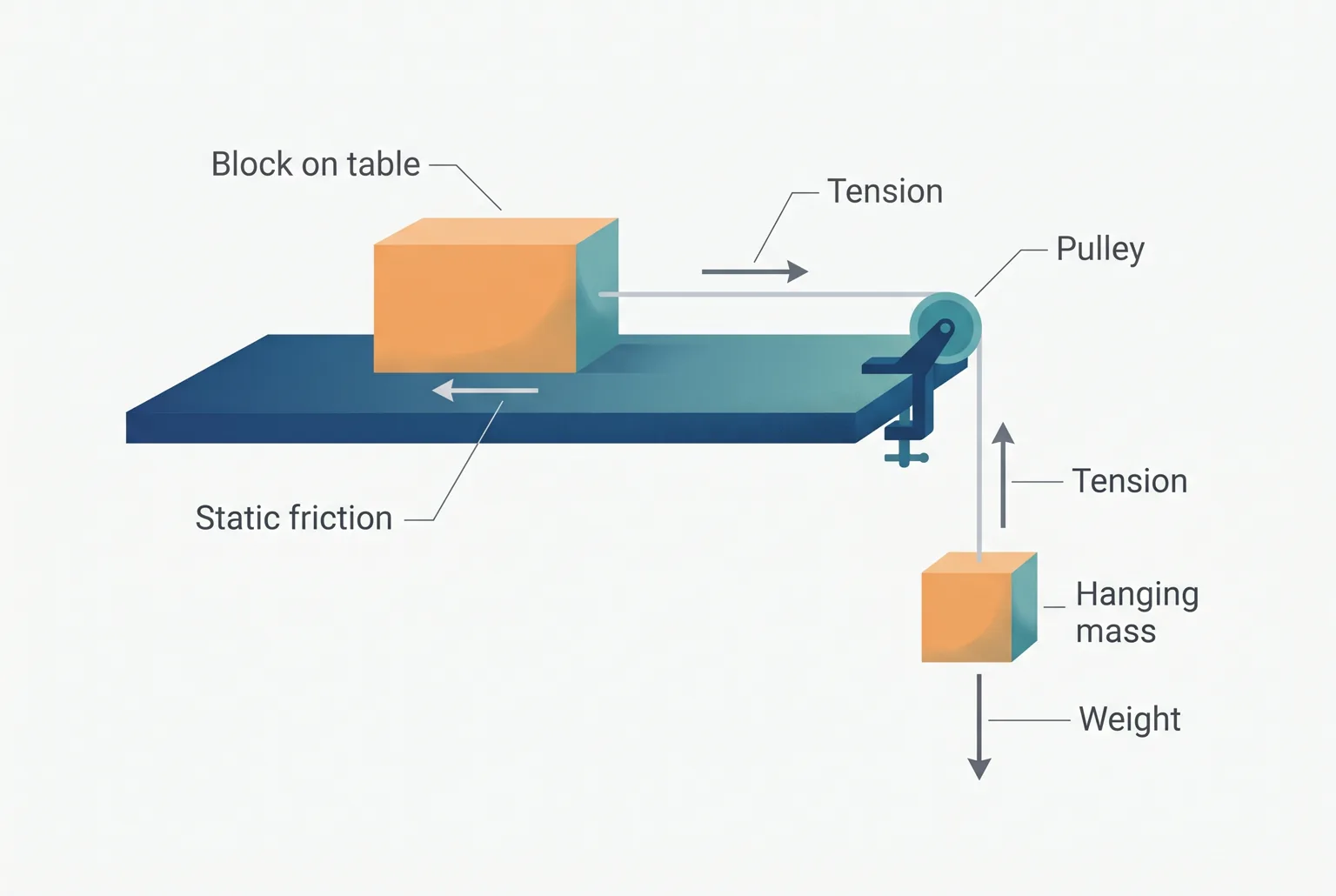
Case studies often involve multi-body systems, such as blocks connected by strings or massive ropes. One specific problem involves finding the minimum mass required to prevent a block from slipping on a table when connected to a hanging mass. This requires a precise force balance where the tension in the string (equal to the weight of the hanging block) must be less than or equal to the limiting static friction of the combined masses on the table.
The resource also tackles the tension in a massive rope. Unlike ideal massless strings where tension is uniform, a rope with linear density has varying tension if it is accelerating. When a force is applied to one end of a rope on a smooth floor, the entire rope accelerates. The tension at any specific point is only responsible for accelerating the segment of the rope trailing that point. By calculating the system acceleration first (), learners can then find the tension at any distance from the force application point by analyzing the mass of the remaining section.
Calculus Applications in Dynamics
Finally, the resource bridges the gap between kinematics and dynamics using basic calculus. In Case Study 3, a particle's motion is described by a displacement equation such as . To find the force acting on the particle, learners must differentiate the position equation twice with respect to time to find the acceleration.
The first derivative () gives the velocity, and the second derivative () gives the acceleration. For the given equation, the acceleration is simply . Applying Newton's Second Law (), the force is determined to be . This section reminds students that the second law is the most general way to describe motion, connecting the geometry of a path to the physical causes behind it. These mathematical tools are essential for handling the non-constant forces often found in advanced JEE or competitive physics contexts.
Frequently asked questions
What is the difference between static and kinetic friction in these problems?
Static friction prevents relative motion and is 'self-adjusting' up to its limiting value (). Kinetic friction acts when objects are already sliding against each other and is generally lower than the limiting static friction.
How do you calculate the impulse of a ball hitting a wall at an angle?
Impulse is the change in momentum (). When a ball reflects without losing speed, only the velocity component perpendicular to the wall changes direction (e.g., from to ). The impulse magnitude is or , depending on whether is measured from the wall or the normal.
Why does a massive rope have different tension at different points?
In a massive rope, the tension at any point must accelerate the mass of the segment behind it. If the rope is being pulled from one end, the tension decreases as you move further from the point of application because there is less 'trailing' mass to pull.
Does the weight of a bird in a cage change when it flies?
The actual gravitational weight of the bird and cage remains constant. However, the 'apparent weight' or the support force experienced by a person holding the cage can change depending on whether the cage is open (allowing air downwash to escape) or closed.
Spotted an error? Report a correction. Practise this in the app: notes, formula sheets and mind maps.








































Loading comments…