CBSE Class 11 Trigonometric Functions Assessment Guide
CBSEMathematicsTrigonometric Functions
This Class 11 CBSE Mathematics file pairs six topic-wise assessments with mixed chapter practice and worked solutions. Use it to practise choosing the right identity, tracking signs and restrictions, and explaining your reasoning in written answers.
What the assessment covers
The file is organised around Chapter 3, Trigonometric Functions. The six assessments cover angle measure, trigonometric functions, compound angles, transformation formulae, multiple and sub-multiple angles and equations, and the sine and cosine formulae for triangles. The separate chapter practice brings topics together and includes case-based questions.
The question formats give you different ways to check your understanding. In an objective question, write down the fact that rules an option in or out, such as a function’s possible range. In a written proof, make the chain of equalities clear and name the identity at the step where it does the work. In a case-based question, identify what each quantity represents before choosing a rule.
Trigonometric Functions | Class 11 | CBSE Assessment
In the StudentCurio app
Topic-wise assessments with worked solutions cover trigonometric functions, identities, angle formulas, transformations, equations, triangle rules and their applications. Helps Class 11 students practise objective, written and case-based questions and check their solution methods.
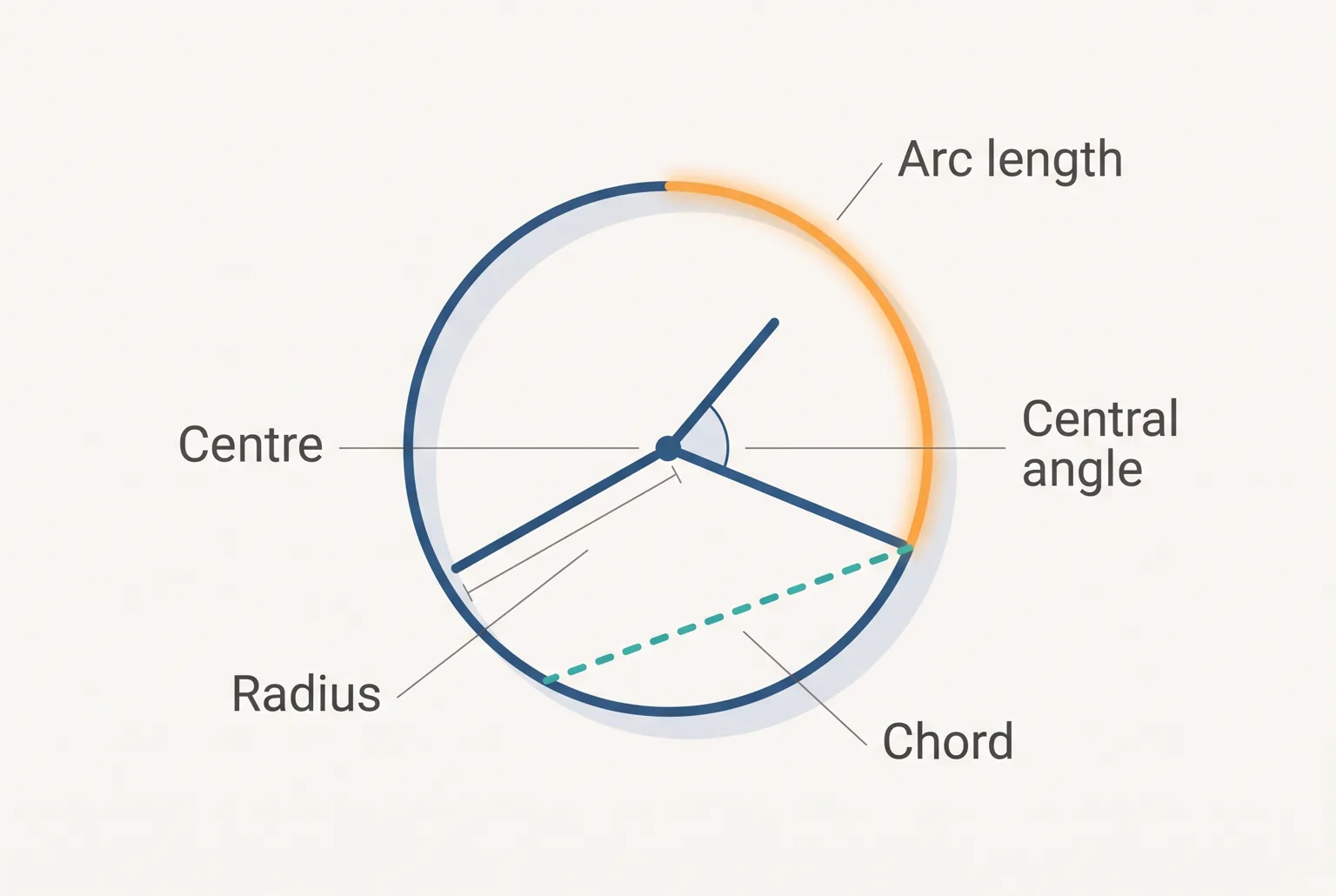
When the arc-length formula applies
The first assessment moves between degrees, radians, and circular situations such as the motion of a watch hand. The conversion rests on radians. If an angle includes minutes and seconds, remember that one degree contains 60 minutes and one minute contains 60 seconds. A negative sign on a degree-minute-second measure applies to the whole angle, not just the degree part.
For an arc of a circle, gives its length when is the radius and is the non-negative central angle swept out along that arc, measured in radians. The arc length is in the same length unit as the radius. In a watch-hand problem, elapsed time tells you the fraction of a turn; the hand length gives the radius. The distance travelled along the arc is not the straight-line distance between the tip’s starting and ending positions.
Use the quadrant, period and domain together
The second assessment asks you to evaluate functions at large or negative angles, infer other function values from a given ratio and quadrant, and justify identities and inequalities. The cover’s sine graph shows one cycle over radians. Sine and cosine repeat every , while tangent repeats every wherever it is defined. When reducing an angle, use the period of the function actually being evaluated.
A reference angle helps you find the magnitude of a function value; the quadrant tells you its sign. Neither check tells you whether a denominator is zero. Tangent and secant are undefined where cosine is zero; cotangent and cosecant are undefined where sine is zero. The assessment treats identities as holding where all displayed expressions are defined. If simplifying a fraction removes a factor from the denominator, values excluded by the original expression are still excluded.
A useful connection: compound angles and transformations
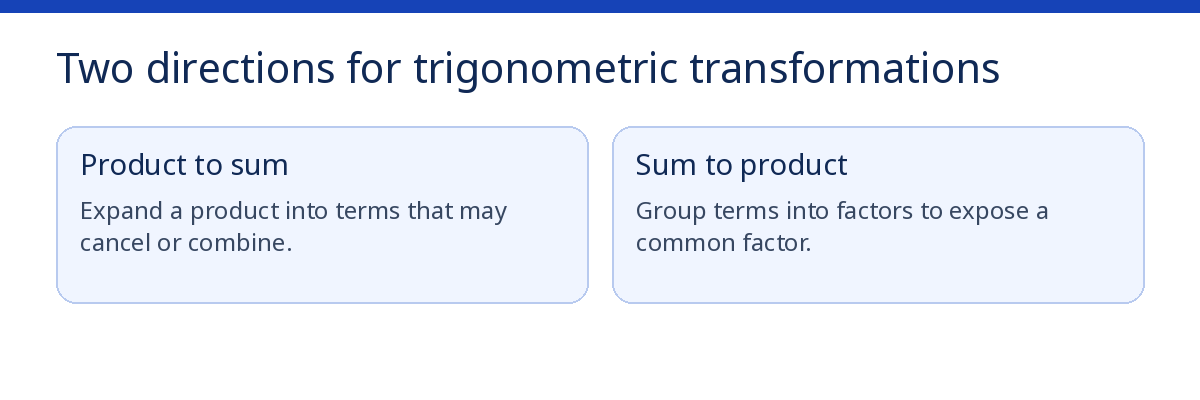
The compound-angle assessment tests functions of a sum or difference. The transformation assessment asks you to turn products into sums or differences and to turn sums or differences into products. The two skills are connected: combining the sine addition and subtraction identities gives . Reading the same identity in reverse shows how a pair of sine terms can be grouped into a product.
Choose the direction according to what you need next. A product-to-sum identity can expose terms that cancel in a longer expression. A sum-to-product identity can reveal a common factor in the numerator and denominator of a quotient. When pairing terms, write down the average and half-difference of their angles before substituting. This is especially useful for differences, where reversing the angle order can change a sign.
Multiple angles and equations: check the solution set
The fifth assessment combines double-angle and higher-multiple identities with half-angle evaluations and equation solving. For example, is a useful form when the rest of an expression already involves sine. When a half-angle calculation gives you a squared value, use the location of the half-angle to determine the sign of the function itself.
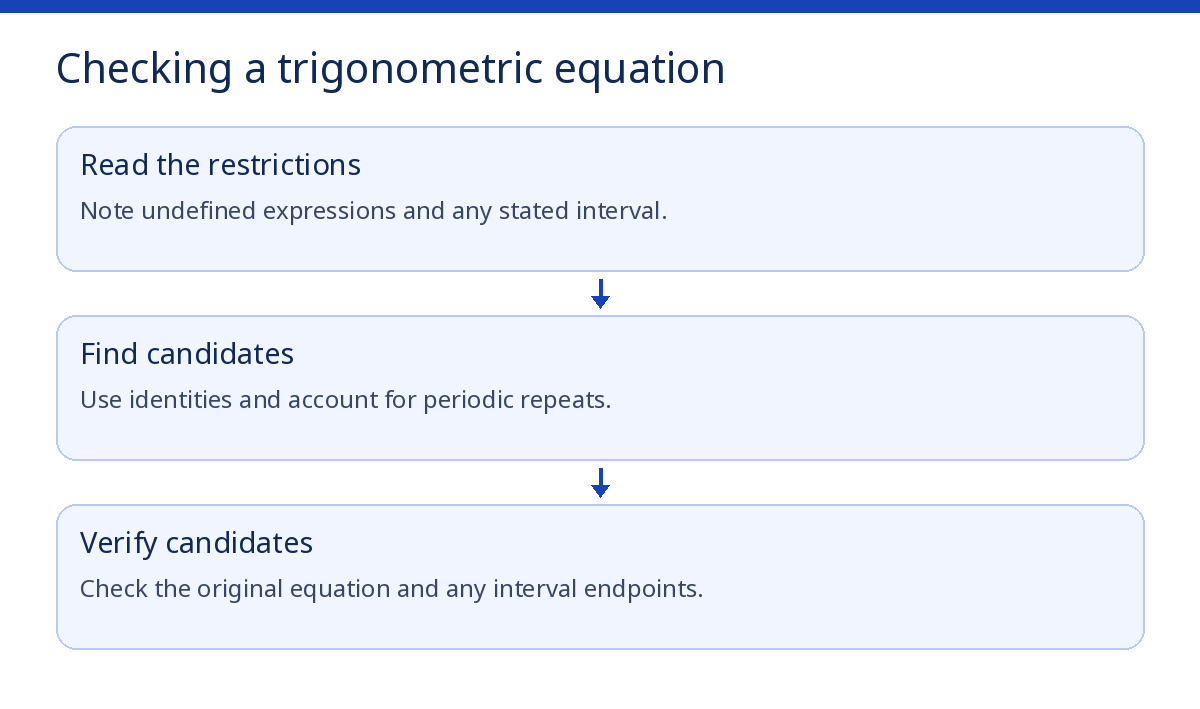
An identity holds throughout its common domain; an equation asks which values in a stated set make it true. The file includes both interval-restricted questions and prompts for all real solutions. For an interval, check which endpoints are included. For all real solutions, account for periodic repeats. If you squared both sides or divided by a variable expression, check candidates in the original equation and consider separately any values that make the divisor zero.
Match triangle sides to opposite angles
The sixth assessment is indexed under Sine and Cosine Formulae. In the file’s notation, , and are opposite , and , respectively. Mark those pairs on a sketch before substituting: the sine rule relates each side to the sine of its opposite angle, so pairing a side with an adjacent angle changes the relation.
The cosine rule serves a different purpose. If two sides and the angle between them are known, it can give the third side. In , the angle is between sides and . Identifying that included angle is what makes the substitution meaningful.
Before you open a worked solution
The file has separate clickable indexes for questions and solutions, and individual question and solution pages link back to each other. Keep the assessment name and original question number together when checking your work, because numbering starts again across assessments.
Before following a solution link, mark the first step you are unsure about. On comparison, decide whether the difference is a conversion error, a missing condition, or simply another valid route to the same result. Then try mixed chapter practice without relying on a topic heading to tell you which formula to use.
Spotted an error? Report a correction. Practise this in the app: notes, formula sheets and mind maps.
Loading comments…