CBSE Class 11 Three-Dimensional Geometry: NCERT Notes Guide
CBSEMathematicsThree-Dimensional Geometry
These CBSE Class 11 Mathematics notes show how to locate points in three-dimensional space and use distances to test geometric relationships. The chapter moves from axes, planes and octants to worked examples on projections, collinearity and the properties of figures.
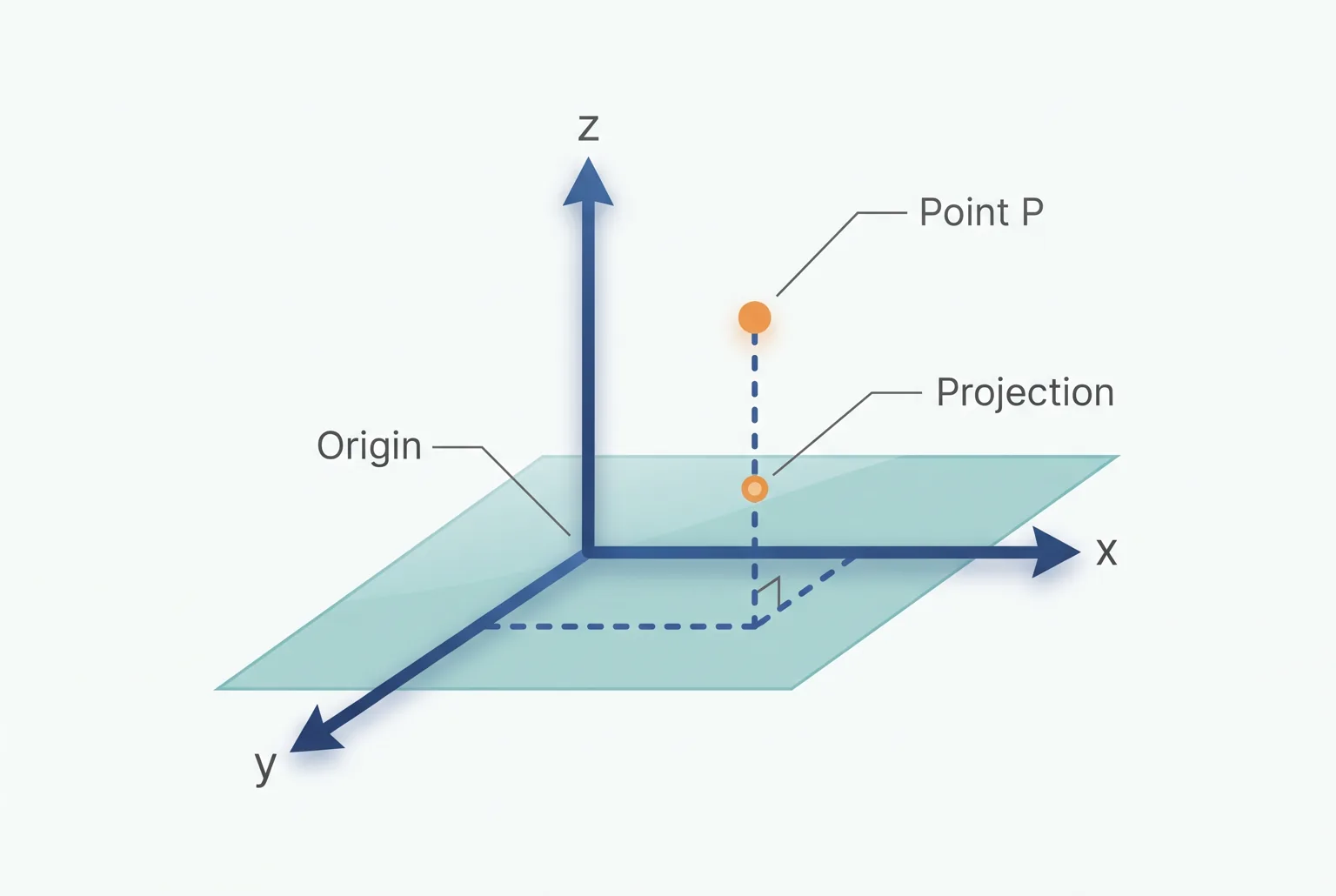
Start with the axes and the planes they form
In plane coordinate geometry, two numbers locate a point. To locate a point in space, the notes introduce a third coordinate and use the ordered triple . The three axes are mutually perpendicular and meet at the origin, . Each coordinate belongs to a particular axis: changing the order of the numbers generally changes the point.
Each pair of axes determines a coordinate plane. The - and -axes form the -plane, the - and -axes form the -plane, and the - and -axes form the -plane. It is these three planes, not the three axes alone, that divide space into eight octants. Compare the axes diagram with the next diagram in the notes to see the difference between the lines and the planes they define.
Introduction to Three Dimensional Geometry Class 11 Maths | NCERT Theory | Revision Notes
In the StudentCurio app
Comprehensive revision notes covering coordinate axes, planes, octants, and the distance formula in 3D space with solved examples for Class 11 students.
Good to remember: Signs locate regions, zeros mark boundaries
For a point off all three coordinate planes, its octant depends on the signs of its coordinates, not their magnitudes. The notes list the signs in order. In their table, the first octant has three positive coordinates, and the first four octants all have positive . The last four have negative . Read the signs as a triple before matching them to an octant number.
If a coordinate is zero, identify the relevant plane instead of assigning an octant. The -plane has , the -plane has , and the -plane has , so a point there has the form . If exactly two coordinates are zero, the remaining coordinate identifies the axis. When all three are zero, the point is the origin.
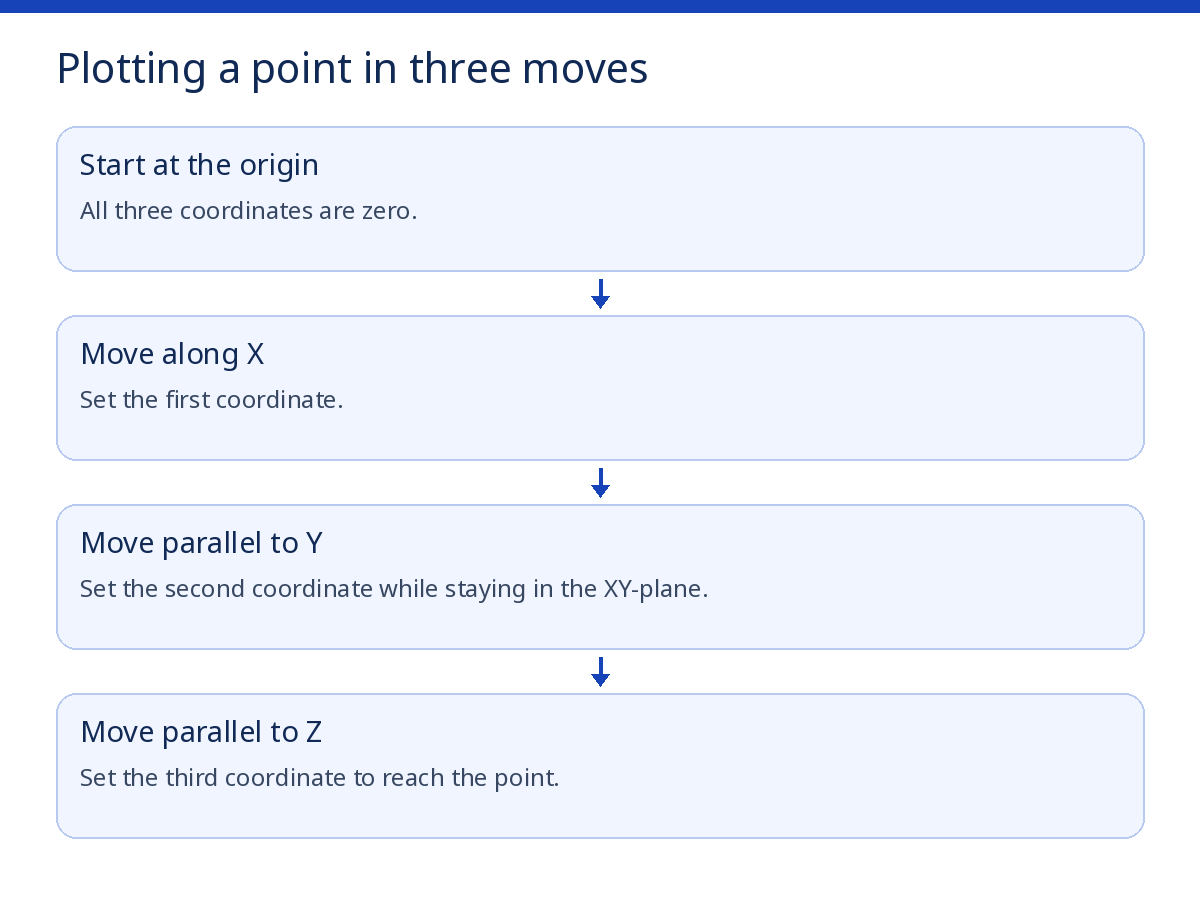
Locate a point and find its perpendicular projection
The plotting method in the notes builds the position in three moves. Start at the origin and move along the -axis. From there, move parallel to the -axis, then parallel to the -axis. The sign of each coordinate tells you which way to move, and its absolute value gives the length of that move. The first two moves leave you in the -plane; the third takes you out of it unless .
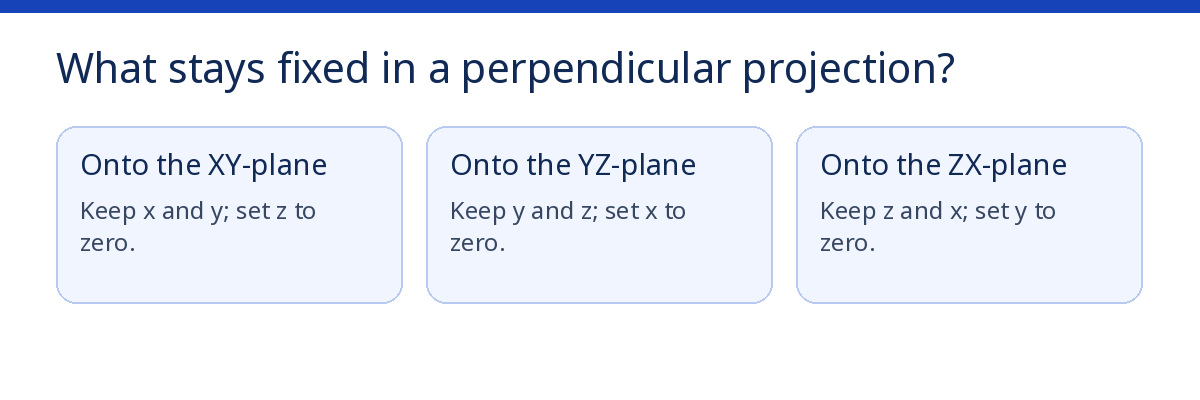
A perpendicular projection onto a coordinate plane keeps the two coordinates named by that plane and sets the other to zero. For example, projecting onto the -plane keeps and unchanged. The perpendicular distance to that plane is , not the signed coordinate . The projection examples in the notes distinguish two questions: where the perpendicular meets the plane, and how far that meeting point is from the original point.
When the three-dimensional distance formula applies
For two points in the same rectangular coordinate system, pair each coordinate with its counterpart. If the points are and , their straight-line distance is . The order of the points does not change the distance: swapping them reverses the signs of the differences, but not their squares.
If both points have the same coordinate in one direction, that difference is zero. If one point is the origin, the formula reduces to . The worked examples also use distance in reverse: a specified length can constrain an unknown coordinate, and an equality of distances can describe a set of points. Since distances are nonnegative, equality of distances is equivalent to equality of their squares. That lets you compare lengths without carrying square roots through the algebra.
Use lengths to test collinearity and classify figures
For three distinct points, calculate the three pairwise distances. The points are collinear if the two shorter distances add to the longest. The specific equation applies when is between and . Do not assume that the second point listed in a question is the middle one. This test uses lengths themselves, not their squares.
For three noncollinear points, the side lengths tell you whether the triangle is scalene, isosceles or equilateral. A right-angle test answers a separate question: the squares of the two shorter sides must add to the square of the longest side, the hypotenuse. A triangle can therefore be both right-angled and isosceles. For quadrilaterals, distinguish sides from diagonals before comparing lengths. In an established rhombus, equal diagonals indicate a square; unequal diagonals are not a requirement for every rhombus. When starting from four points in space, remember that a plane quadrilateral requires coplanar vertices.
Quick self-check: Choose the rule before calculating
Use the clickable index to move between the coordinate diagrams, the distance examples and the chapter summary. Before reading a worked solution, identify what the question asks for: an octant, the foot of a perpendicular, a length, or evidence for a geometric property. Then compare your choice of method with the notes, not just your final result.
Can you explain why a negative coordinate can still give a positive distance to a plane? When checking collinearity, can you say which segment must be longest before writing the addition equation? If you are classifying a triangle, can you distinguish an equality of side lengths from an equality involving their squares? These checks help you decide which information matters before you substitute any numbers.
Spotted an error? Report a correction. Practise this in the app: notes, formula sheets and mind maps.







Loading comments…