Class 11 Complex Numbers: CBSE Case-Based Assessment Guide
CBSEMathematicsComplex Numbers and Quadratic Equations
This CBSE Class 11 Mathematics assessment uses two case studies to practise comparing complex numbers, working with conjugates, and deciding when a complex expression is real or purely imaginary. Here’s what the file covers and how to use its linked solutions to check your reasoning.
What the two case studies cover
The file belongs to the chapter Complex Numbers and Quadratic Equations, but the practice in this assessment concentrates on complex-number algebra rather than on solving quadratic equations. It contains two case studies with eight subparts, linked step-by-step solutions, and no separate chapter-practice section. Use it to check specific skills from the chapter, not as a test of everything named in the chapter title.
The first case study focuses on equality and operations: comparing real and imaginary parts and writing a product in standard form. The second moves from carrying out operations to recognising properties of the result, including what conjugation does and how to tell whether a complex expression is real or purely imaginary.
Complex Numbers and Quadratic Equations Class 11 | Maths| CBSE Case Based Assessment
In the StudentCurio app
This assessment provides case-based practice questions and detailed step-by-step solutions for Class 11 students, focusing on complex number algebra, the Argand plane, and powers of i.
Why equality gives two equations
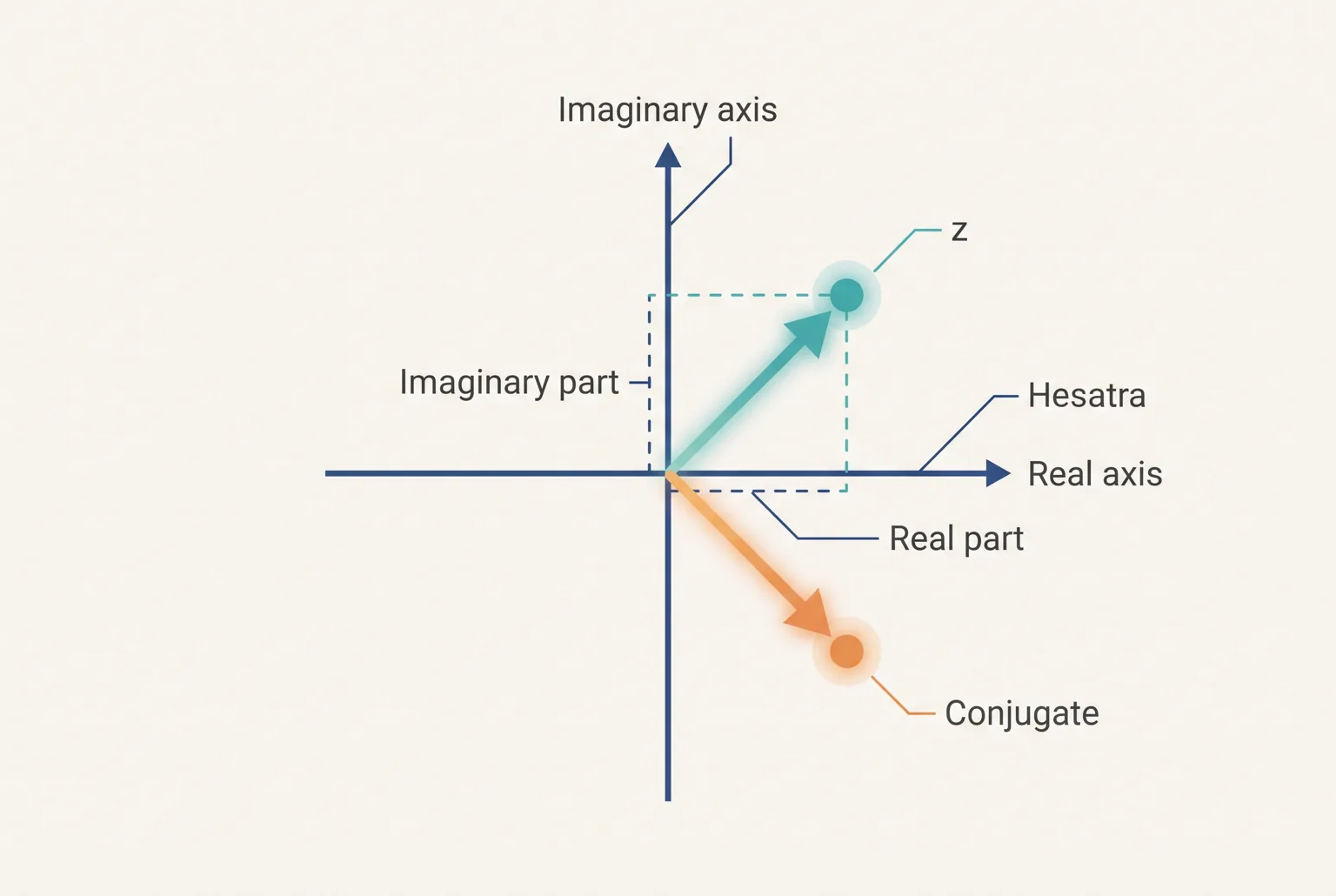
In the standard form , both and are real. The real part is and the imaginary part is , not . Two complex numbers are equal exactly when their real parts match and their imaginary parts match. That is why a single equality between complex expressions can give two equations in real unknowns.
Before comparing parts, simplify both sides enough to see which terms are real and which multiply . For example, a term involving contributes to the real part because . After forming the two equations, check what the question actually asks for: the unknowns themselves and a quantity formed from them are different endpoints. When reviewing the linked working, look for both the step that separates the parts and the step that connects the equations to the requested quantity.
A useful connection: multiplication and conjugation
Complex multiplication starts with the distributive law. In the product of two numbers in standard form, multiplying their imaginary terms contributes a real term because the two factors of give . The cross terms contribute to the imaginary part. Keeping these contributions separate helps you see where the signs come from rather than relying on a memorised expansion.
Conjugation keeps the real part and reverses the sign of the imaginary part: if , then . For a product, . In other words, you can multiply and then conjugate, or conjugate both factors before multiplying. The bar over the entire product matters: it tells you that the operation applies to the result of multiplication, not only to the factor nearest the bar.
Common mix-up: which part must vanish?
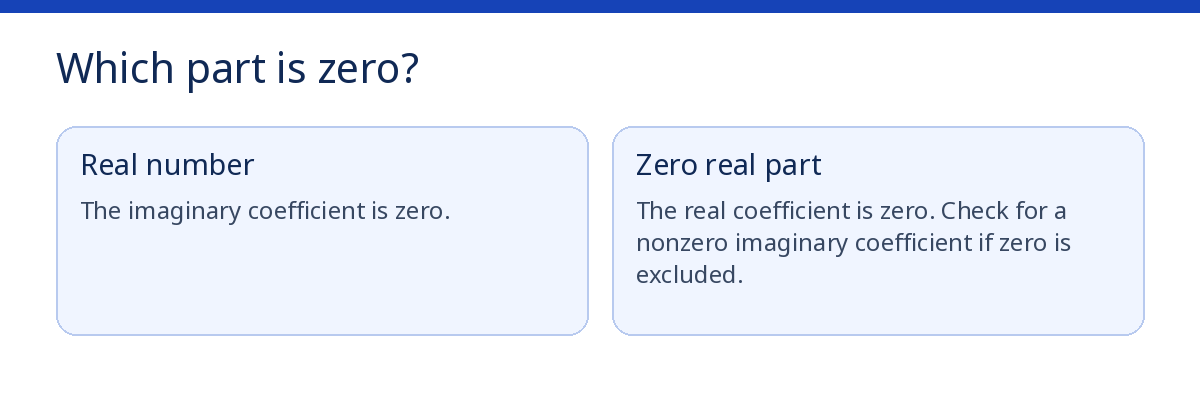
A complex number is real when its imaginary part is zero. It has zero real part when the real coefficient vanishes; if the convention for “purely imaginary” excludes zero, its imaginary coefficient must also be nonzero. In conjugate notation, the real condition is , while the zero-real-part condition is .
Apply the test to the whole expression after simplification, not to an individual numerator, denominator, or summand. A fraction can have both real and imaginary terms in its numerator and still simplify to a real number. If the expression is a sum, contributions to one part can also cancel. Once you have written the result in standard form, set only the required part to zero and retain any restrictions stated in the question.
When a denominator needs its conjugate
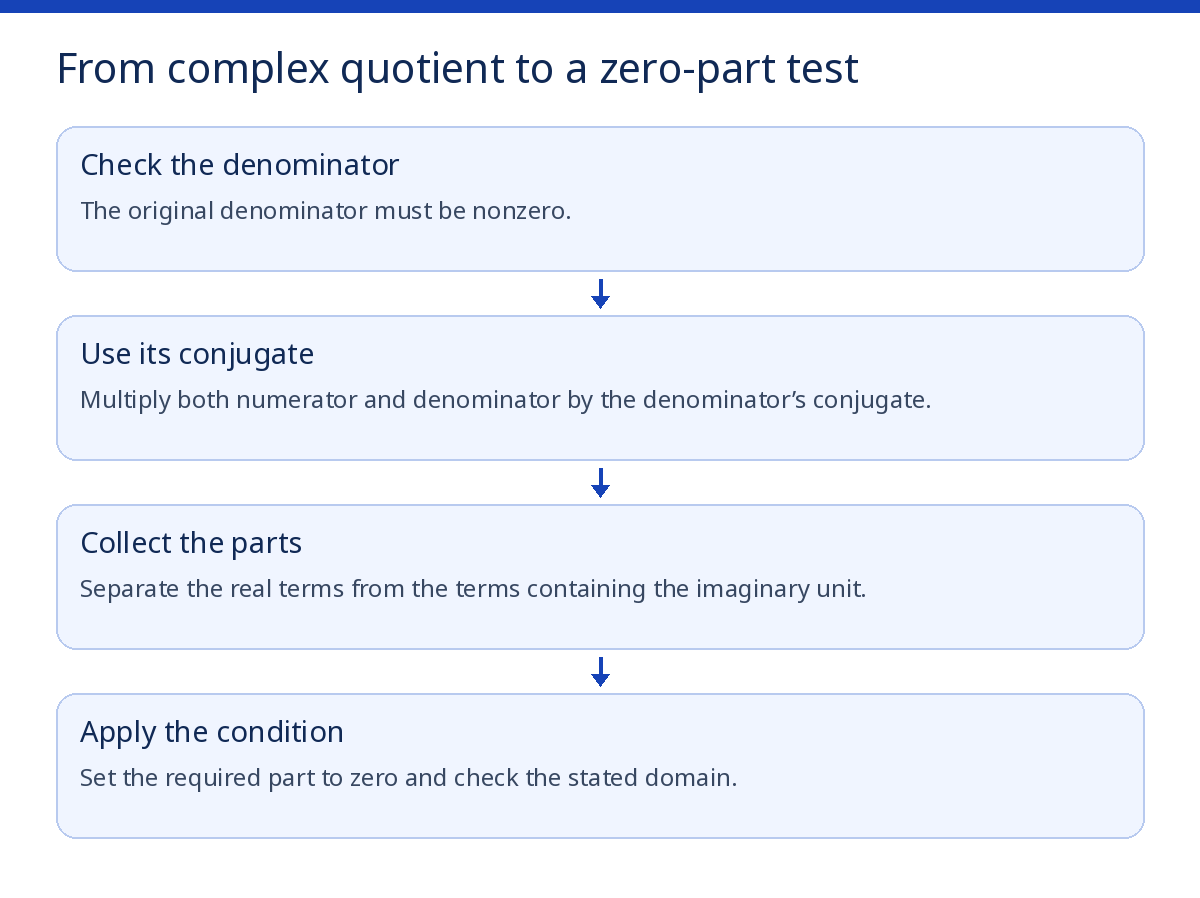
For a nonzero complex denominator , with and real, multiplying numerator and denominator by leaves the quotient unchanged. The denominator becomes , which is real and positive. Multiplying only the denominator would change the value of the expression. This step is useful because it lets you read the real and imaginary parts once the numerator is expanded and collected.
If one part must be zero, a nonzero real denominator means you can test the corresponding numerator for zero. That does not remove restrictions on the variables. In a question that gives an interval for an angle, use the interval to check which signs and values are admissible. An algebraic candidate outside the stated interval cannot satisfy the original question.
Quick self-check: why powers of i repeat
The rule gives , so every complete group of four factors contributes a factor of one. For a nonnegative integer exponent, write it as a multiple of four plus a remainder. The remainder tells you which of , , , or remains, in that order for remainders zero through three.
Before moving on, ask yourself two things: Why can you remove complete groups of four without changing the value? And why does an even exponent tell you the result is real without telling you its sign? The second question checks that you are distinguishing the two even remainders rather than using parity alone.
Use the linked solutions to locate an error
Open a case from the clickable index and attempt a clearly stated subpart before following its solution link. Compare the first line where your working differs, not just the final line. In an equality problem, check what you put on each side of the comparison; in a quotient, check how you made the denominator real before deciding which part should vanish. The return links let you go back and retry the same subpart without the working in view.
The file flags wording or notation issues in 1(A), 2(A), and 2(E). This guide omits the disputed details and keys. Leave those items out of any self-marking total unless the wording and keys are confirmed.
Spotted an error? Report a correction. Practise this in the app: notes, formula sheets and mind maps.






















Loading comments…