Straight Lines: CBSE Class 11 Assessment Guide
CBSEMathematicsStraight Lines
This CBSE Class 11 Mathematics assessment pairs four topic-wise sets with mixed chapter practice and worked solutions. Use it to practise choosing a method from the information given, whether a problem asks for a slope, a line equation, an intersection or a perpendicular distance.
How the assessment is organised
The four sets revisit coordinate geometry, develop slope, compare forms of line equations and apply perpendicular distance. The chapter practice then brings these skills together. The clickable index separates questions from worked solutions and lists the starting pages by topic and question type. The file includes objective, very short-answer, short-answer and long-answer questions, with case-based questions listed under chapter practice.
Start with the topic you want to check rather than reading the solutions in order. For an objective question, write down the condition that justifies your choice before checking it. For a longer problem, compare the first step in your attempt with the first step in the worked solution. If yours went wrong, identify whether you misread the geometry, chose a form that did not apply or made an algebraic error after a sound setup.
Straight Lines | Class 11 | CBSE Assessment
In the StudentCurio app
Class 11 assessments and worked solutions cover straight-line equations, slopes, intercepts, distances, parallel and perpendicular lines, intersections, collinearity, and triangle applications. Includes objective, short-answer, long-answer, and case-based practice to help students strengthen problem-solving skills.
Coordinate geometry: identify what you need to find
The first assessment reviews axes, point-to-point distance, internal division and midpoints. These tools answer different questions: the distance formula gives a length, while the section formula gives the coordinates of a point that divides a segment in a specified ratio. A midpoint is the special case in which the two parts are equal. In axis problems, write the coordinate restriction first: a point on the horizontal axis has zero ordinate, while a point on the vertical axis has zero abscissa.
The set also uses these ideas in collinearity and polygon problems. For a distance-based collinearity argument, the relevant equality says that the two shorter distances add to the longest one. That also identifies which point lies between the other two. Later sets ask for collinearity through slopes or a line equation, giving you a way to compare three methods for establishing the same geometric fact.
Slope checks: zero is not undefined
Slope measures vertical change per unit of horizontal change. When finding it from two distinct points, subtract the coordinates in the same order in the numerator and denominator. A horizontal line has zero slope because its vertical change is zero. A vertical line has undefined slope because its horizontal change is zero. In terms of inclination measured anticlockwise from the positive horizontal axis, applies only to nonvertical lines.
For distinct nonvertical lines, equal slopes mean the lines are parallel. Two lines with finite slopes are perpendicular when ; a horizontal and a vertical line are also perpendicular, but the product rule does not apply to them. When using the slope formula for the smaller angle between two intersecting nonvertical lines, a zero denominator indicates a right angle, not a fraction to simplify. The slope set uses these relationships in collinearity, angle and orthocentre problems.
Choose a line equation that fits the givens
Use point-slope form when you know a point and a finite slope. Use the two-point slope form when you know two points with different horizontal coordinates. If distinct points have the same horizontal coordinate, write the line directly as , where is that common coordinate. Similarly, a horizontal line has the form , with a constant vertical coordinate.
Slope-intercept form makes the slope and vertical intercept visible. Intercept form is useful when both axis intercepts are finite and nonzero; their signs tell you on which side of the origin the crossings occur. Normal form instead describes the line using the perpendicular from the origin: its length and the direction of the normal. The equation set gives you practice switching between how a line is described and how it is written. After forming an equation from given points, substitute those points back in to verify that they lie on the line.
Before subtracting constants, match the coefficients
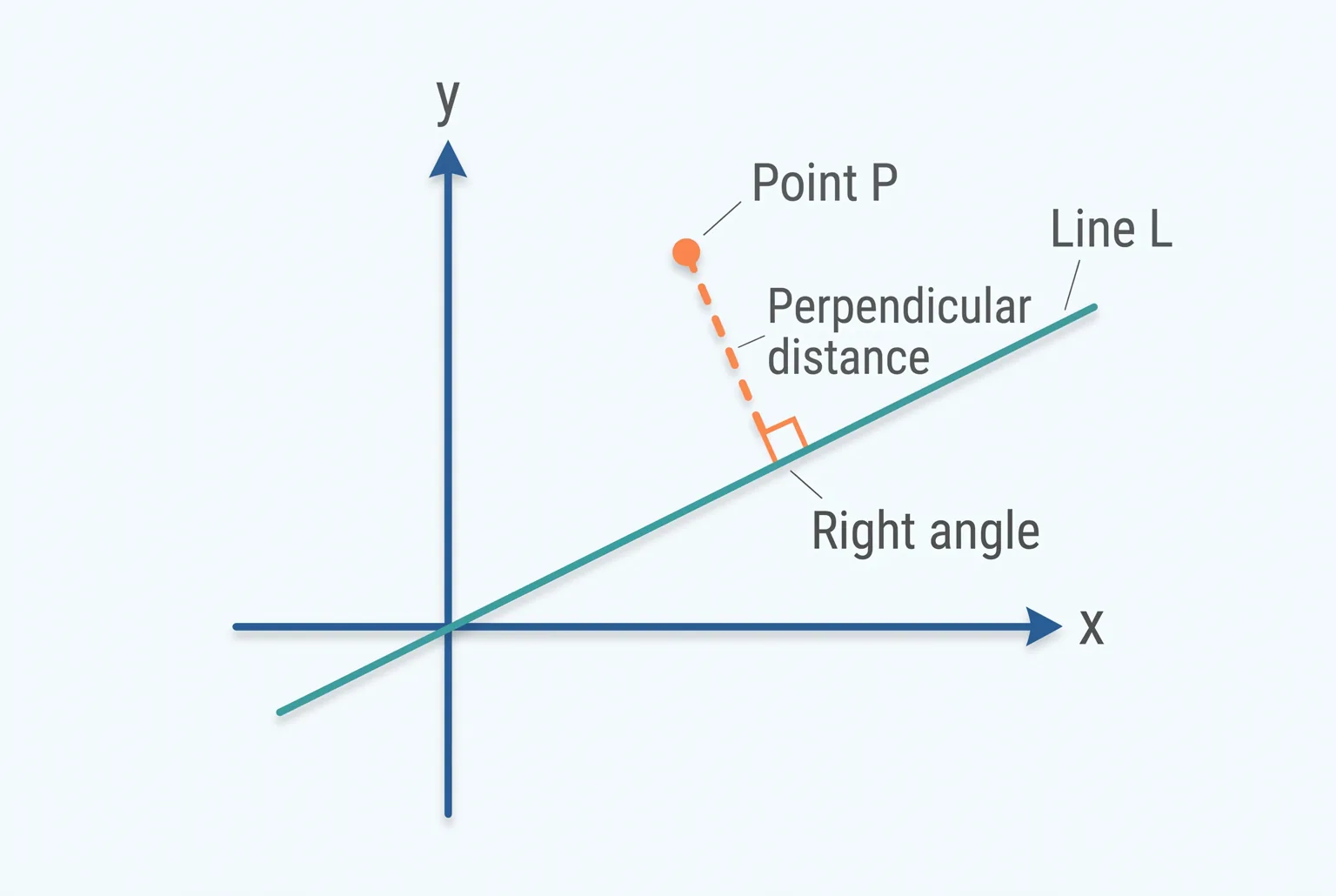
The distance set treats distance from a point to a line as the length of the perpendicular, not the length of an arbitrary segment joining the point to the line. For , with and not both zero, the distance from is . The absolute value makes the distance nonnegative regardless of which side of the line the point lies on.
For the distance between parallel lines, first scale the equations so that both have exactly the same coefficients of and . Only then take the absolute difference of the constants and divide by . Proportional coefficients establish the shared direction, but subtracting the constants before matching those coefficients can give the wrong separation. The set also connects perpendicular distance to geometry: it can give the separation of opposite sides of a square or supply the height for a triangle’s area.
Use chapter practice to test the setup
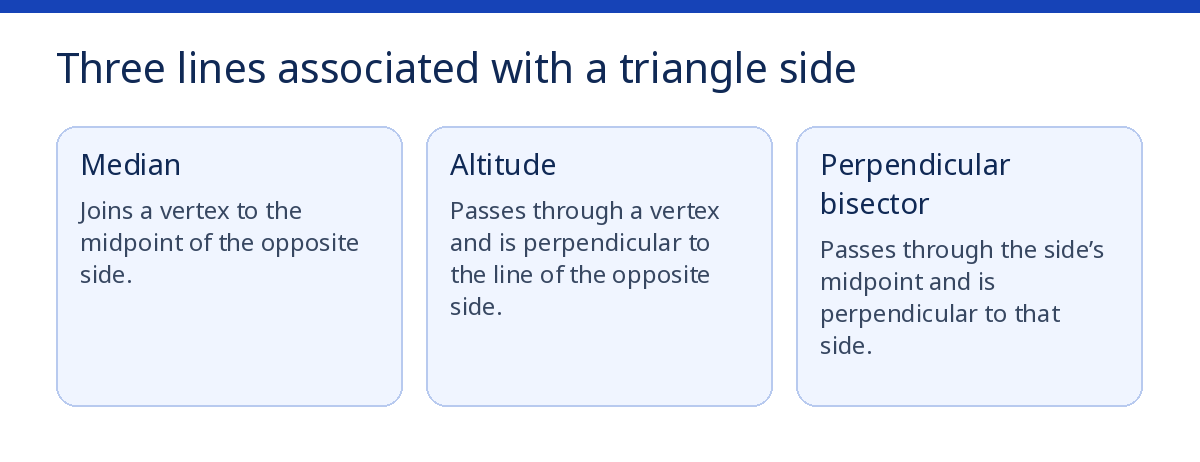
Mixed practice tests whether you can recognise the method without a topic heading to cue it. A useful distinction for the triangle questions is that a median joins a vertex to the midpoint of the opposite side, an altitude goes through the vertex perpendicular to that side’s line, and a perpendicular bisector goes through the midpoint at a right angle. Before writing an equation, name the point the required line must pass through and the condition that fixes its direction.
When a problem asks where two lines meet, the intersection must satisfy both equations. When it asks for a height, the target is a length rather than an intersection coordinate. Use those distinctions to check whether your final result answers the question, then use the worked solutions to see where an alternative setup is shorter or clearer.
Spotted an error? Report a correction. Practise this in the app: notes, formula sheets and mind maps.
Loading comments…