CBSE Class 11 Conic Sections: Case-Based Assessment
CBSEMathematicsCoordinate Geometry
This Class 11 Mathematics assessment uses a suspension bridge, a football graph and a chip-shaped curve to practise parabola and hyperbola problems. Its linked solutions show how to turn a diagram, a set of coordinates or an equation into a standard form you can use.
What the three cases assess
The file covers selected skills from the NCERT Conic Sections chapter for CBSE Class 11. It contains three case studies with 13 subparts: the suspension bridge and football graph have five multiple-choice questions each, while the hyperbola case has three short-answer questions. There is no separate chapter-practice section, so use the file to practise the skills these cases assess rather than as a complete review of conic sections.
The cases give you different starting points. The bridge gives physical distances that must be expressed as coordinates. The football case starts with a graph, then supplies a different equation for a translation task. The hyperbola case asks you to work both from geometric features to an equation and from an equation back to geometric features.
Conic Sections Class 11 | Maths| CBSE Case Based Assessment
In the StudentCurio app
Case-based assessment questions and detailed step-by-step solutions for Class 11 Conic Sections, covering real-world applications of parabolas and hyperbolas.
Common mistake: Reading a cable coordinate as a wire length
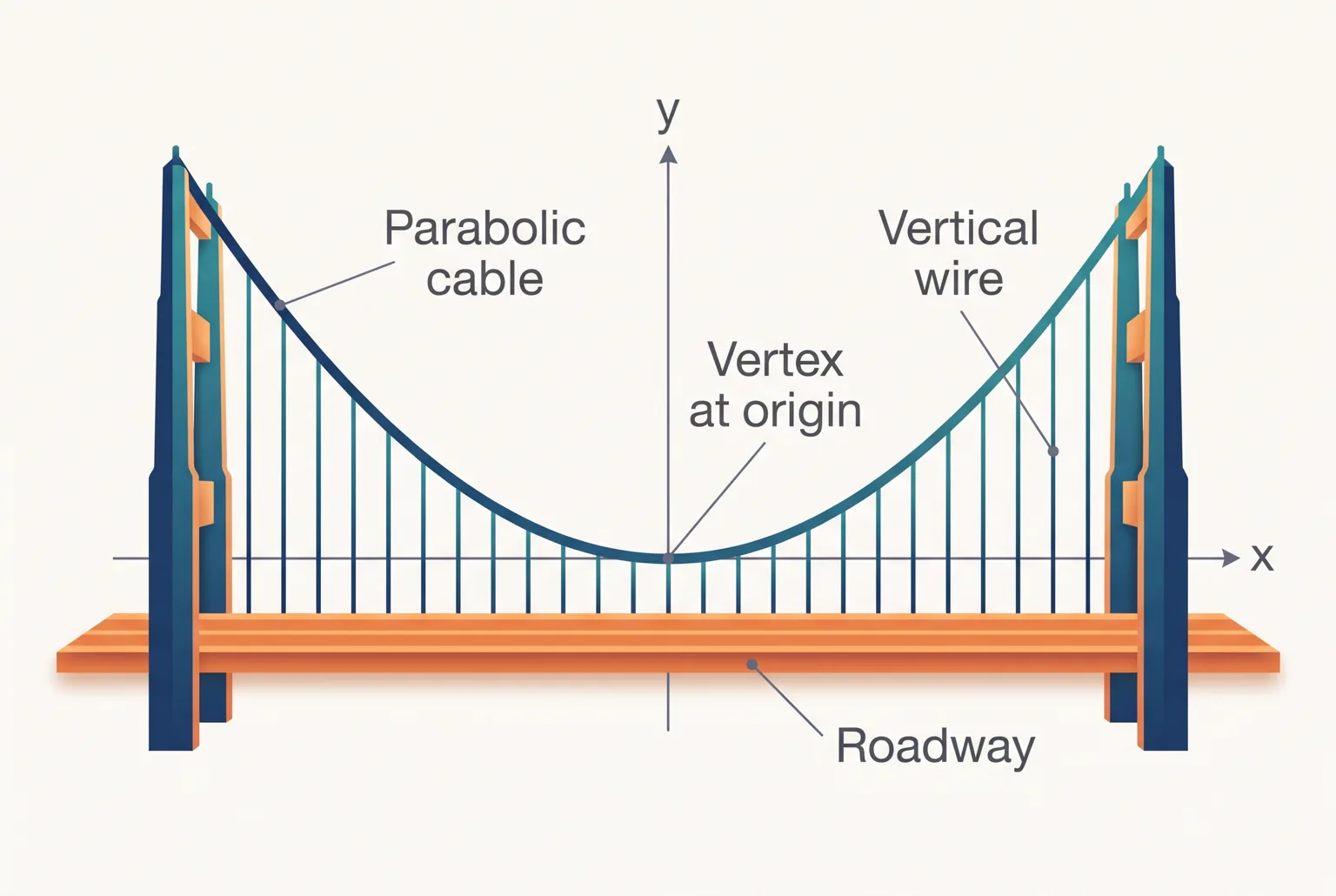
The bridge case models the cable as a parabola and the supports as vertical wires above a horizontal roadway. The solution places the origin at the lowest point of the cable, not on the road. That choice makes the vertex simple to locate, but it also means the roadway has a negative vertical coordinate. When you read an endpoint from the diagram, its height above the road is not its height above the origin.
A vertical wire joins two points with the same horizontal coordinate. Its length is therefore the cable’s vertical coordinate minus the roadway’s vertical coordinate at that position. Keep the two reference levels distinct when setting up the equation and when interpreting its output. The cable equation gives a position relative to the axes; the question about the wire asks for a distance in metres between the cable and the roadway.
What the football diagram tells you
For the football case, read the supplied graph as a coordinate-geometry schematic. The solution notes that its sideways opening is not the usual downward-opening projectile path on conventional horizontal and vertical axes. Use the pictured curve to choose an equation rather than inferring its orientation from the football story.
For an origin-centred standard parabola with its vertex at the origin, squaring gives a horizontal axis, while squaring gives a vertical axis. With , the sign in the standard form distinguishes the two opening directions along that axis. A point on the graph can then fix the parameter. Once you have the form, distinguish the directrix, which is a line, from the latus rectum, which is a chord through the focus perpendicular to the axis. Its endpoints are coordinate pairs; its length is a distance.
When a directrix formula needs translated coordinates
The final football subpart introduces a separate parabola whose equation is not initially in vertex form. Completing the square groups the squared variable with its shift and makes the vertex visible. Writing the resulting equation in translated coordinates places that vertex at the new origin without rotating the axes or changing the curve’s opening direction.
The standard directrix rule then gives a line in the translated coordinates. If the question asks for the line in the original coordinates, substitute the definition of the translated variable back into that line. A useful check is to locate the directrix relative to the vertex: it should be on the opposite side from the focus. This checks the sign geometrically rather than relying on the completed-square algebra alone.
From hyperbola geometry to an equation and back
In the chip case, the symmetric foci locate the centre and identify the horizontal transverse axis. The solution explains that the prompt prints one vertex despite using the plural; reflection in the centre gives the paired vertex. For a hyperbola centred at the origin with a horizontal transverse axis, the standard form is , with . Here is the centre-to-vertex distance, while the centre-to-focus distance is . The relationship is , so the focus is farther from the centre than the vertex and the eccentricity exceeds one.
The last subpart reverses the process. Start by normalising the given equation so the right-hand side is one, then read and from the denominators in standard form. Keep the requested lengths distinct: the conjugate axis has length , whereas a latus rectum has length . They describe different segments even though both calculations use the same standard-form parameters.
Quick self-check before opening a linked solution
Use the clickable index to open a case and study its labelled diagram where one is provided. In the multiple-choice cases, write down the relevant equation or distance relationship before comparing the options. For a short answer, record which quantities come from the given geometry and which must be derived. This gives you something more useful to compare with the worked steps than a final choice or number alone.
Before following an individual solution link, ask: Have I measured from the origin or from the roadway? Have I expressed this line in the coordinates the question uses? Have I normalised the hyperbola before naming its parameters? If your result differs from the worked solution, find the first step where the two approaches diverge. The return link lets you go straight back to that subpart and retry it.
Spotted an error? Report a correction. Practise this in the app: notes, formula sheets and mind maps.
Loading comments…